
The public site
Tessera's app is for your own people, behind your sign-in. tessera publish writes a separate public site: plain pages for the groups and people who opt in, which any web server can serve. The app itself never needs to face the internet.
uv run tessera publishThe site is written to public/ in the data home, or wherever [publish] out says. It has:
- a home page with every published group, by kind;
- a page for every group that opted in, following its published blocks (see Groups): what it does, its leaders and people, its publications, grants, studies, themes and projects, openings, news, topics, and contact;
- a page for every person who opted in: their groups and roles, ORCID iD, research areas and topics, publications, grants, and studies. Its address (
people/<name>/) is kept from the first time it is published, so links to it keep working, even when someone of the same name opts in later (their page gets the next free address); - indexes of groups and people, a
404.html,robots.txt, and, whenbase_urlis set, asitemap.xml; - for every public group, pages to embed in another website and a JSON feed.
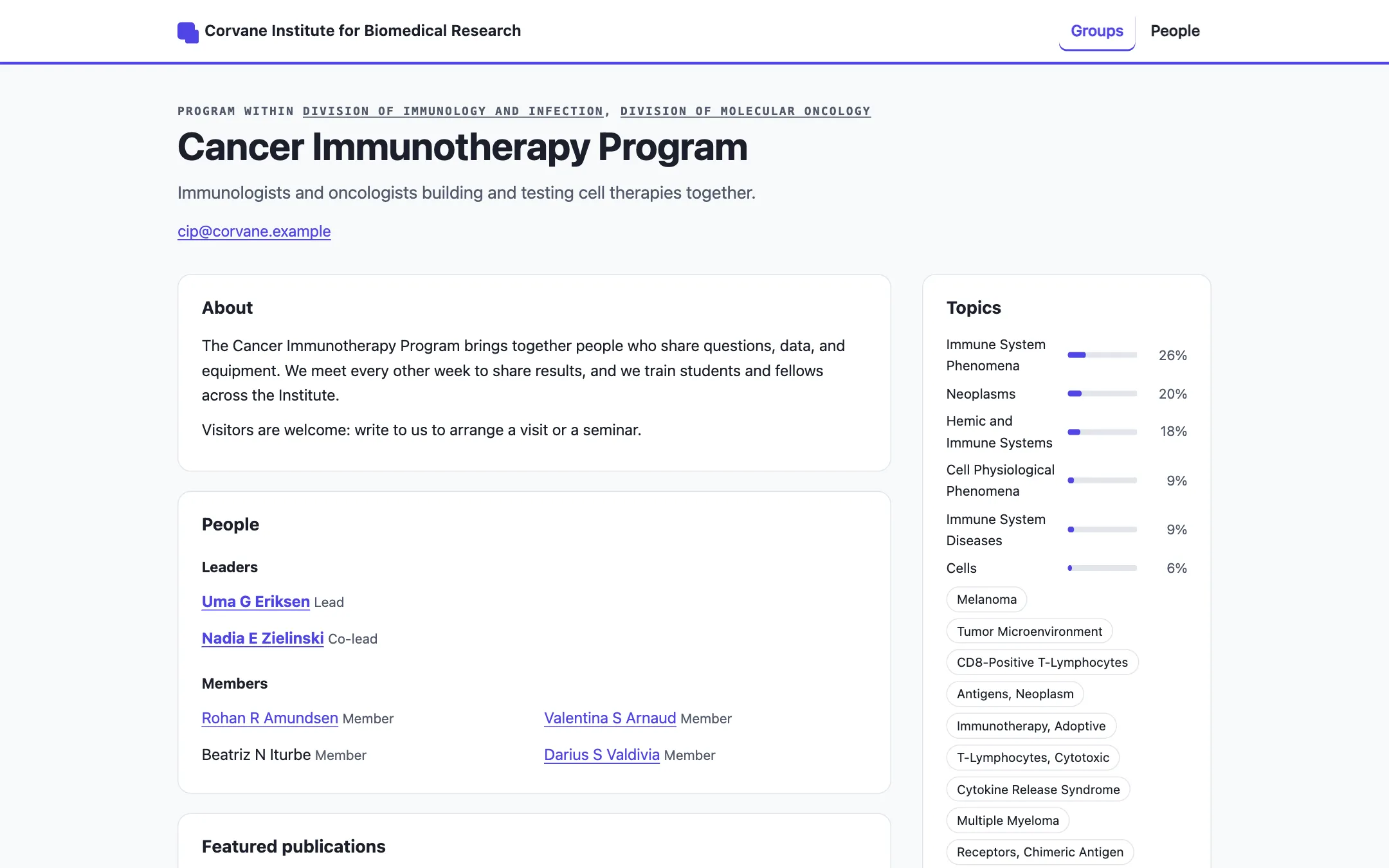
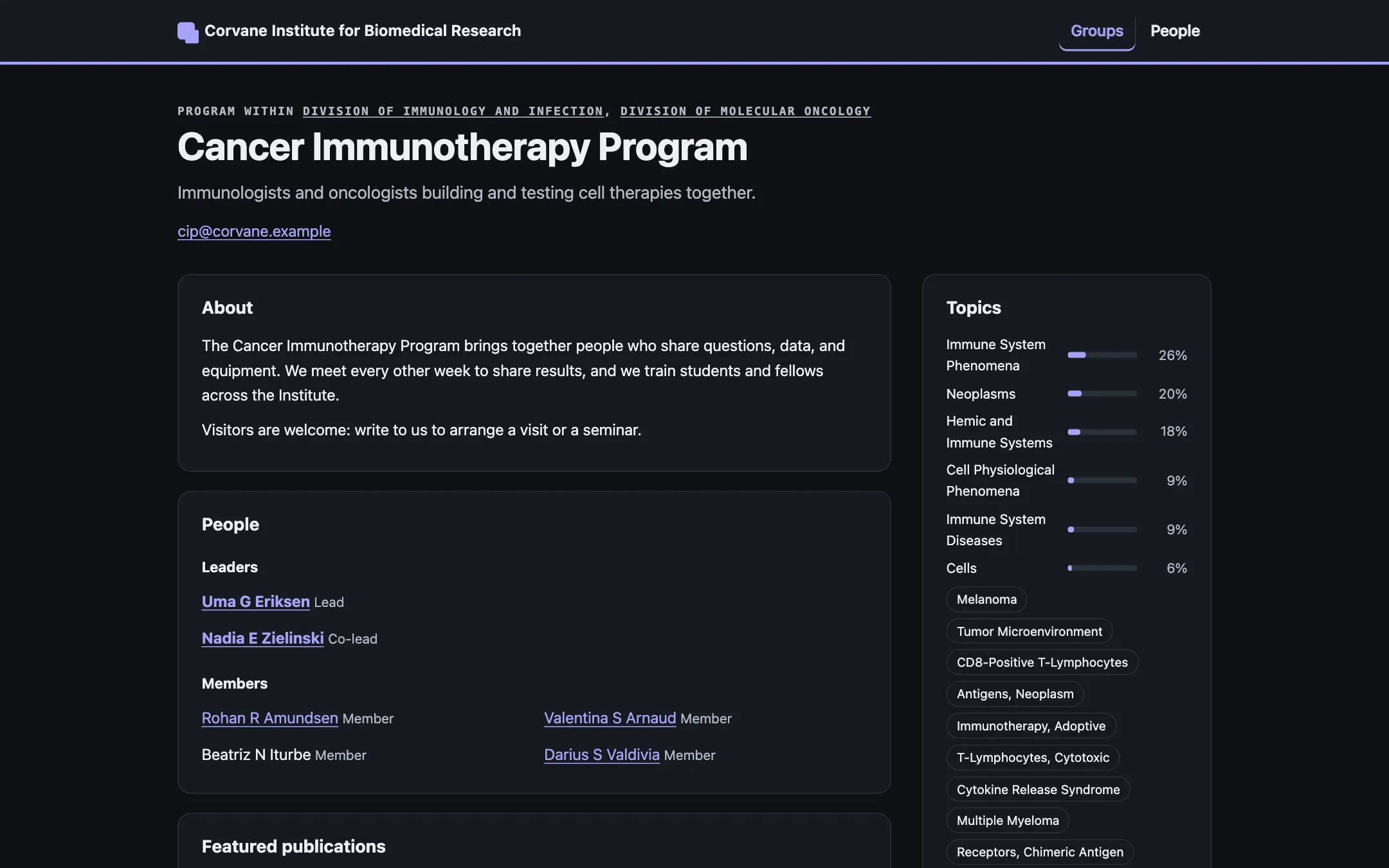
Who appears#
Nobody appears unless they opt in.
- A group opts in with Public page in its page editor (its managers or curators), or
tessera groups public <address>. - A person opts in with Public profile on their profile, or Make it public in the Public page card on its About tab (they themselves, if their account is linked to it, someone they named to act for them, a curator, or an admin), or
tessera people public <ID>. The same card chooses which sections their page shows, and the eye on an entry leaves that entry off it; Preview the public page shows the page as the next publish will build it. See Profiles.
--off on either command takes pages away at the next publication. A group's page lists its people by name and role; only people who opted in link to a profile.
What the site shows, and what it never shows#
The site is built from an allowlist: every field on it is chosen by name, so nothing new reaches it by accident.
| Shown | Never shown |
|---|---|
| Names, roles, titles, and dates of membership | Email addresses of people (a group's own contact address is shown) |
| On a person's page, the profile sections they chose (overview, interests, positions, education, honors, service, teaching, talks, links, featured publications), less any entry they left off | Sections and entries a person left off, and anything on a profile that is not public |
| Confirmed publications, as citations: authors, title, journal, year, with links to the DOI and PubMed | Abstracts, suggestions, scores, evidence, and decisions |
| Grants by title, number, institute, and years; studies by title, NCT number, phase, and status | Anything from the internal app: IDs, accounts, history, the review queue |
| Topics and research areas, with credit to MeSH; topics, and a group's connections to other groups, come from confirmed papers | Unconfirmed papers: only papers someone confirmed are published |
| A group's themes, projects, open openings, news, and contact | Openings that have closed |
| Approved plain-language summaries, labeled as drafted with AI assistance and approved by whom, while the assistant is on | Summary drafts, rejected summaries, and every summary while the assistant is off |
tessera publish notes public profiles that have no confirmed papers yet: confirm their papers in the app, and they appear at the next publication.
Checked before it is published#
The site is built in a fresh folder and checked before it replaces the published one. Every page must declare its language, have one title and one main heading with headings in order, have its landmarks (header, labelled navigation, main content, footer), give every link and image a text alternative, carry no scripts (other than structured data), no inline styles, and no event handlers, and link only to pages that exist. The site's colors must meet WCAG 2.2 level AA in both light and dark mode. If anything fails, the command lists the problems, exits with status 1, and leaves the published site as it was. tessera publish --check builds and checks without writing anything.
Pages work without JavaScript, follow the reader's light or dark preference, carry page descriptions, Open Graph tags, and schema.org structured data for people and organizations, and print cleanly.
Settings#
[publish]
out = "/srv/www/research"                     # where to write the site (default: <data home>/public)
base_url = "https://research.example.edu"     # where it is served: for the sitemap and canonical links
title = "Research at Example University"      # the site's title (default: the organization's name)
intro = "Who we are and what we work on."     # a sentence or two for the home page
The site takes its colors from your branding; see Configuration.
Embedding group content in another website#
A group's publications, people, openings, and news can appear on its own website, kept current by Tessera. For every public group, tessera publish also writes small pages made to be framed, and a feed:
| File | What it is |
|---|---|
groups/<address>/embed/publications.html | The group's publications (featured first), as on its page |
groups/<address>/embed/people.html | Its leaders and members |
groups/<address>/embed/openings.html | Its open openings, which drop off when they close |
groups/<address>/embed/news.html | Its news |
groups/<address>/feed.json | A JSON Feed of its news, openings, and confirmed publications, for sites that show content themselves |
An embed shows only what the group's own public page shows: a part the group leaves off its page (its people, say) is empty in its embed, and left out of its feed.
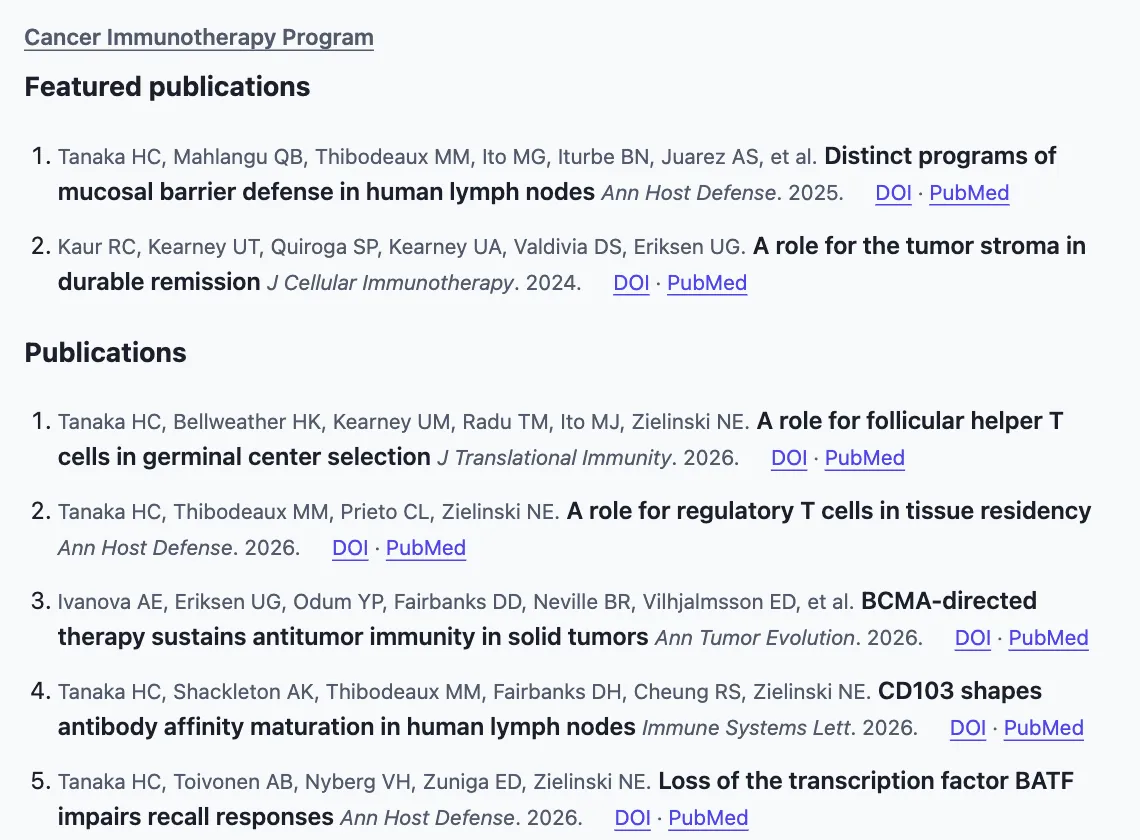
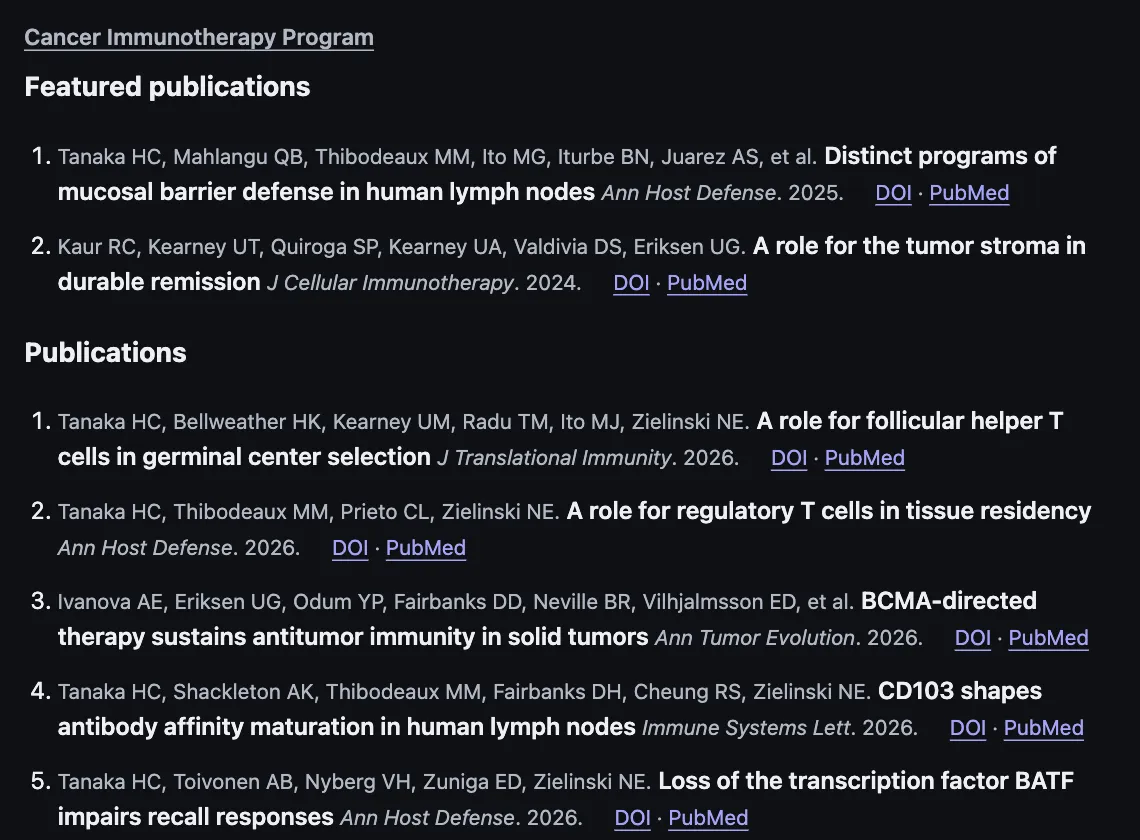
Each embed comes in three versions: publications.html follows the reader's light or dark preference, and publications-light.html and publications-dark.html stay light or dark to match the page around them. Embeds have no site header, carry no scripts, open links in the page around them, show only what the group's public page shows, and link back to it. They always exist for a public group, even with nothing to show yet, so the code on another site keeps working; a group that is not public has none, and search engines are asked not to index them on their own.
The group's managers find the code in Edit page → Embed on another website, once [publish] base_url says where the site is served:
<iframe src="https://research.example.edu/groups/okafor-lab/embed/publications-light.html"
        title="Publications of the Okafor Lab" width="100%" height="600" style="border:0"
        loading="lazy"></iframe>
The site serving the embeds must allow other sites to frame them: if your web server sends X-Frame-Options or a frame-ancestors policy for the public site, allow the sites that embed it.
Keeping it current#
Openings close on their dates and decisions change what is shown, so publish every day after the sync:
30 3 * * * cd /srv/tessera && /usr/local/bin/uv run tessera --quiet publishServe the output folder with any web server (nginx, Apache, Caddy, or a static host). Pages link to each other with relative addresses ending in index.html, so the site also works from a sub-folder and from disk. Point the server's not-found page at 404.html.