Open AI governance for research organizations
AI governance people actually use.
GovWren is an open system of record for AI governance: one front door for every AI request, review in proportion to the risk, a connected inventory of what your organization actually runs, and evidence behind every decision. It is built first for organizations where many labs and units adopt AI faster than any committee can track.
A front door, not a gate
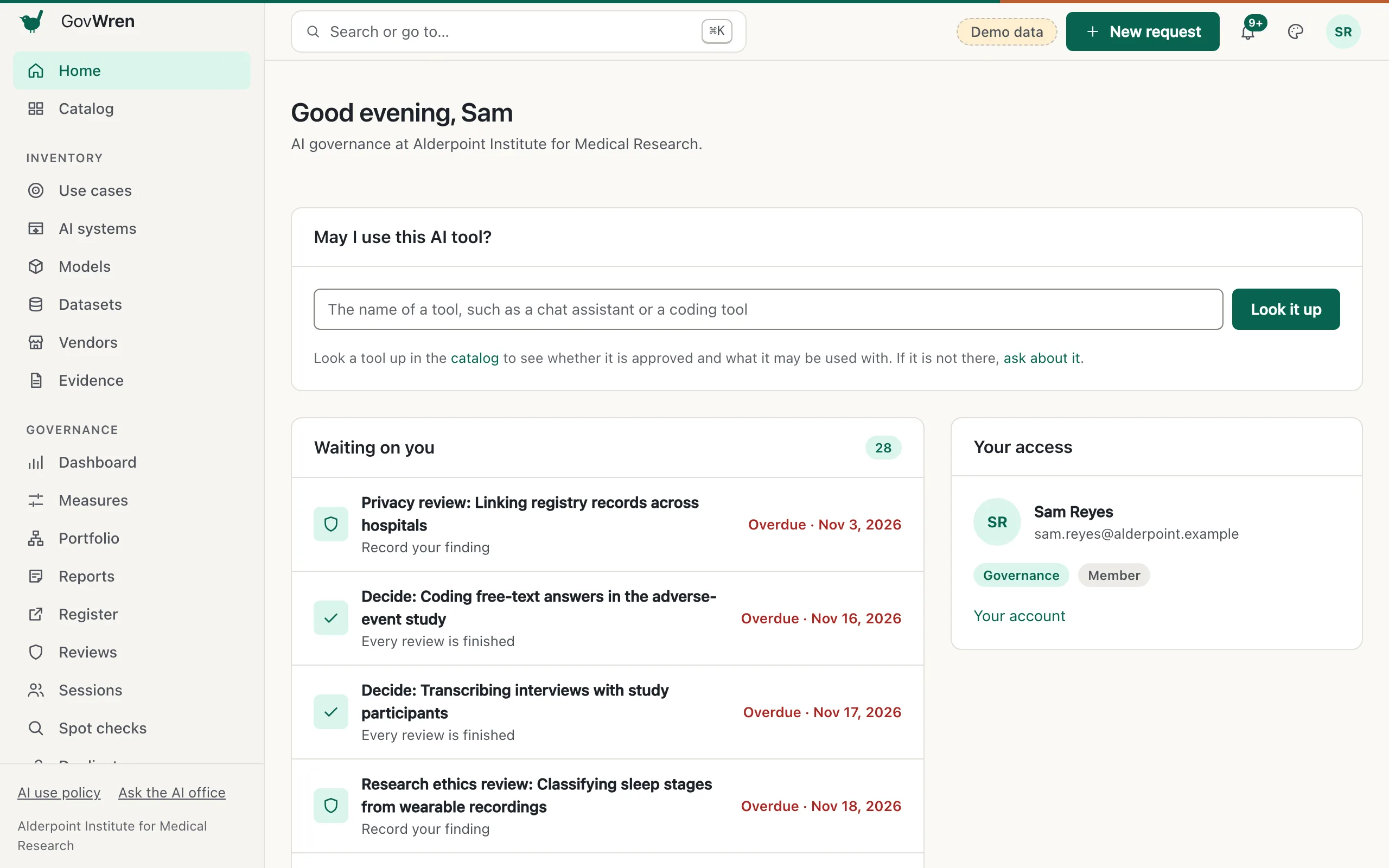
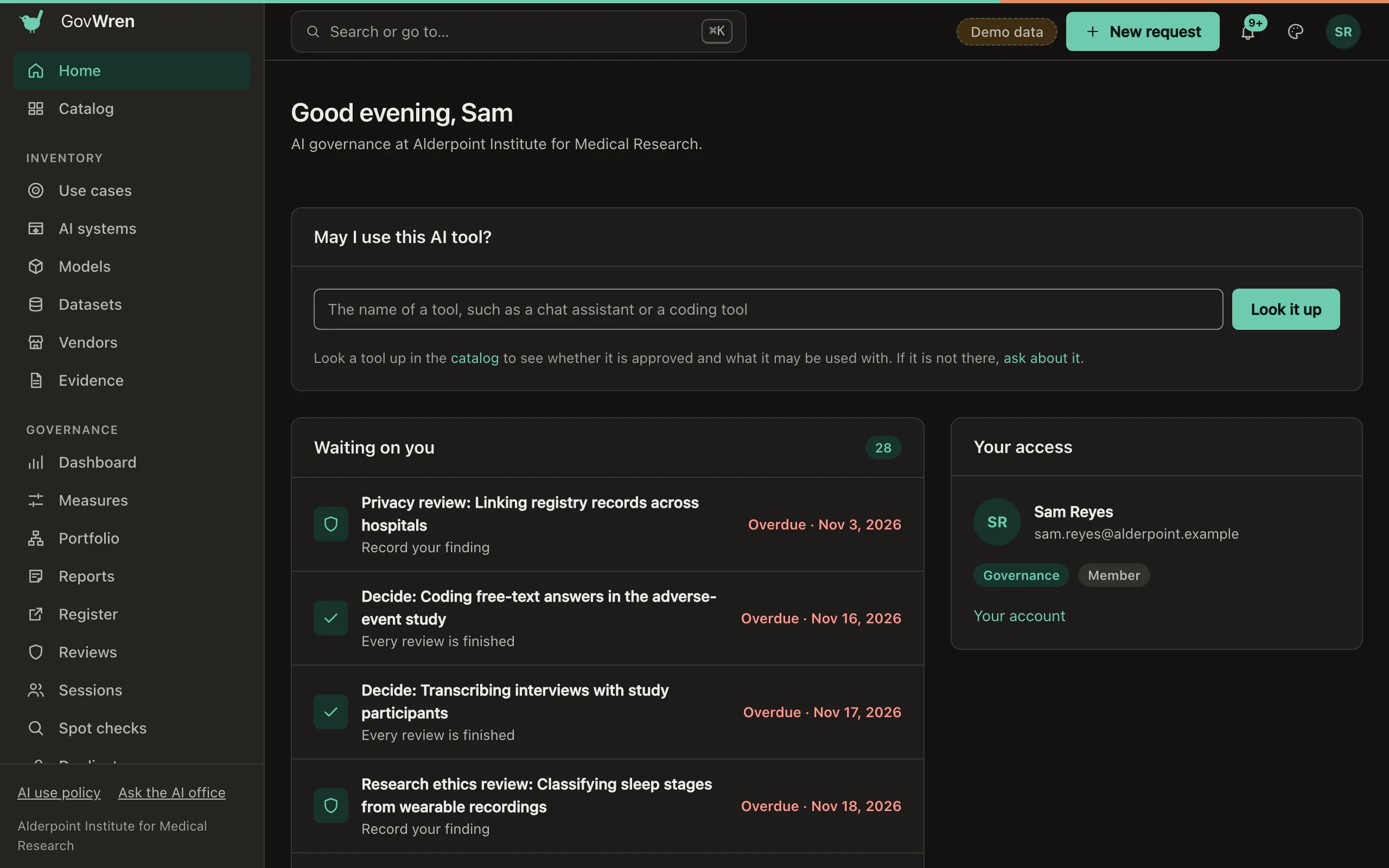
A catalog answers "may I use this?" in seconds, and registering an everyday use takes a minute. The easy path is the governed one.
In proportion
A tier that explains itself decides who reviews, who decides, and how often anyone looks again. Most requests never need a meeting.
Passive by design
No scanners, agents, or log collectors. GovWren knows what people tell it, and makes telling it worth their while.
Open and yours
Apache 2.0, runs on a laptop or one server, and takes your name, your logo, your forms, and your rules.
The catalog
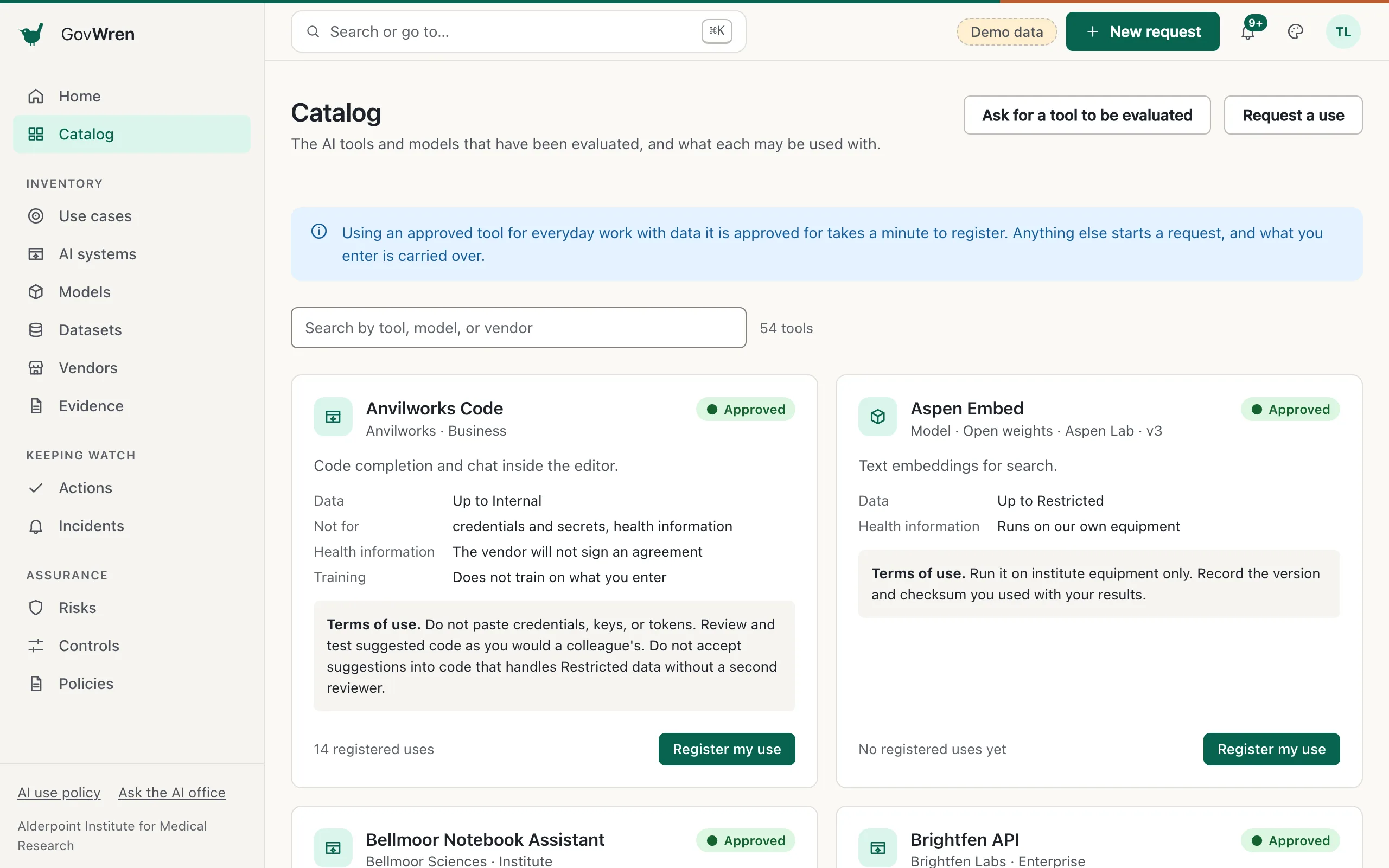
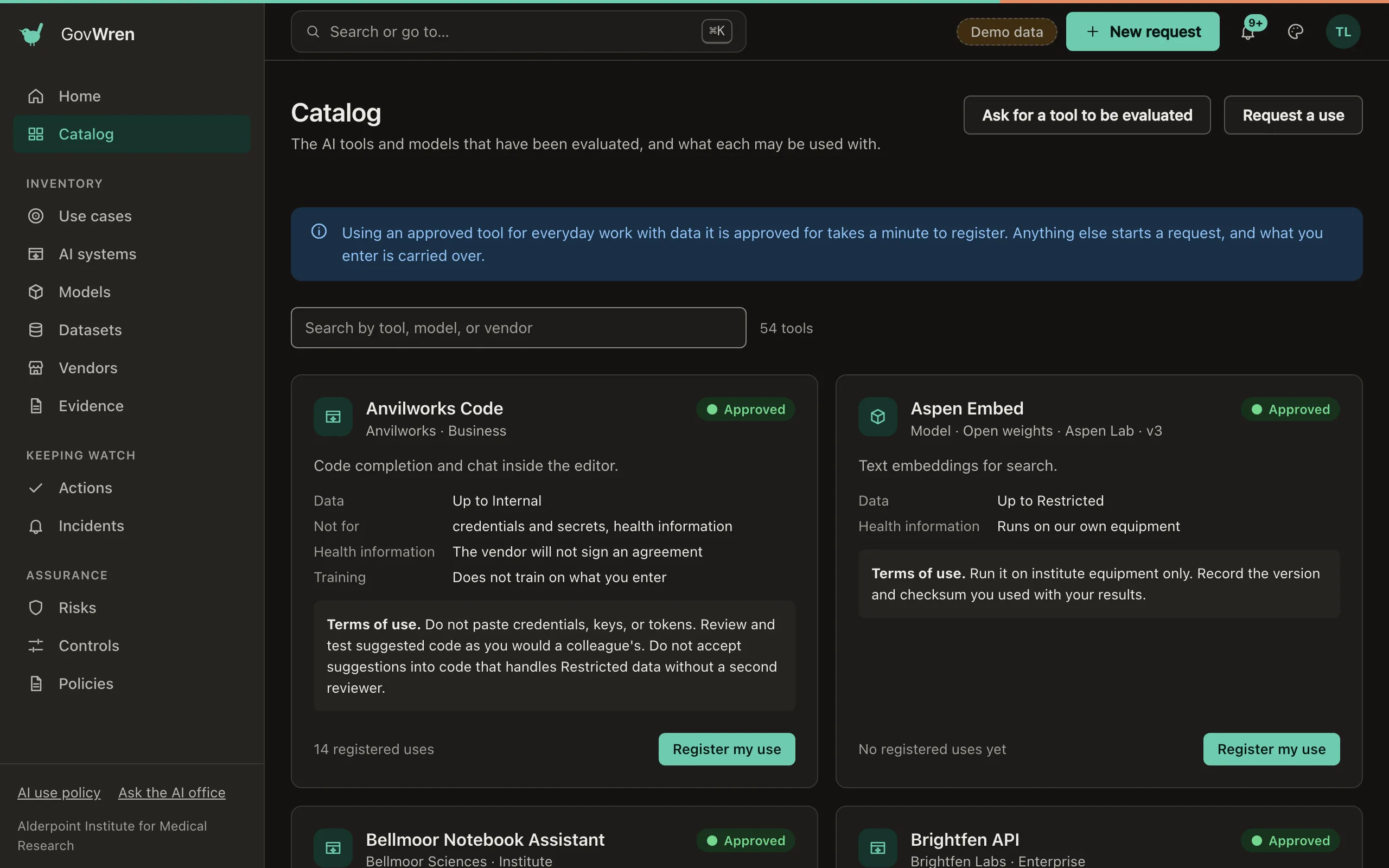
"May I use this?" answered in seconds
Every tool and model your organization has evaluated is in one searchable catalog, with its standing, the data it may be used with, and its terms of use. Using an approved tool for everyday work is registered in a minute and approved on the spot.
Requests
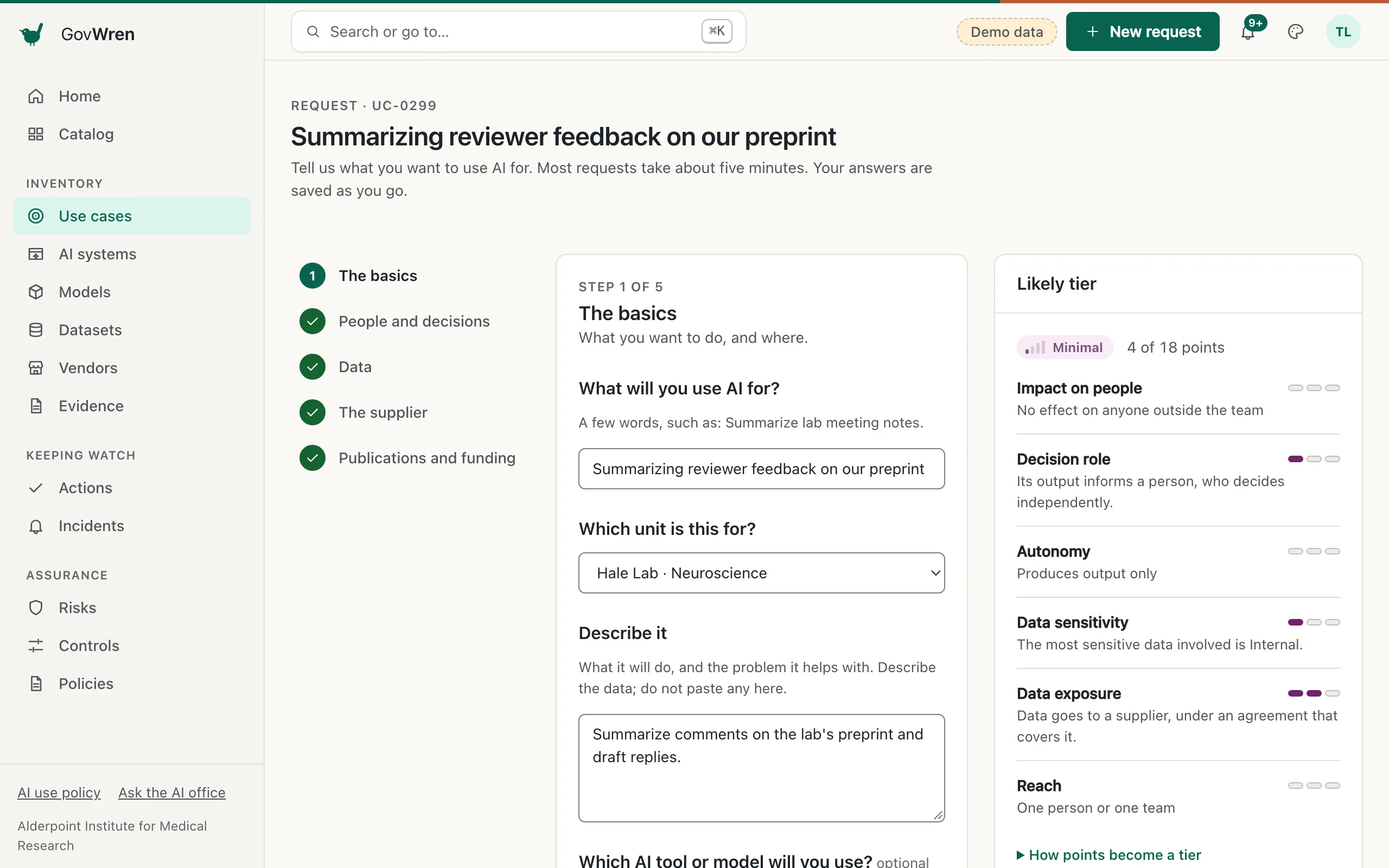
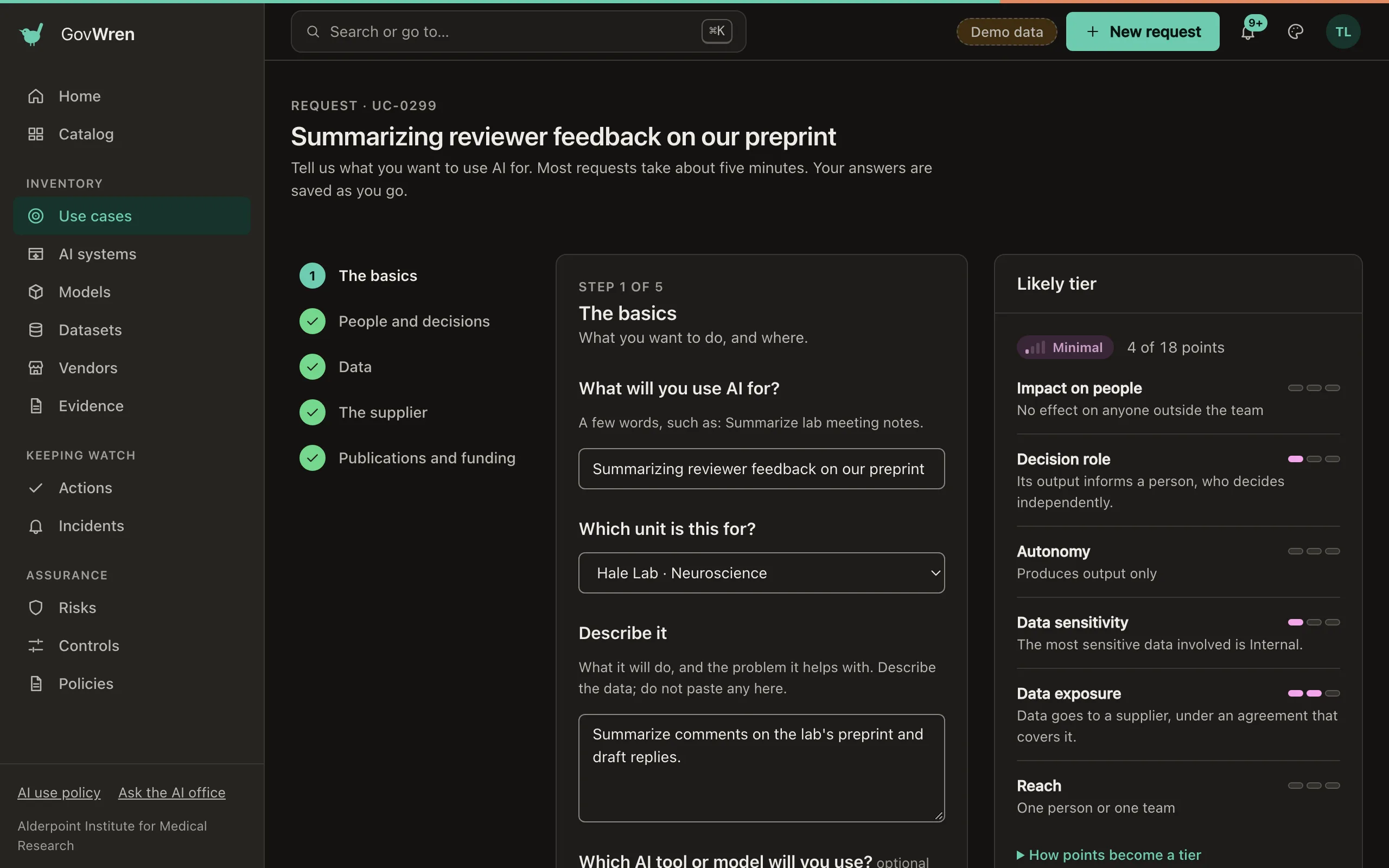
A form that asks only what it needs
Anything new starts with a short form. Questions appear only when earlier answers call for them, and the likely risk tier is shown beside the form as it changes, with the reason for every part of it.
Review
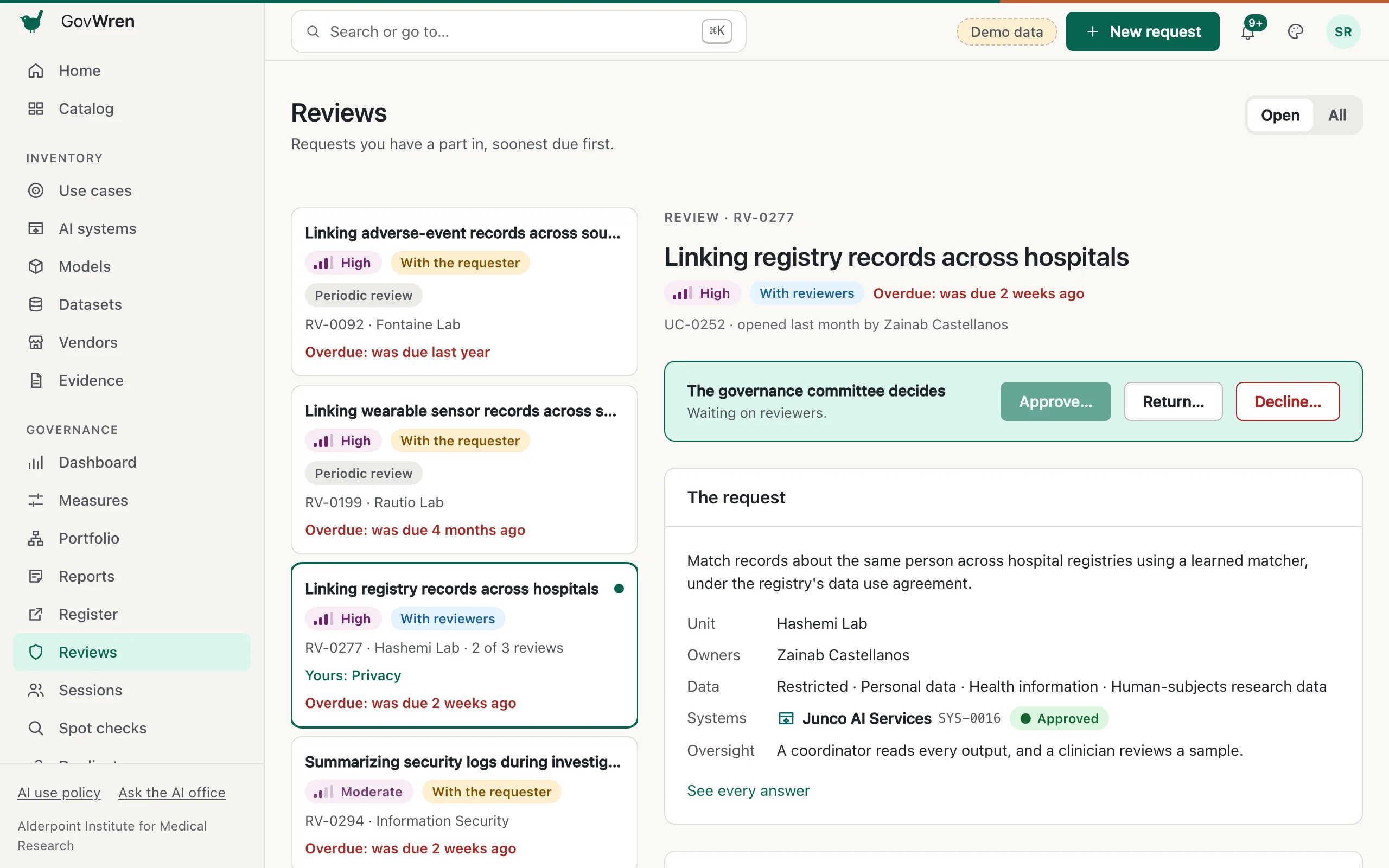
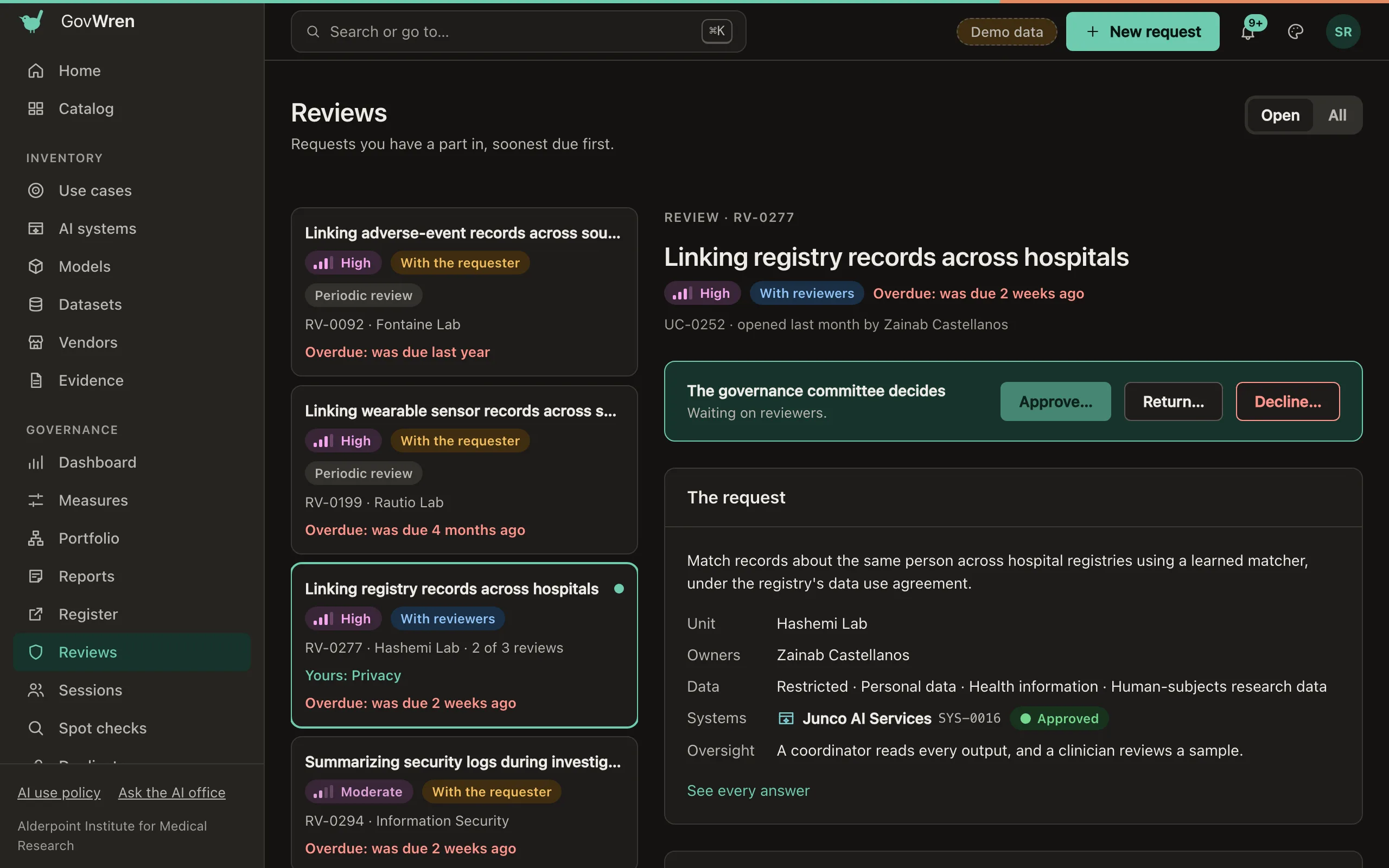
One packet, one decision
Rules route each request to the reviewers it needs, who work in parallel. Whoever decides sees one packet: the request, why it has its tier, every finding, and the discussion. Nobody reviews or decides their own request.
Decisions
Every decision, with its reasons
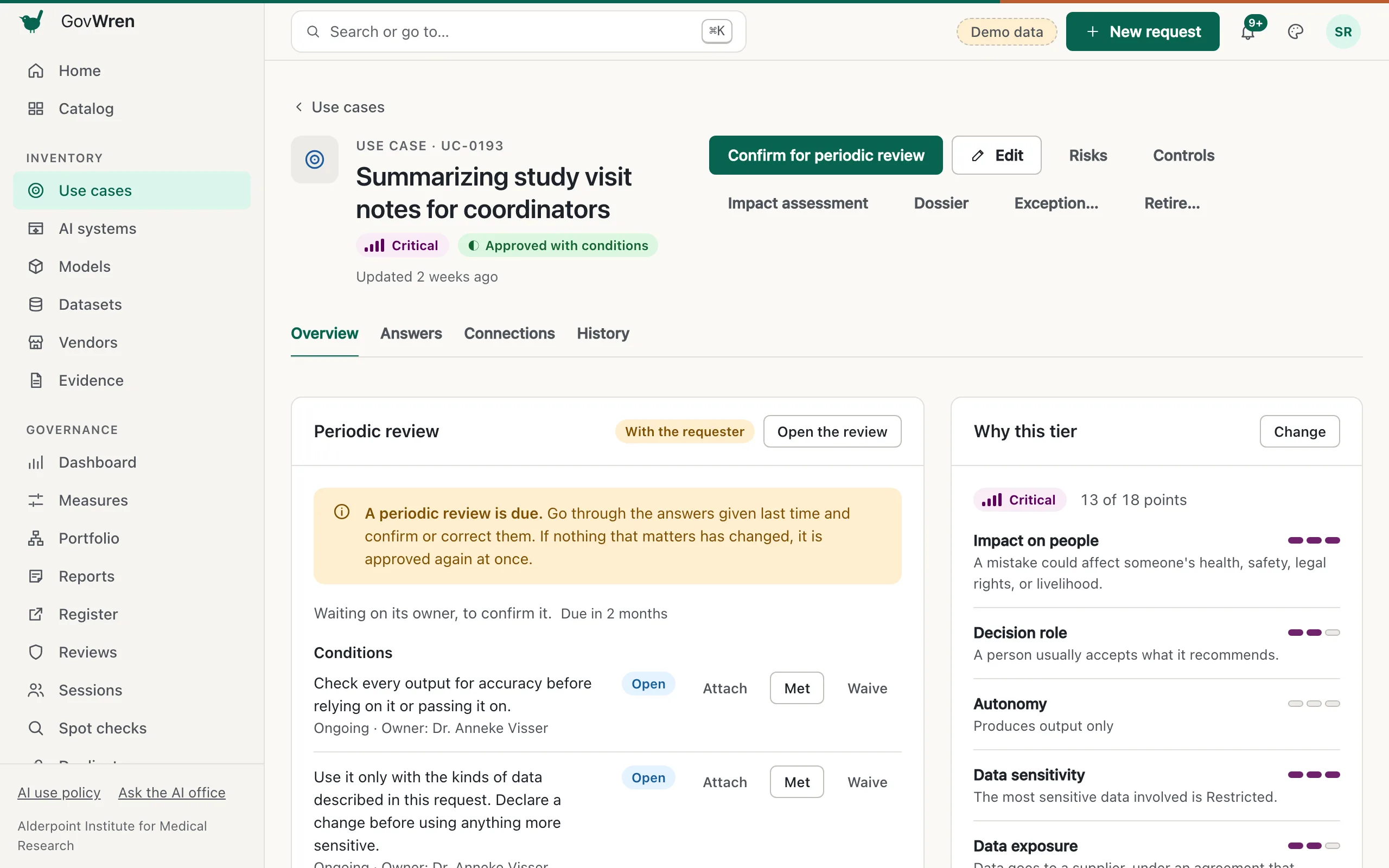
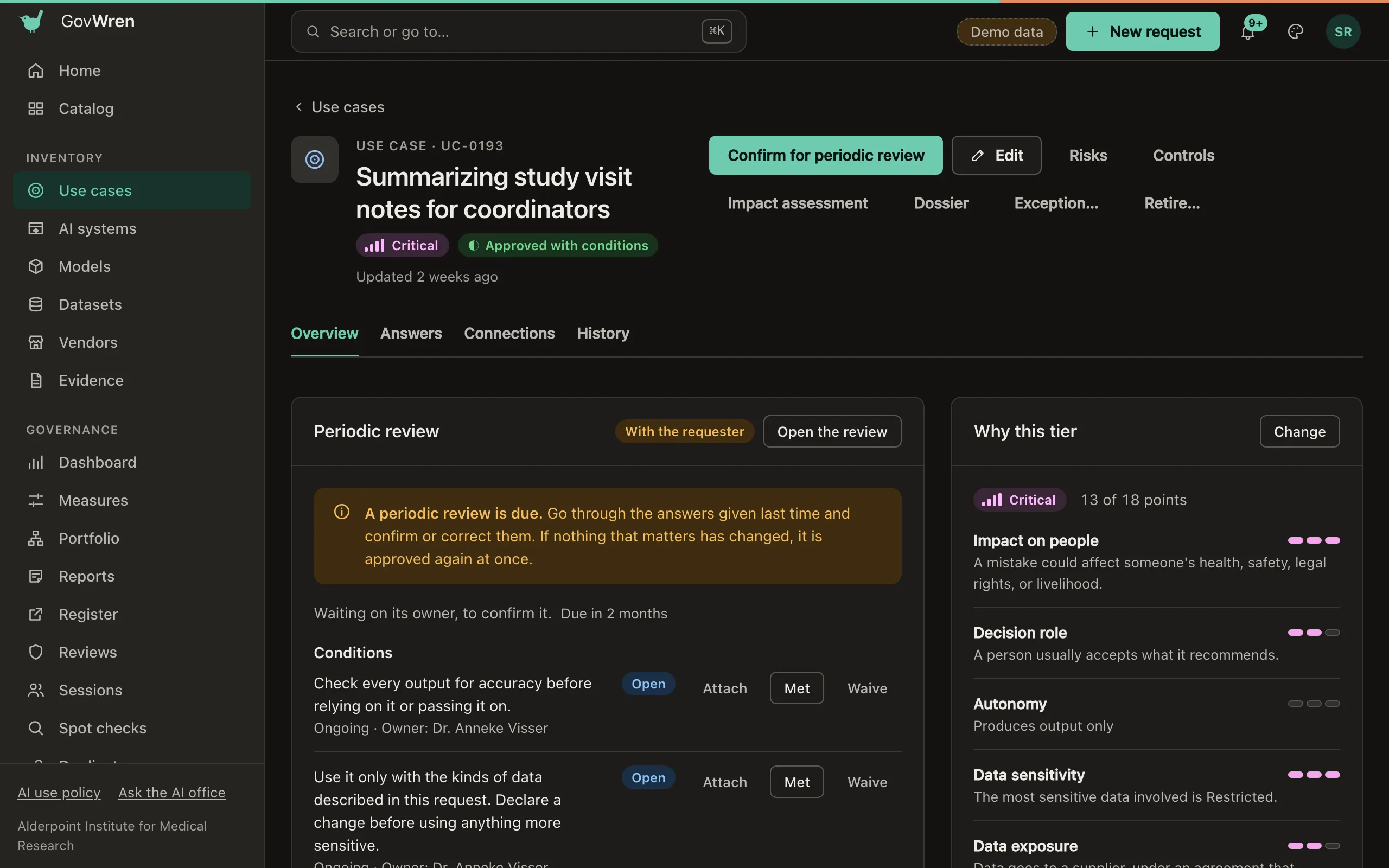
A decision carries its rationale, the conditions it was made on, and who owns each one. Conditions that must be met before use hold the approval until they are, and evidence can be attached to show they were.
The inventory
Models you run yourselves, on the record
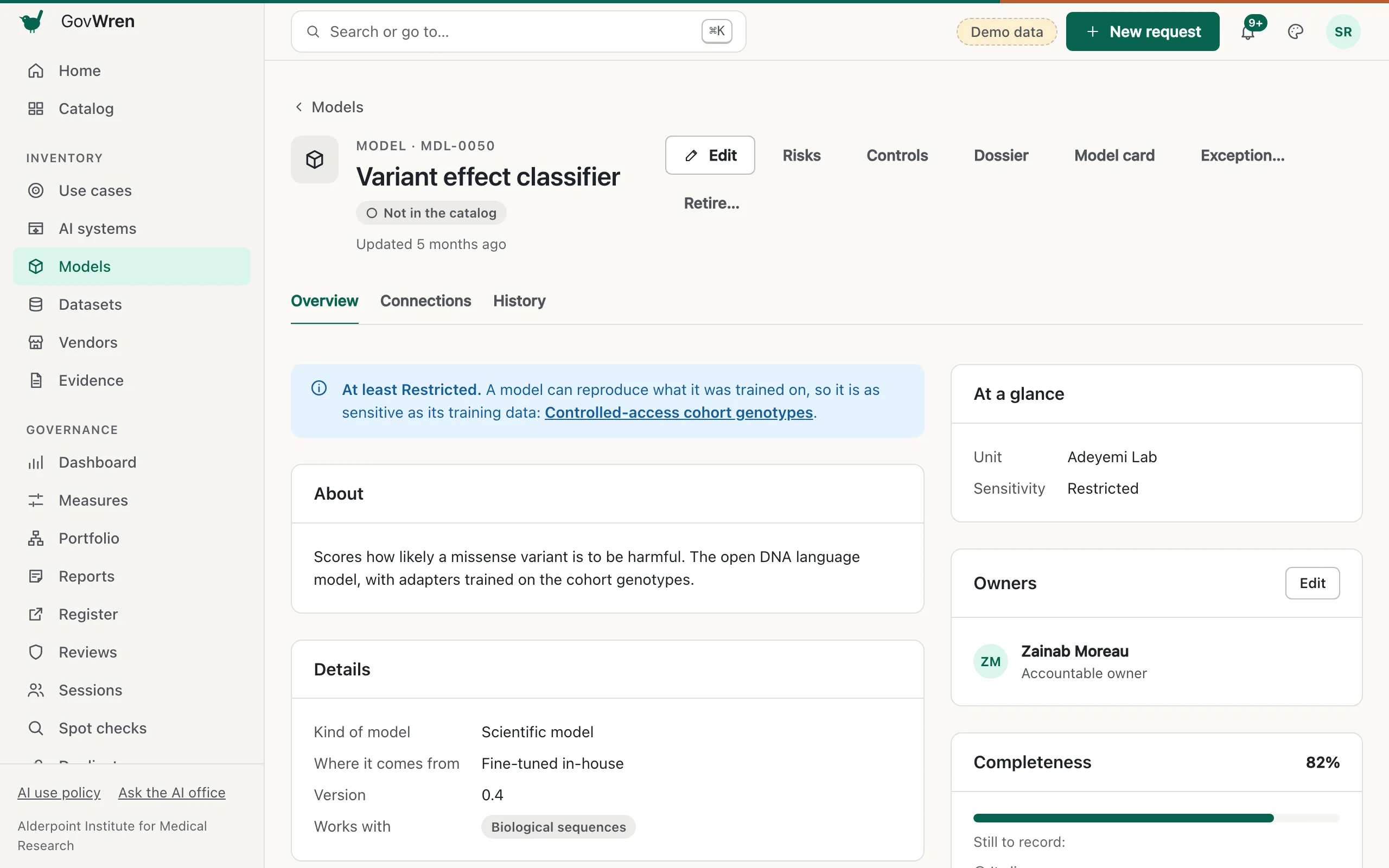
Open weights on a lab workstation and models fine-tuned in-house are governed like anything else: where the weights came from, their checksum and license, where they run, and a model card. A model is never less sensitive than the data it was trained on.
Connections
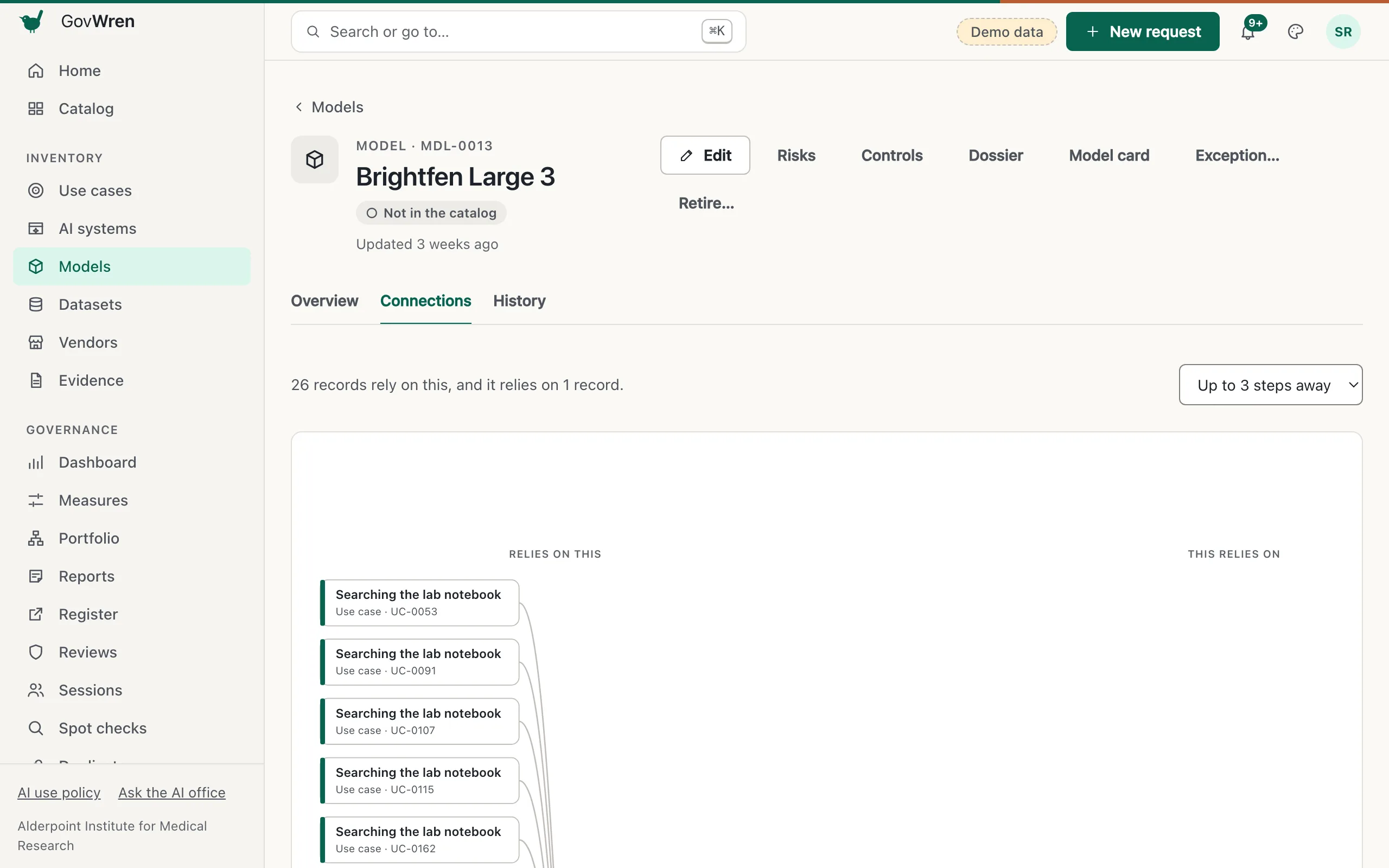
See what depends on what
Use cases, systems, models, datasets, and vendors are linked. When a supplier withdraws a model, one tab shows every system built on it and every use case that relies on those systems.
Your program
Change the rules without a developer
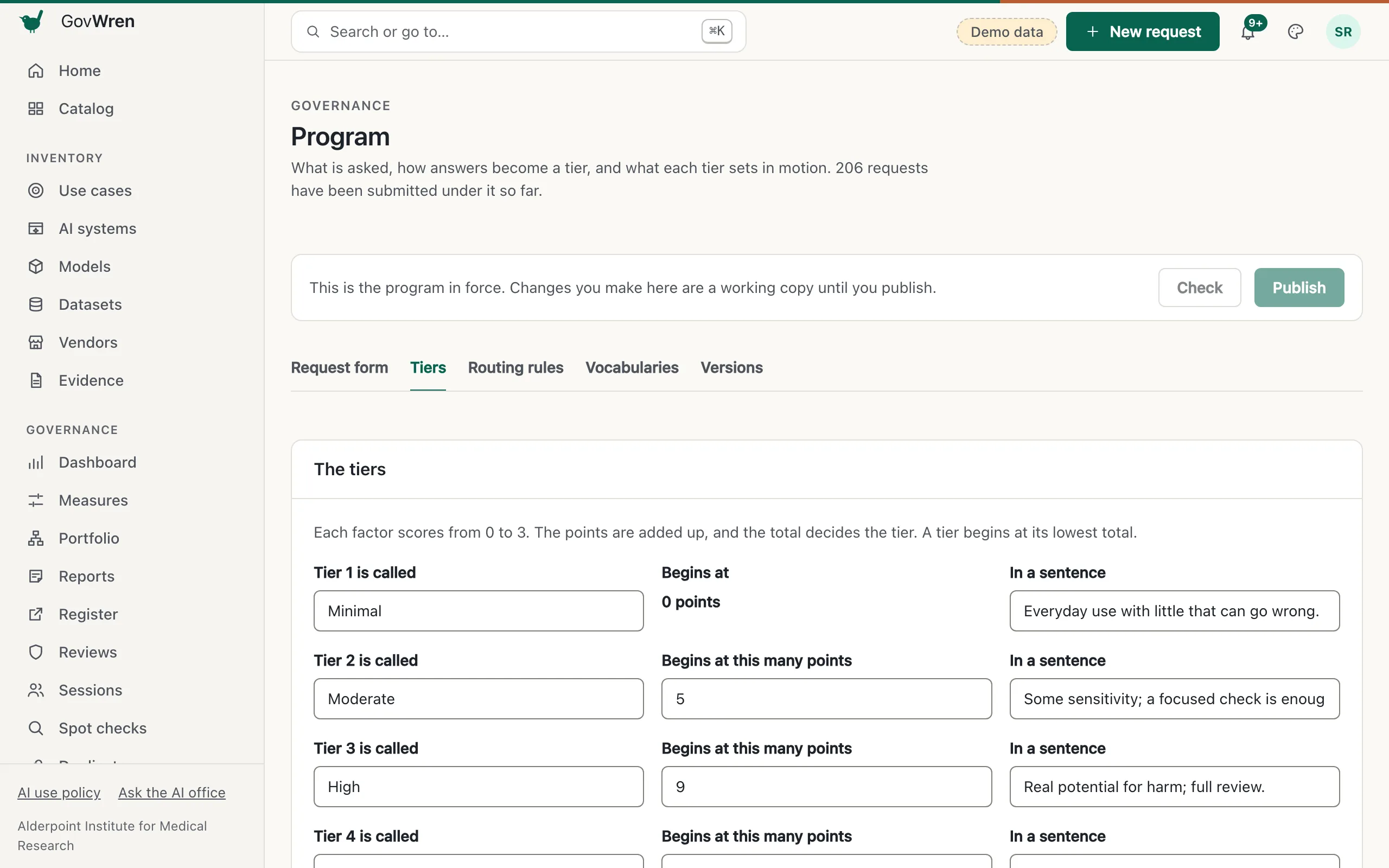
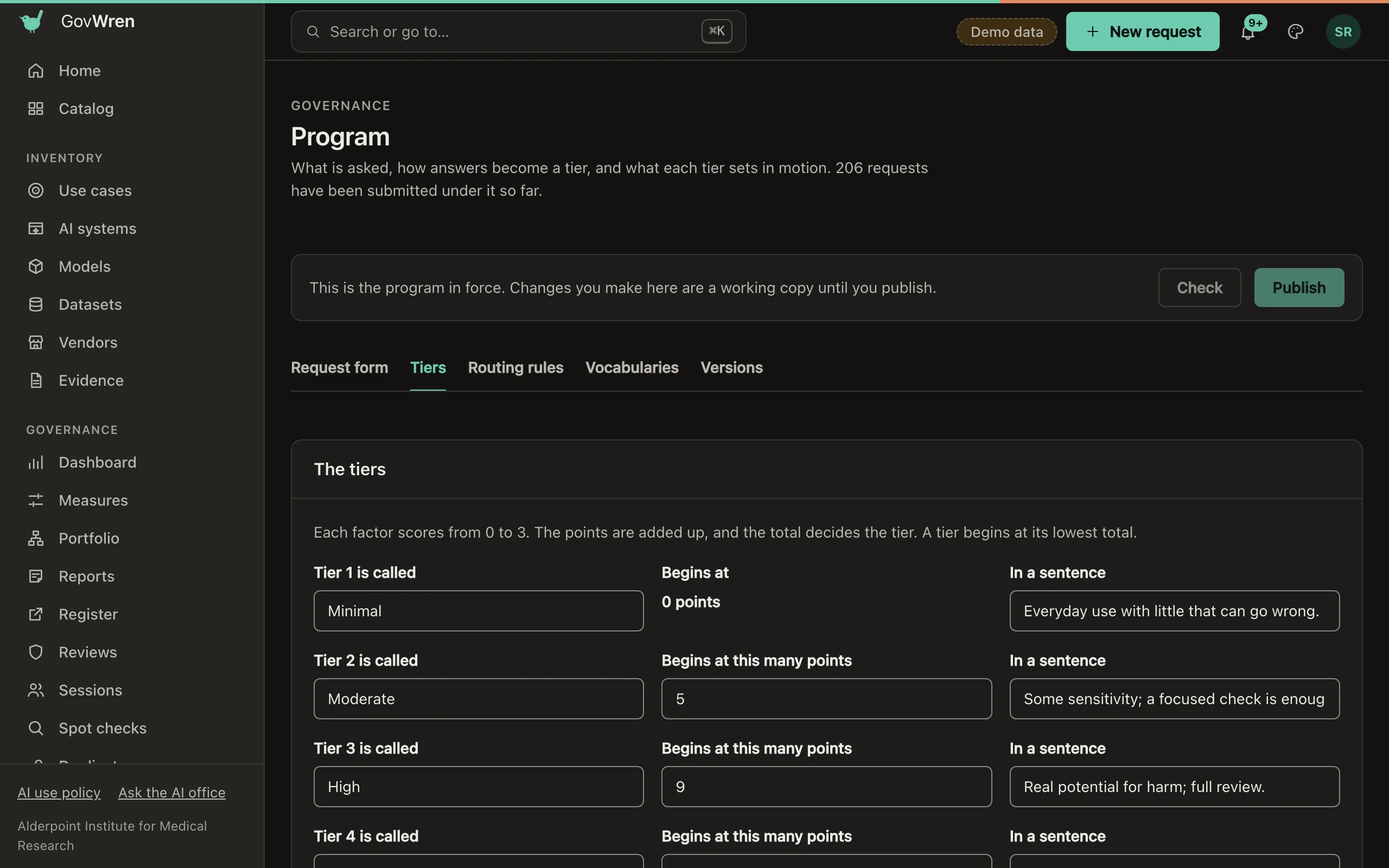
The form, the tiers, the routing rules, and the vocabularies are edited in the app. Before publishing a change you see what it would have done to the requests already decided, and nothing that was decided is ever rewritten.
Oversight
Where the program stands, today
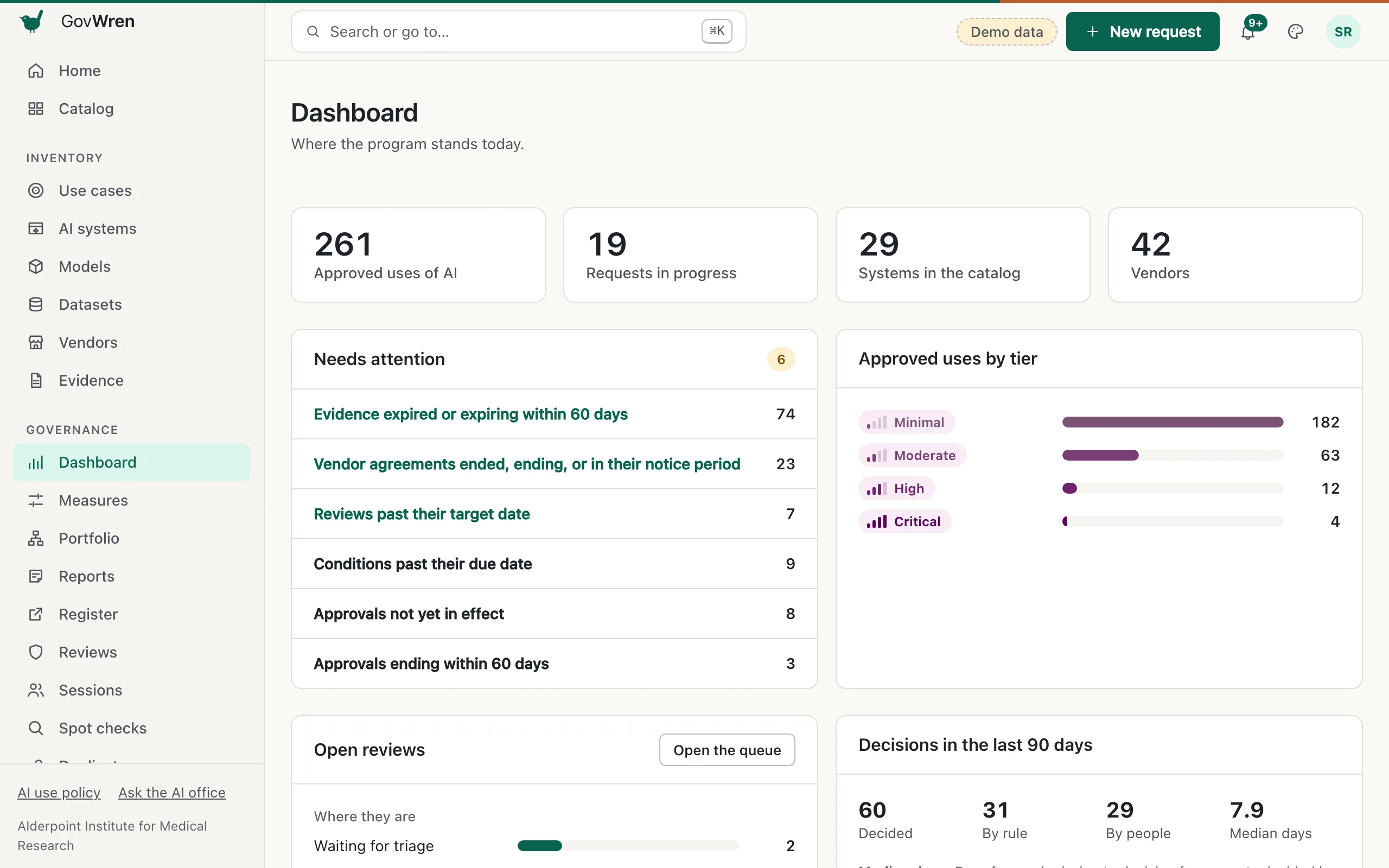
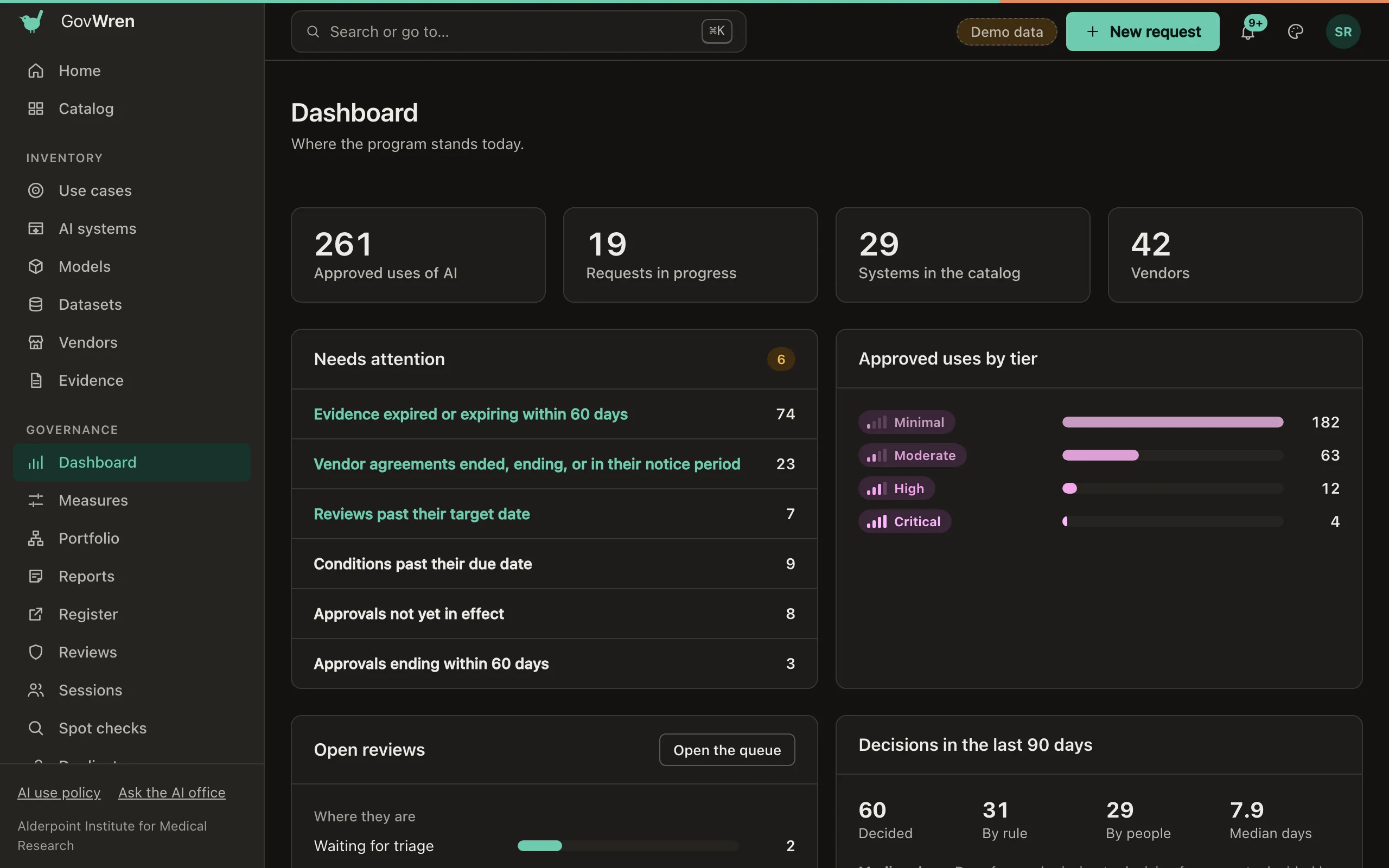
The dashboard counts approved uses by tier, unit, and area, open reviews by age, what is overdue, and how complete the records are. Every total and bar opens the records it counts.
Keeping watch
An inventory that stays true
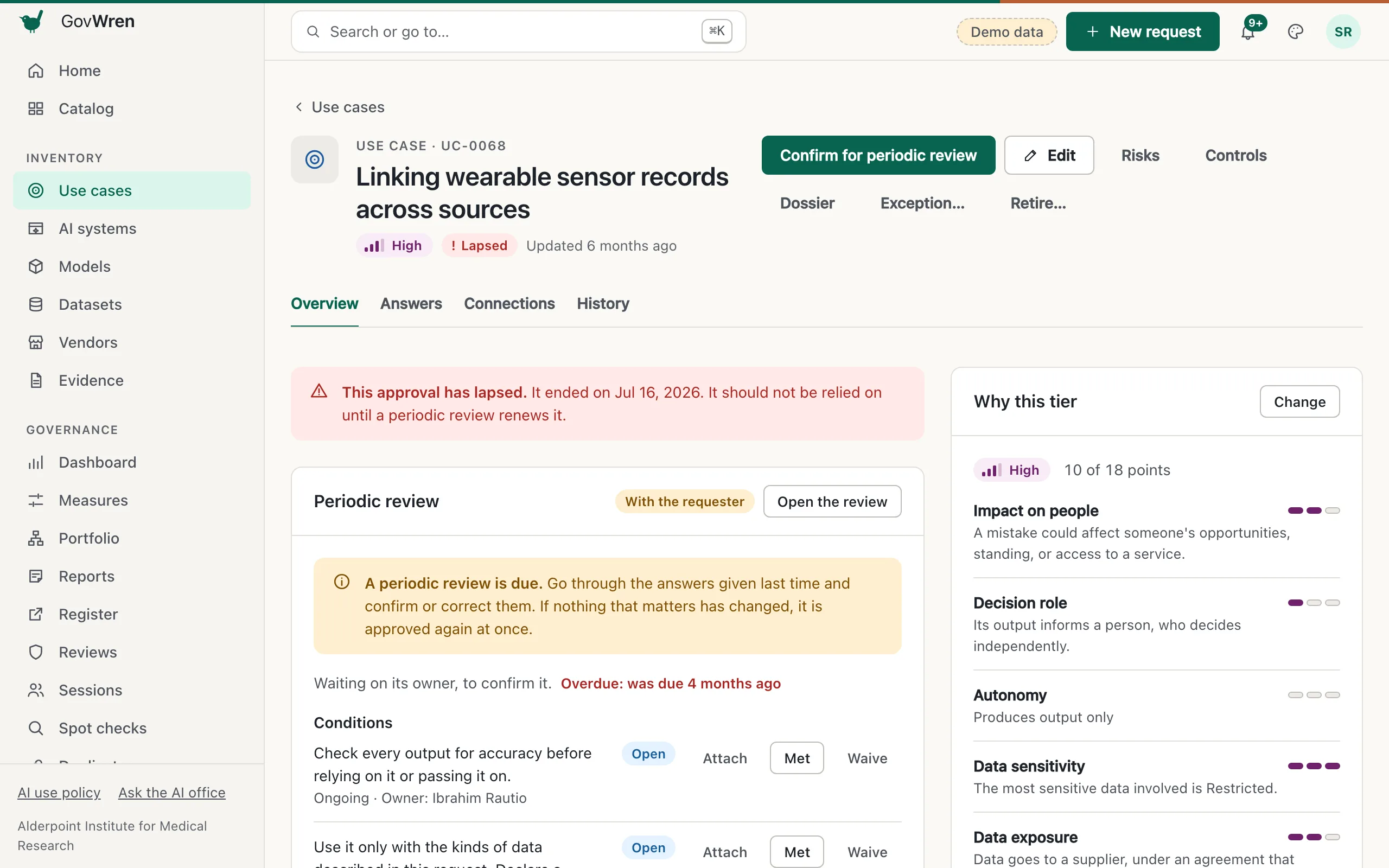
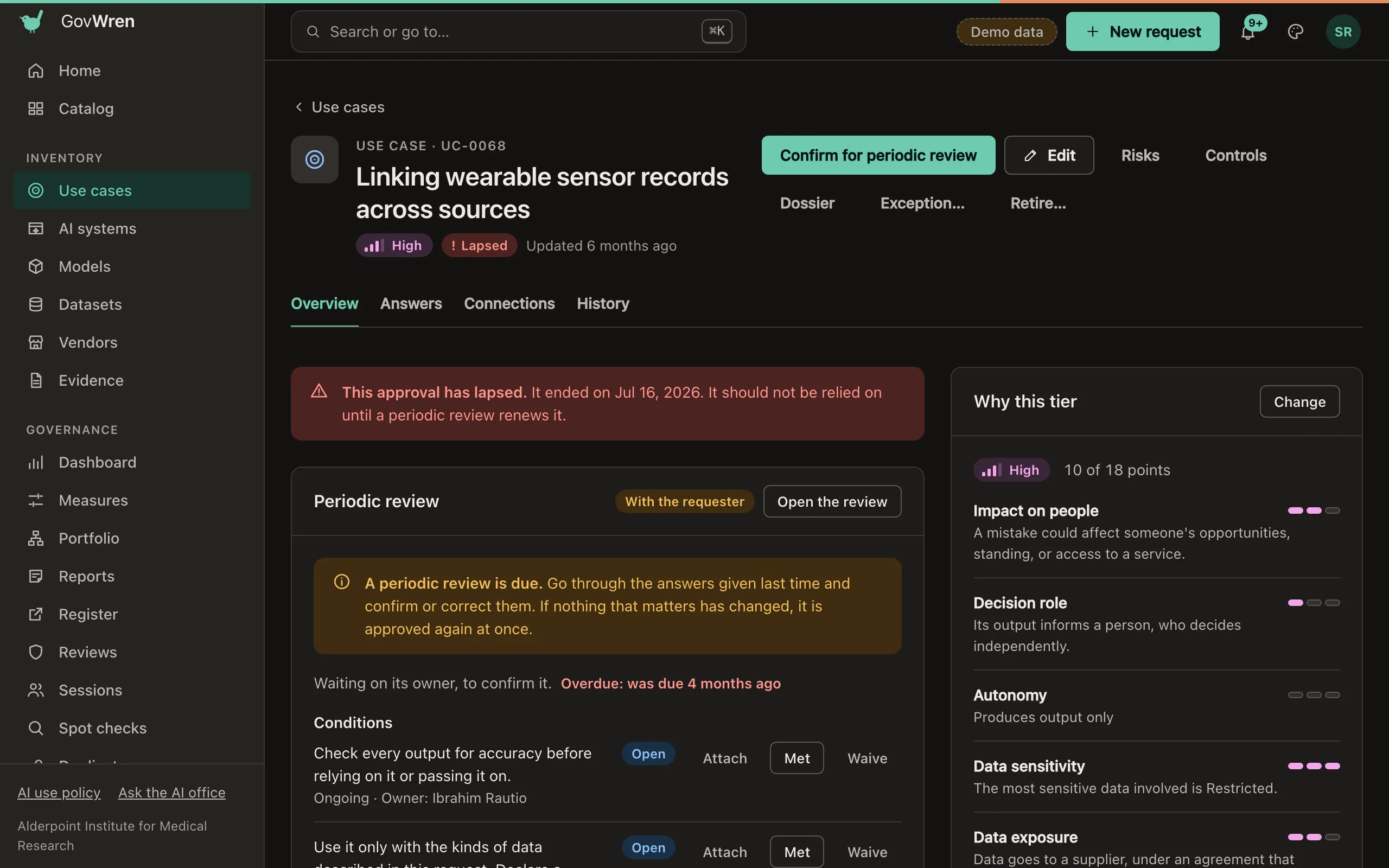
Sixty days before an approval ends, its owner is asked to confirm the answers given last time. If nothing that matters has changed, it is approved again on the spot. An approval nobody renews is marked lapsed, in the open, with the reason.
Attestation
Owners confirm in a few clicks
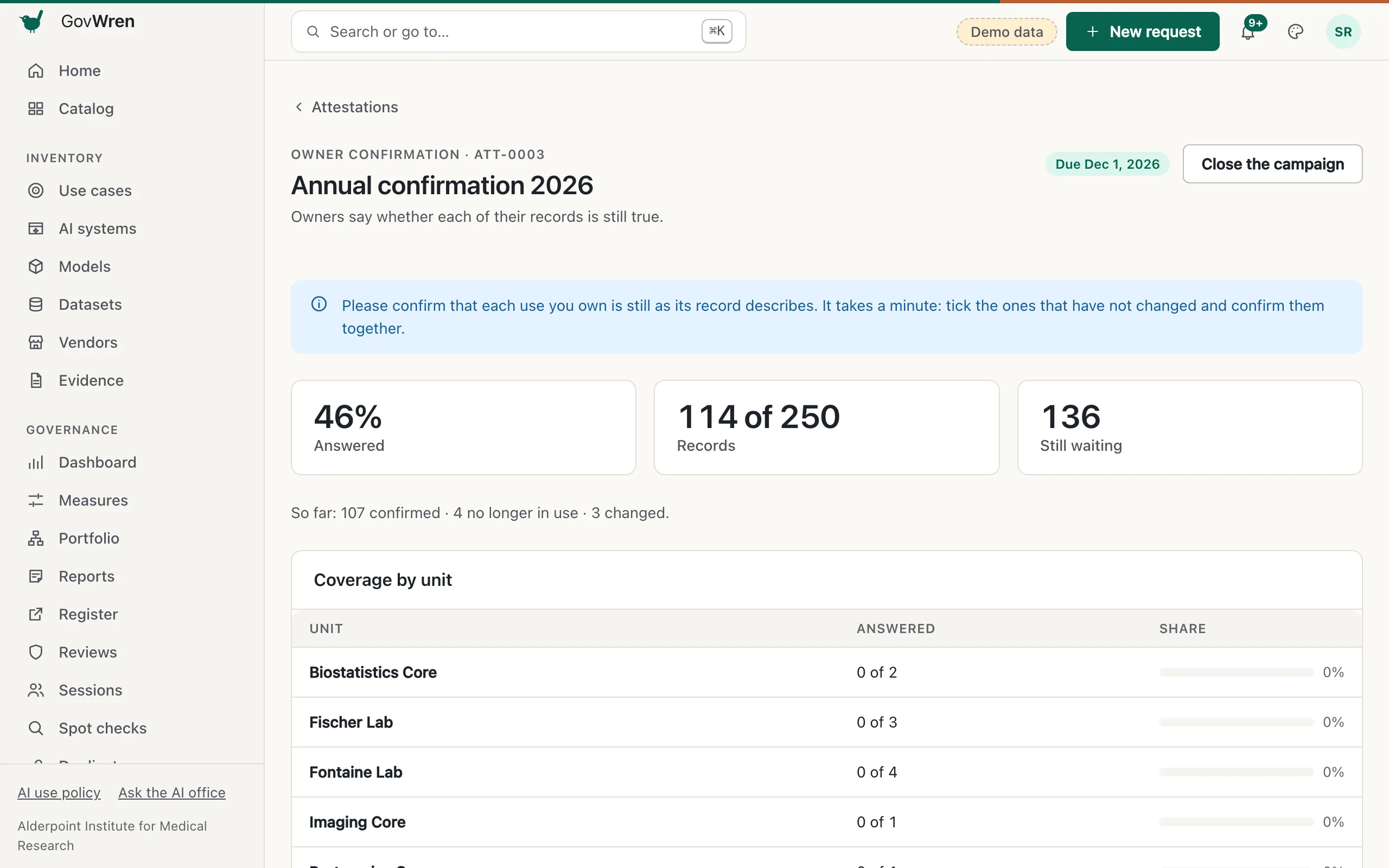
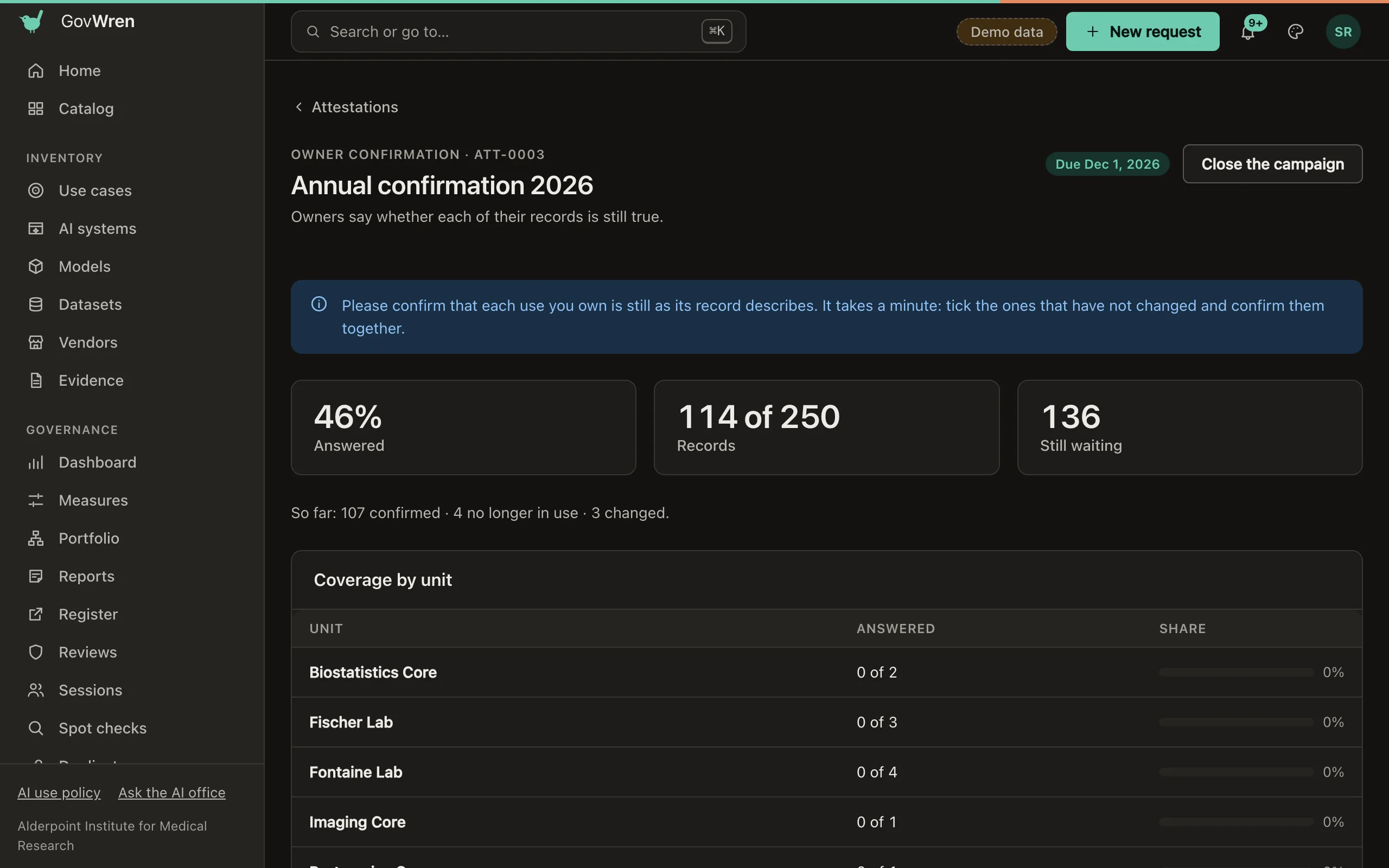
A campaign asks every owner whether each record is still true, and every steward whether their unit's list is complete. Coverage is counted by unit, with who has yet to answer. A record reported as changed goes straight into a change declaration.
Incidents
When something goes wrong, everything that depends on it knows
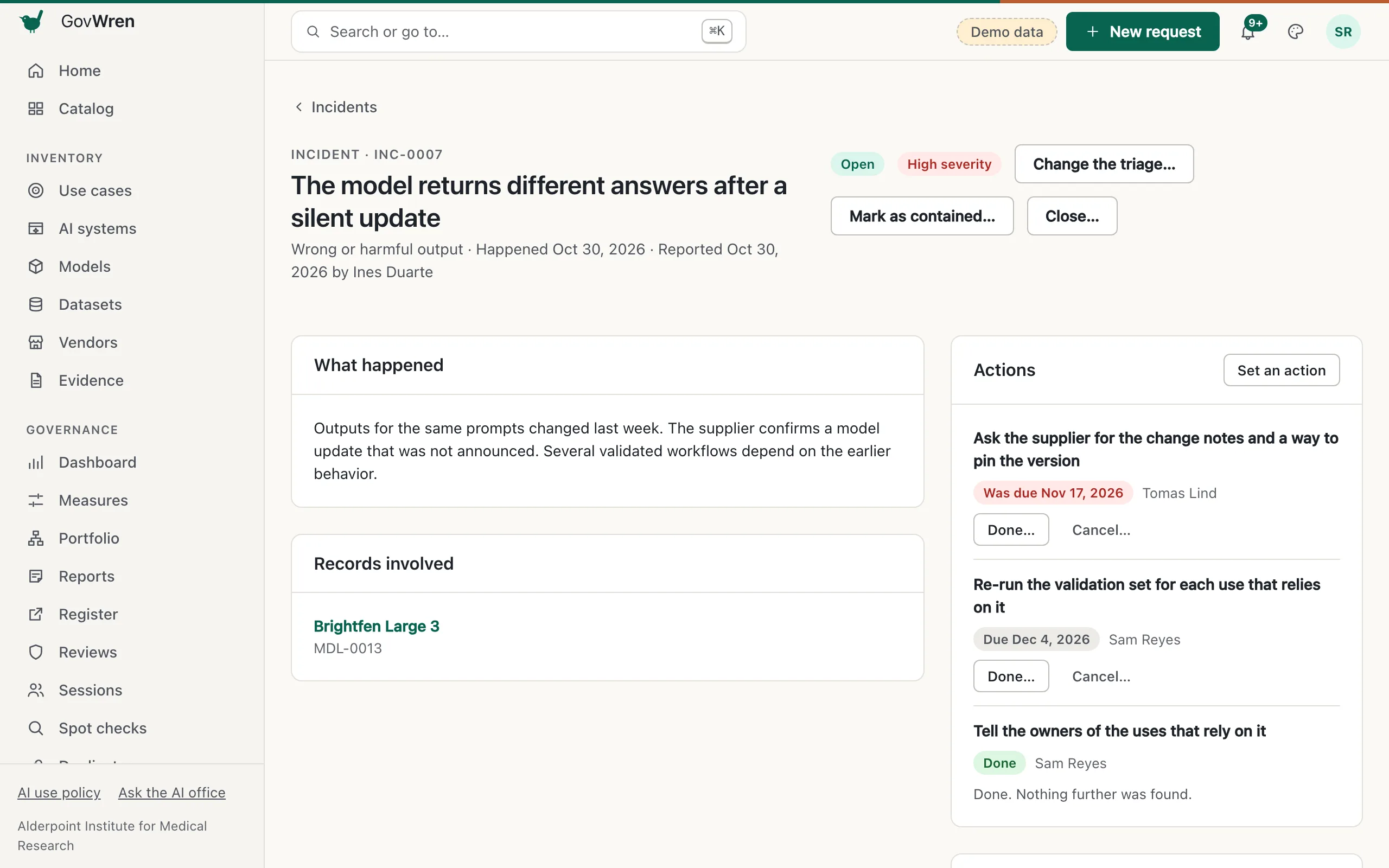
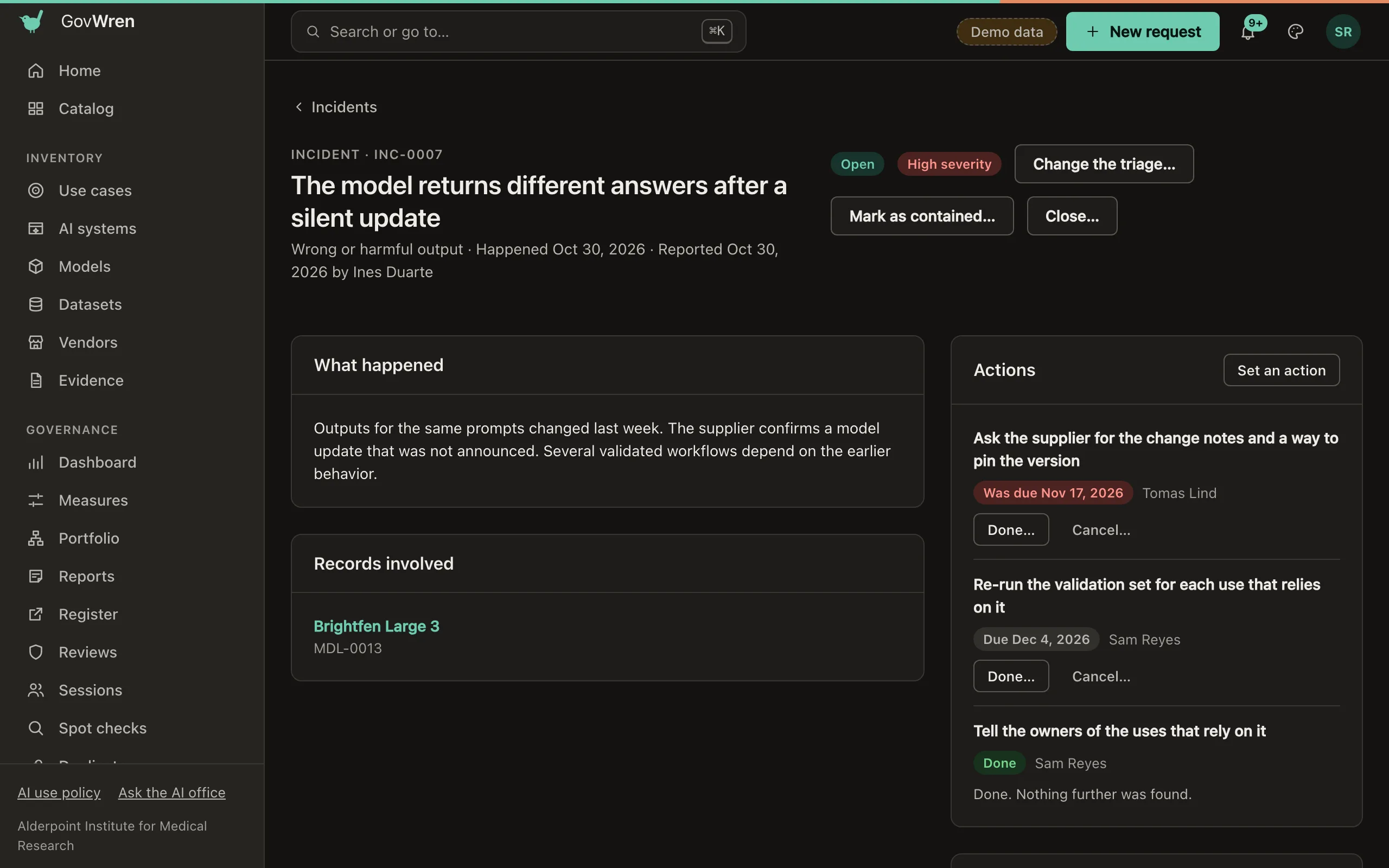
Anyone can report an incident or a near miss. Governance triages it, may suspend an approval or open a review, and sets actions with owners and dates. An incident on a model shows on every system built on it and every use of those systems.
The committee
Meetings with an agenda, decisions, and minutes
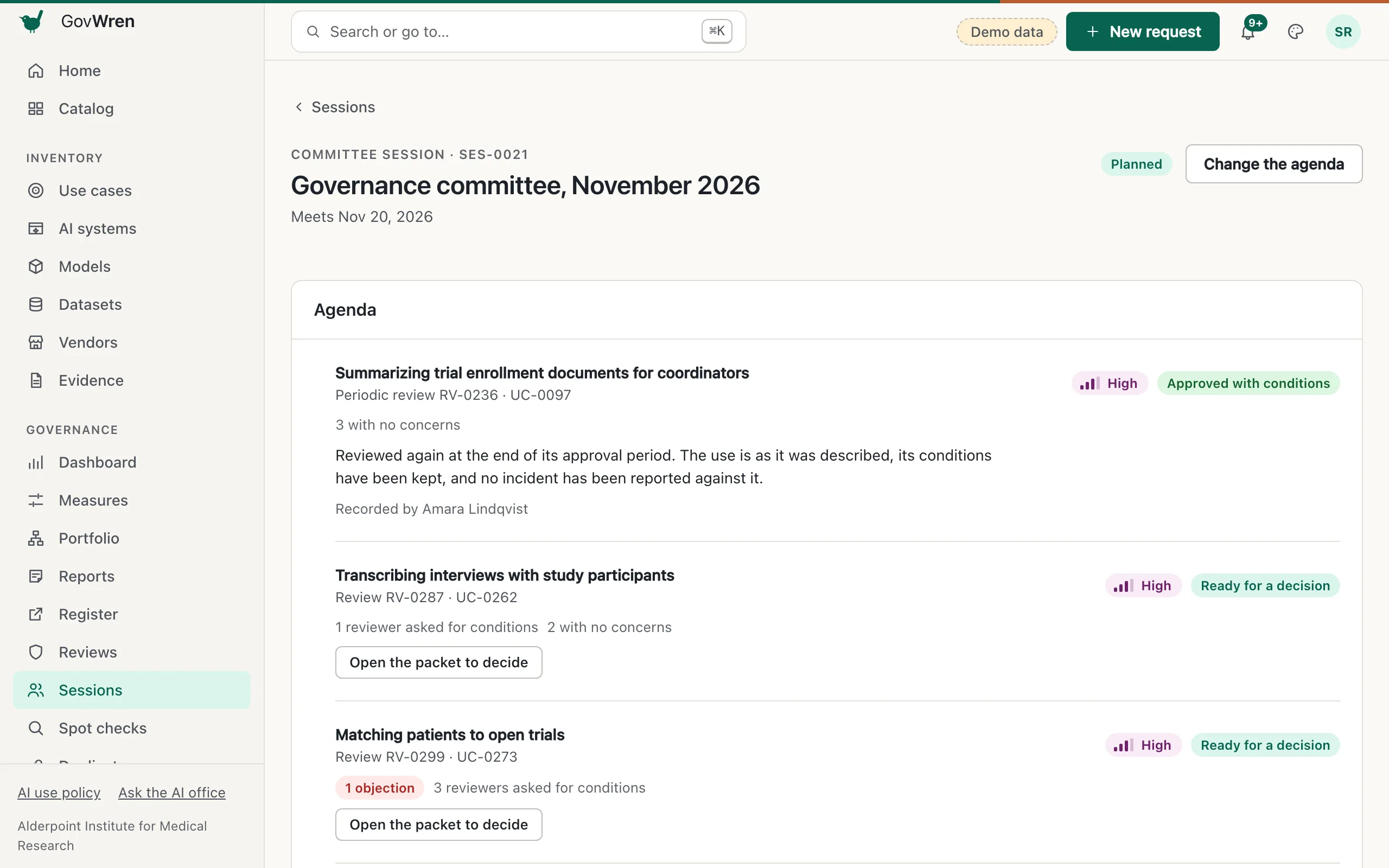
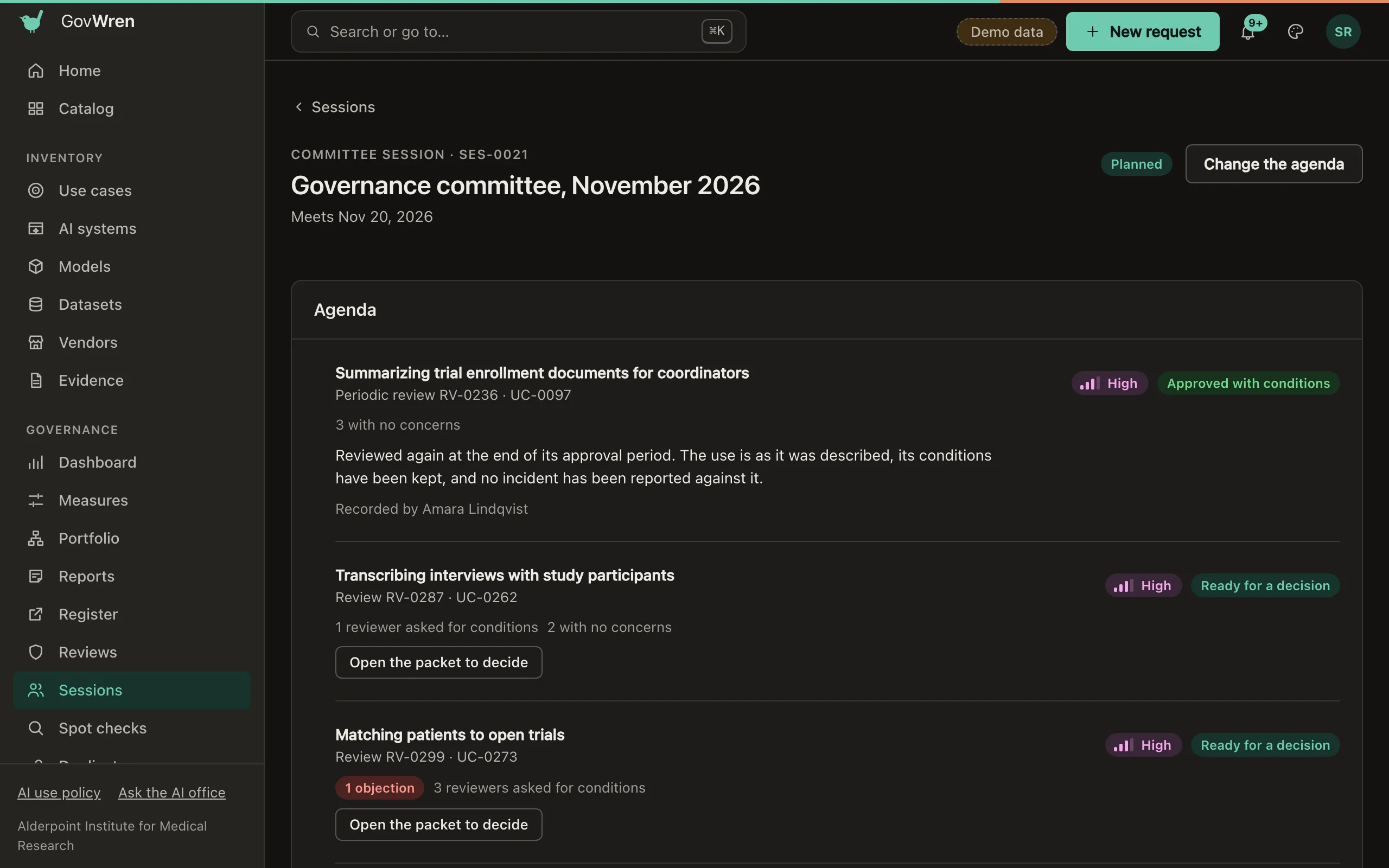
Reviews that a committee decides are gathered into a session. Each decision is recorded as made there, and a closed session cannot be changed. Where the rules require it, a named person accepts the risk before anything is approved.
Assurance
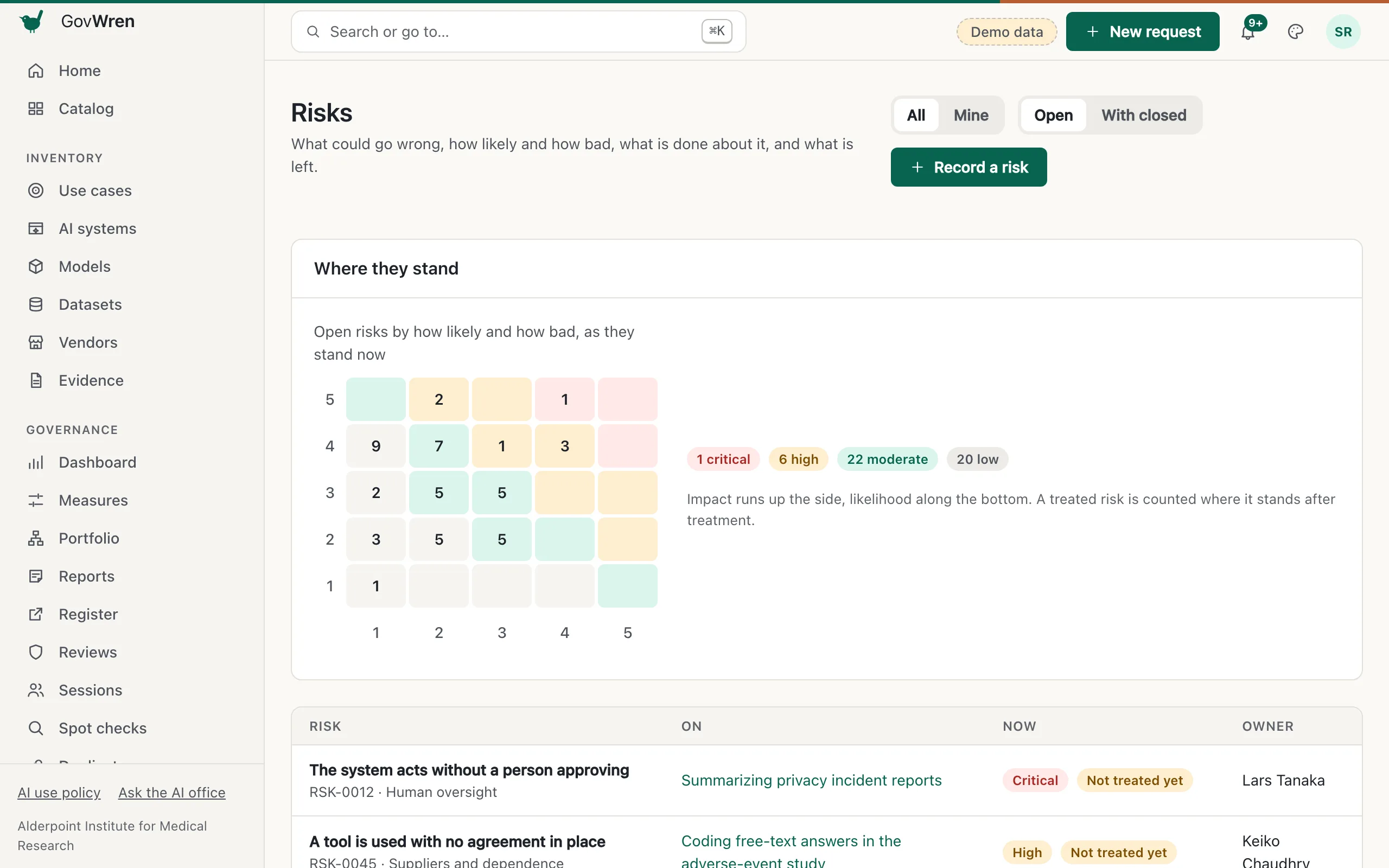
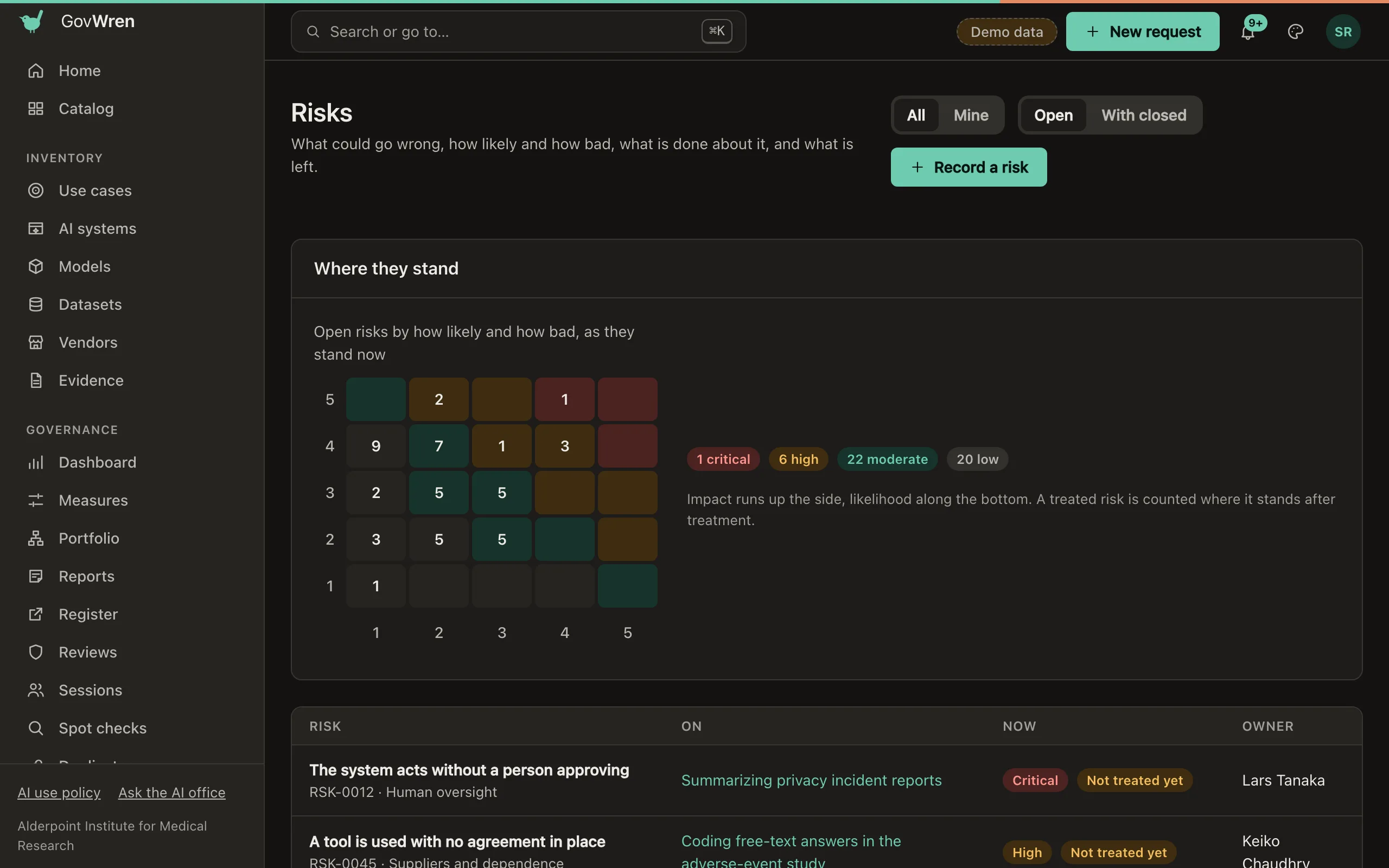
Risks written down, scored, and owned
Draw a risk from a library written for research and health settings, score it before and after treatment, and name who owns it. A grid shows where open risks stand, and a high risk shows on everything that relies on its record.
Controls
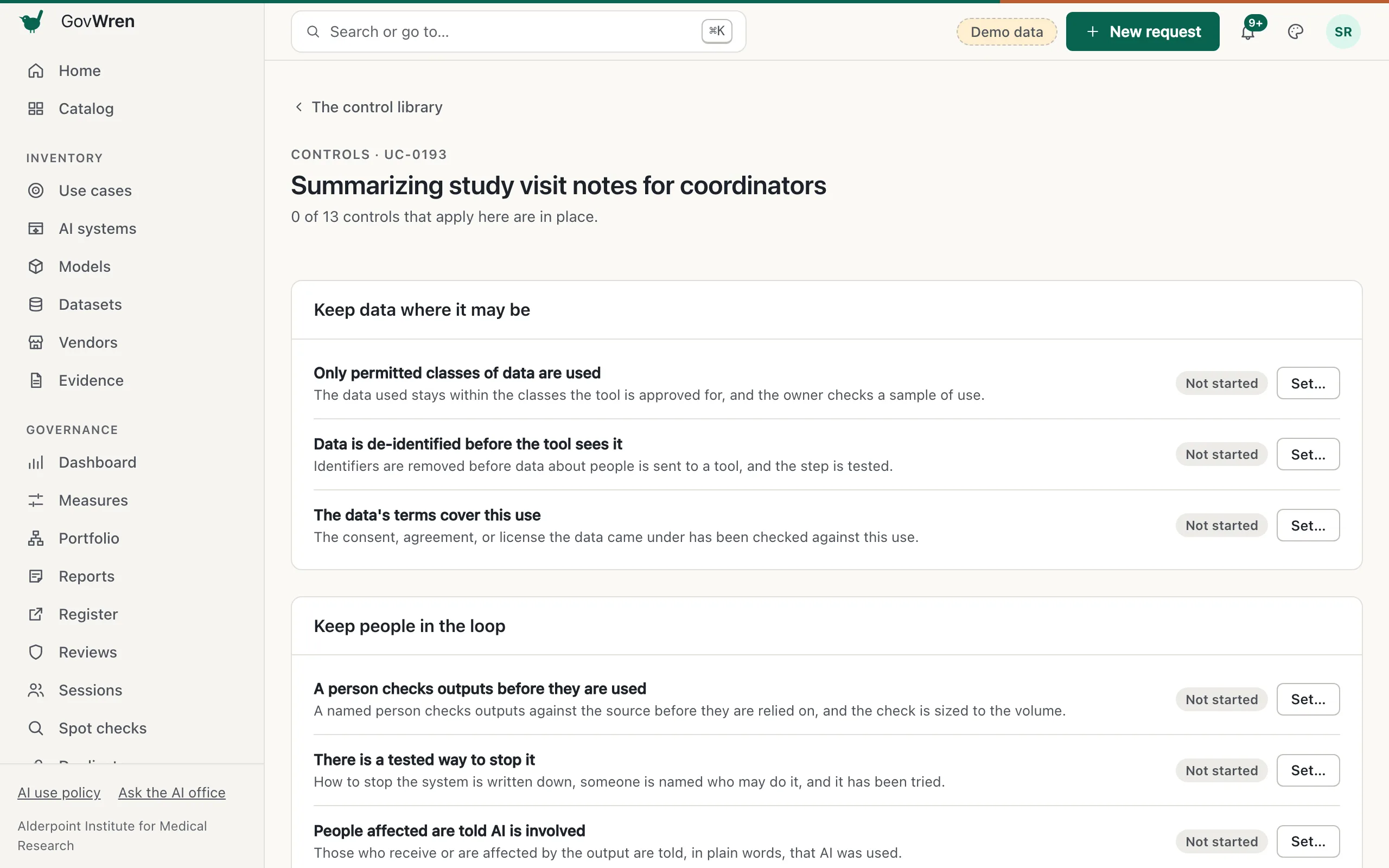
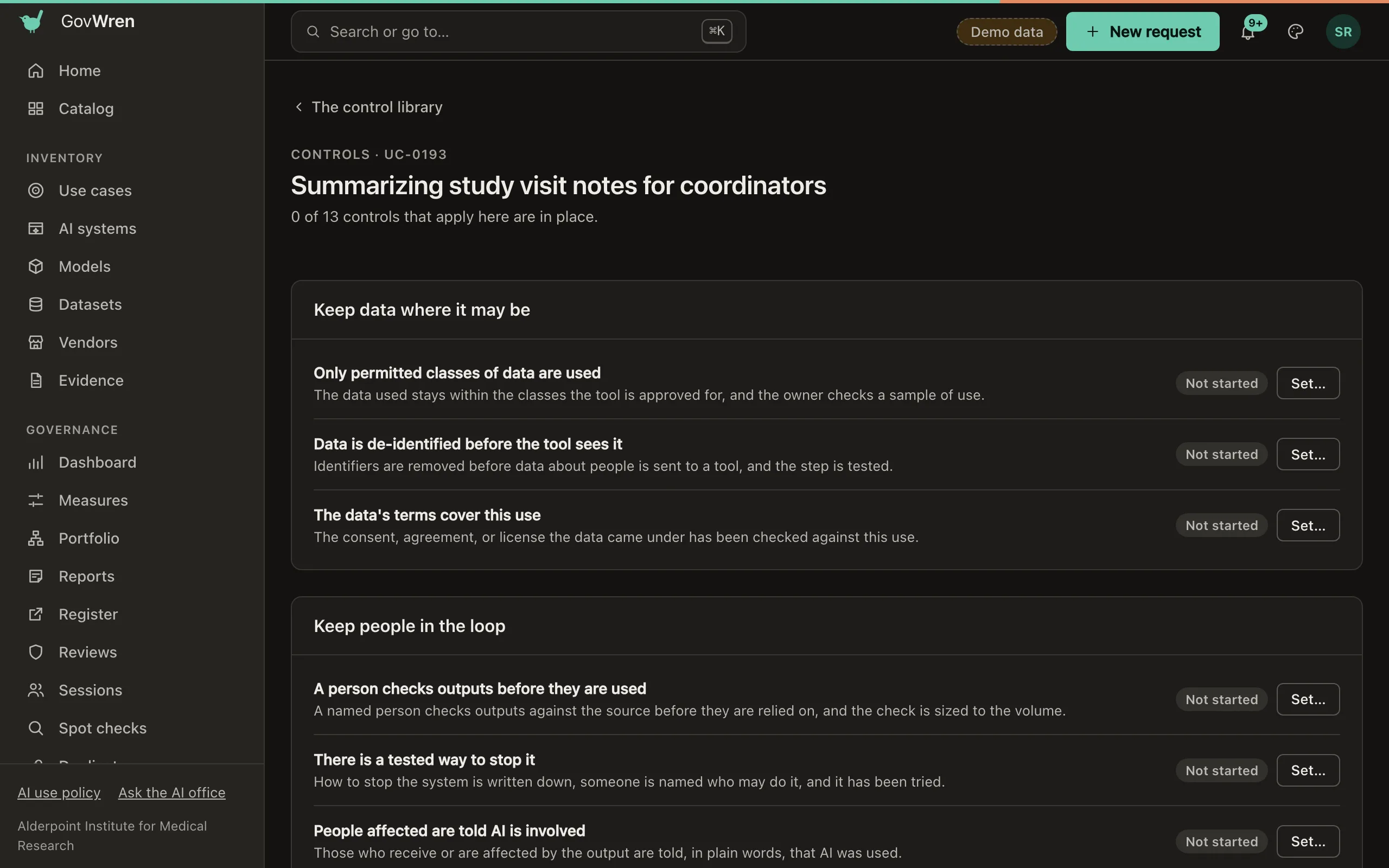
Safeguards defined once, shown with their evidence
Nearly fifty controls say what a governance program has to do. Each applies to the program or to every record its rule picks out, and has a standing, an owner, evidence, and a date it is next checked. Evidence that runs out becomes someone's action.
Frameworks, if you need one
Readiness that is worked out, not typed in
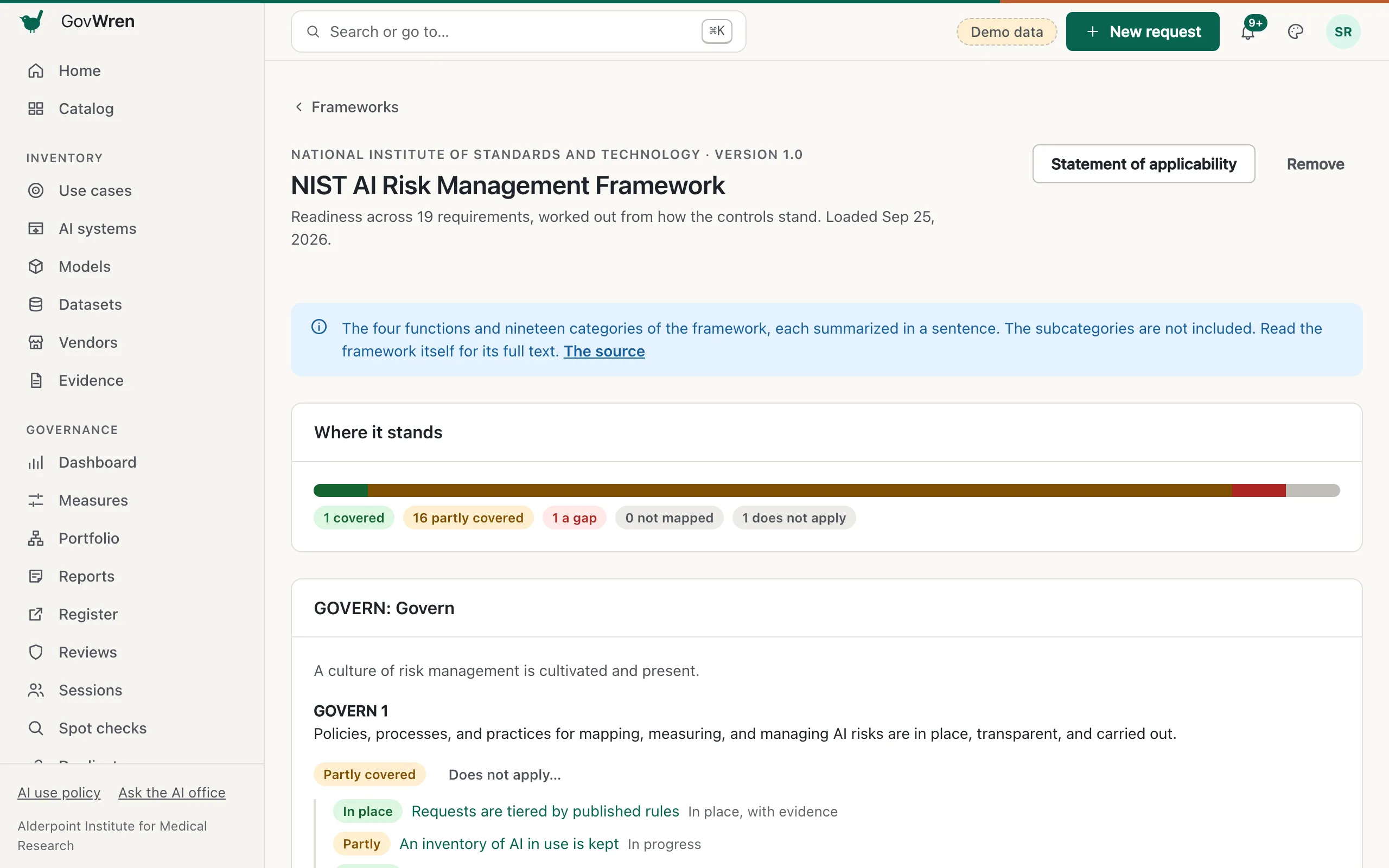
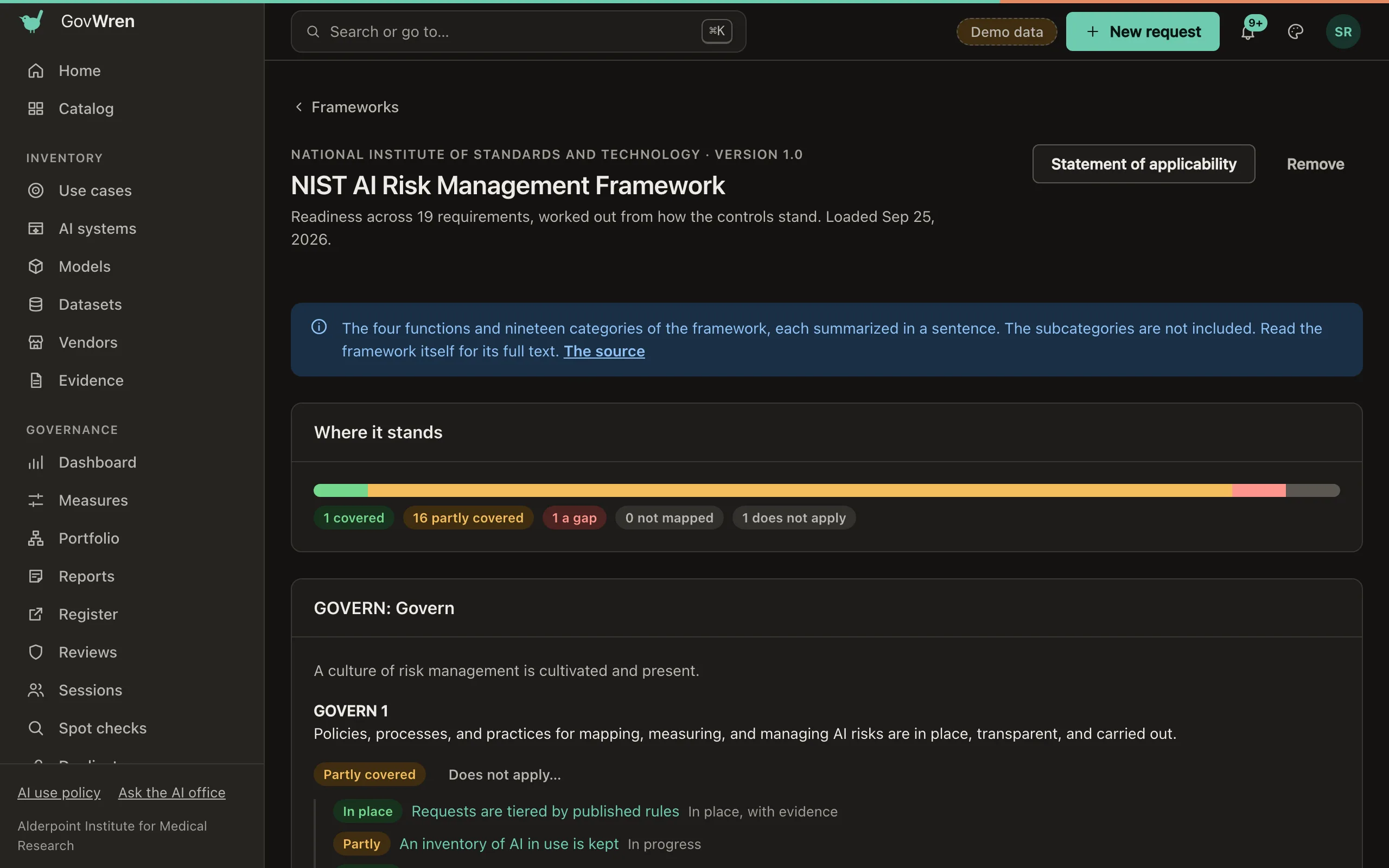
The NIST AI RMF, ISO/IEC 42001, HIPAA, and a list of risks for AI agents come built in, and your own load as data. Each requirement shows as covered, partly covered, a gap, or not mapped, from how your controls stand. Nothing needs a framework, and no single percentage hides the gaps.
Frameworks and readiness → · What GovWren does and does not do under each →
Insight
Figures that say what they count
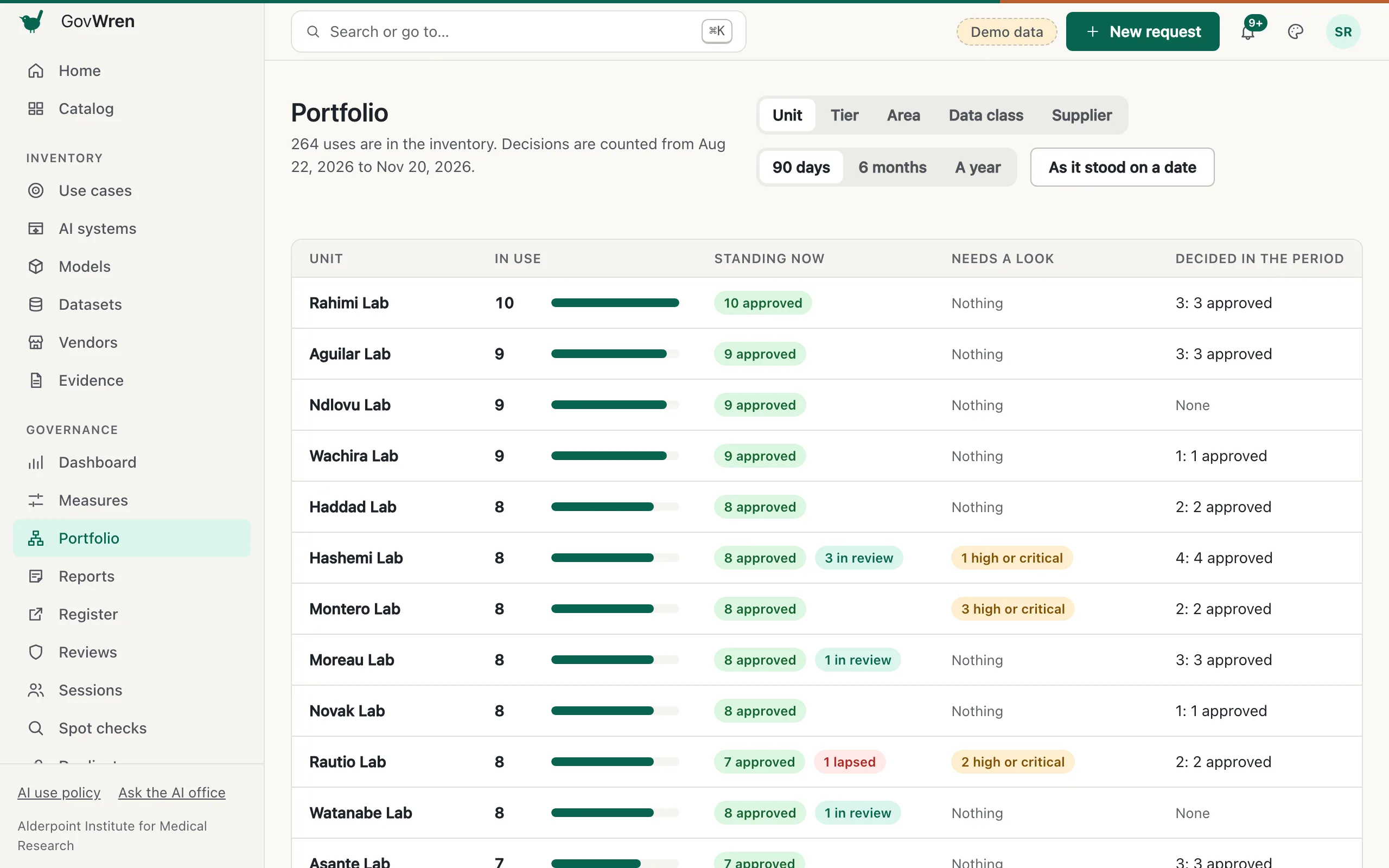
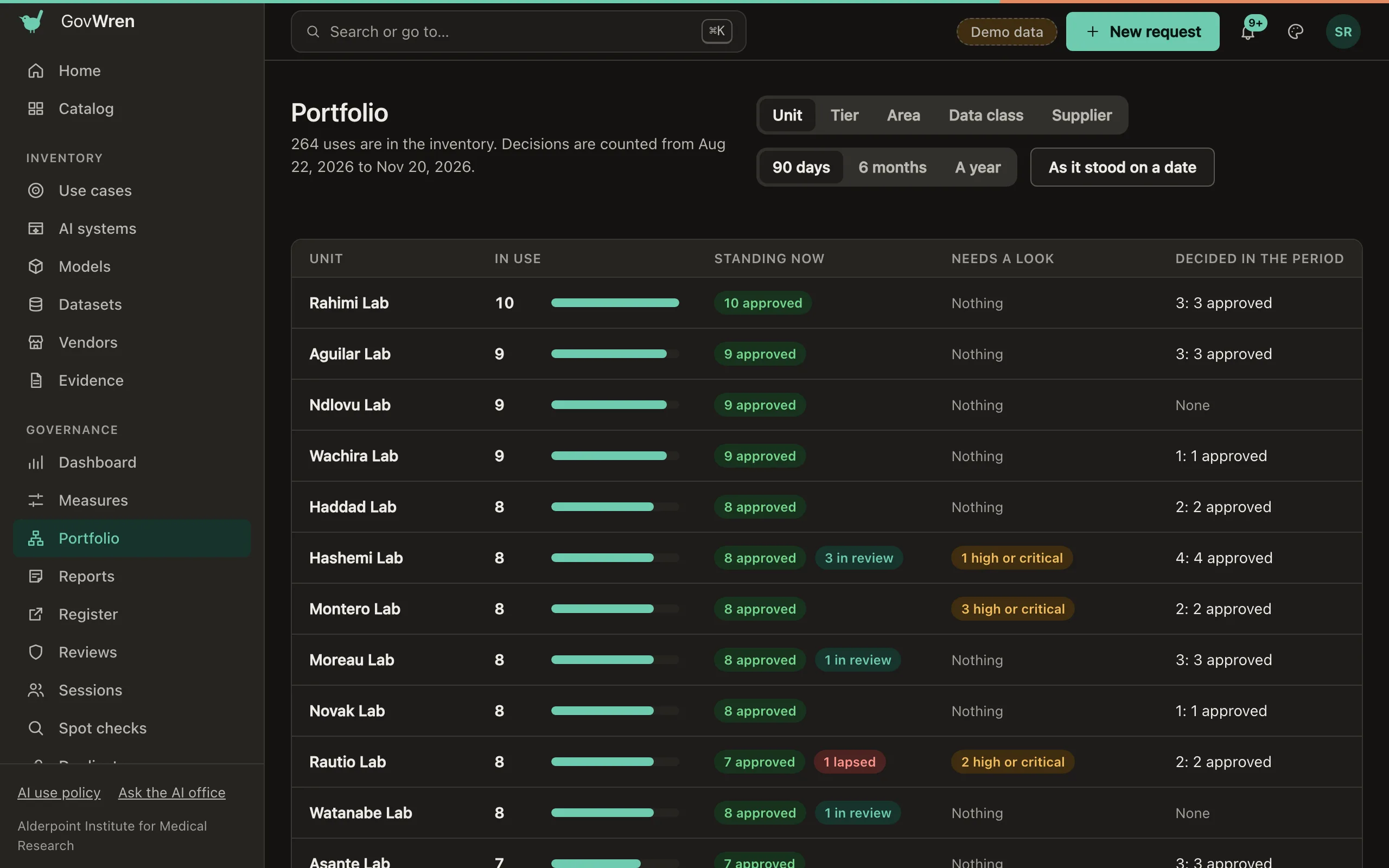
Five measures, each shown with the sentence that defines it and a trend stored day by day. The portfolio groups every use by unit, tier, area, data class, or supplier, and every figure opens the records behind it.
Reports and dossiers
What you showed leadership stays what you showed
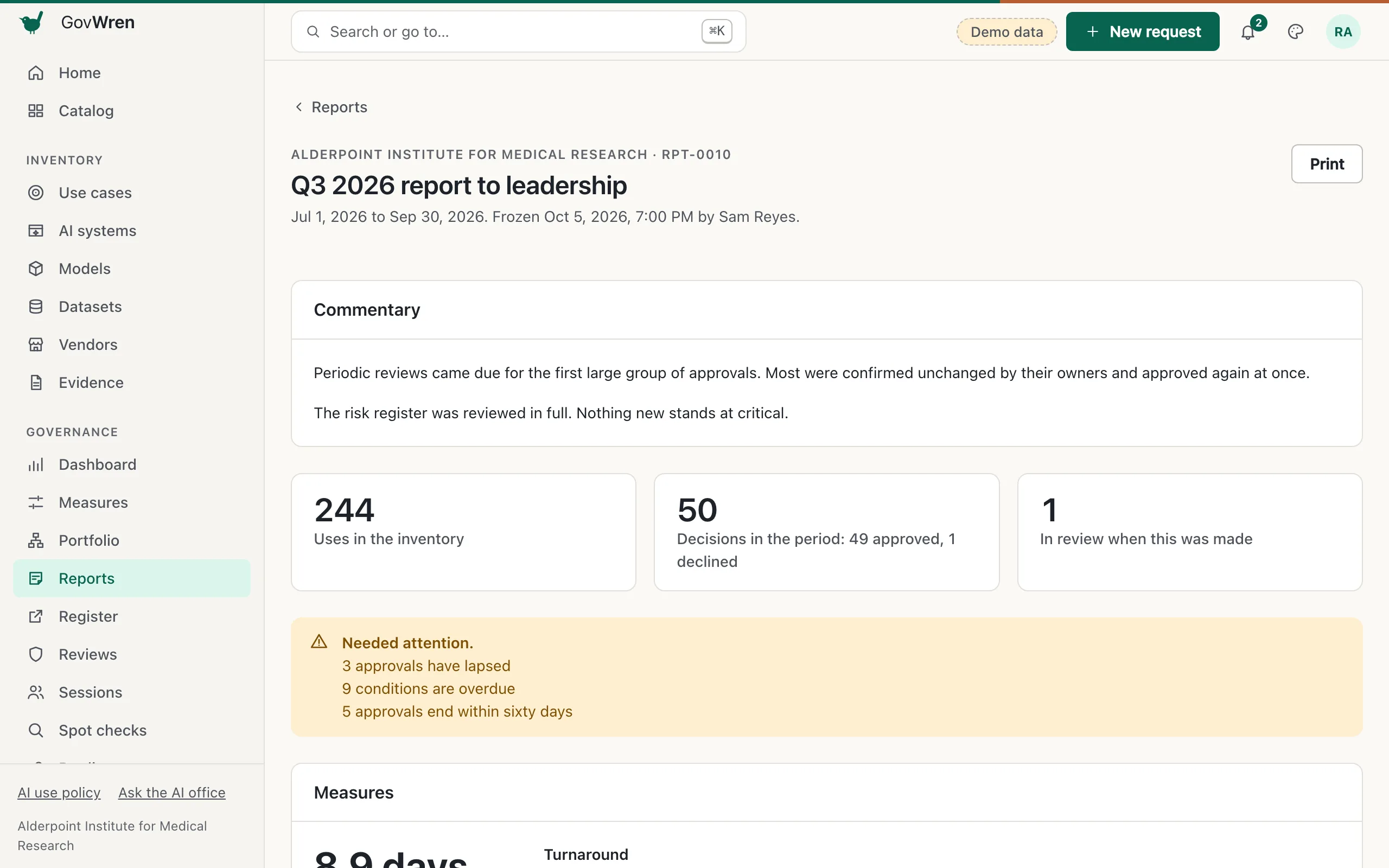
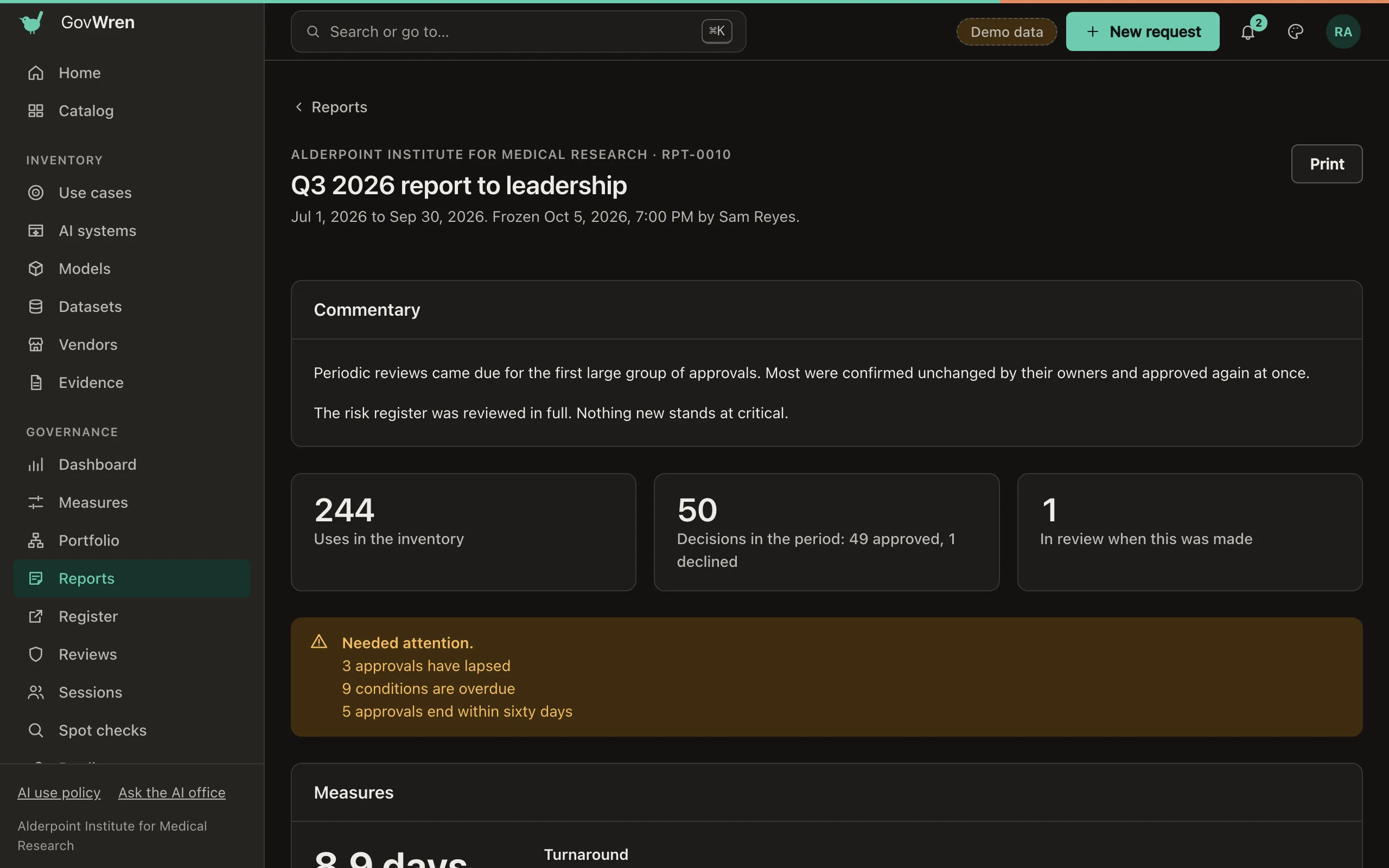
A report to leadership is worked out once and frozen, with a hash that proves it. Any record prints as a dossier or leaves as a package with its evidence and a manifest that verifies, and any day in the past can be seen as it stood.
In the open
A public register, in your own words
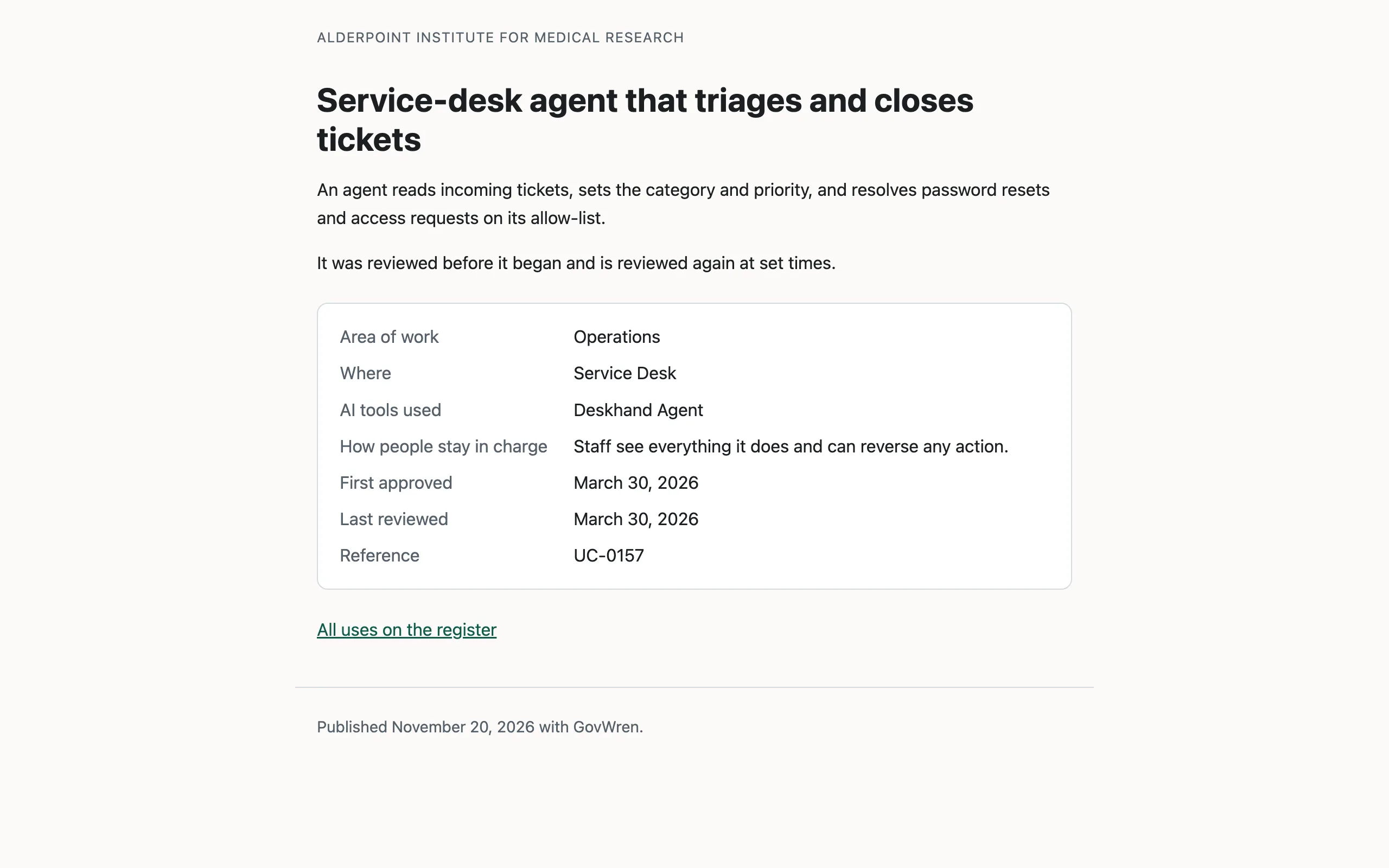
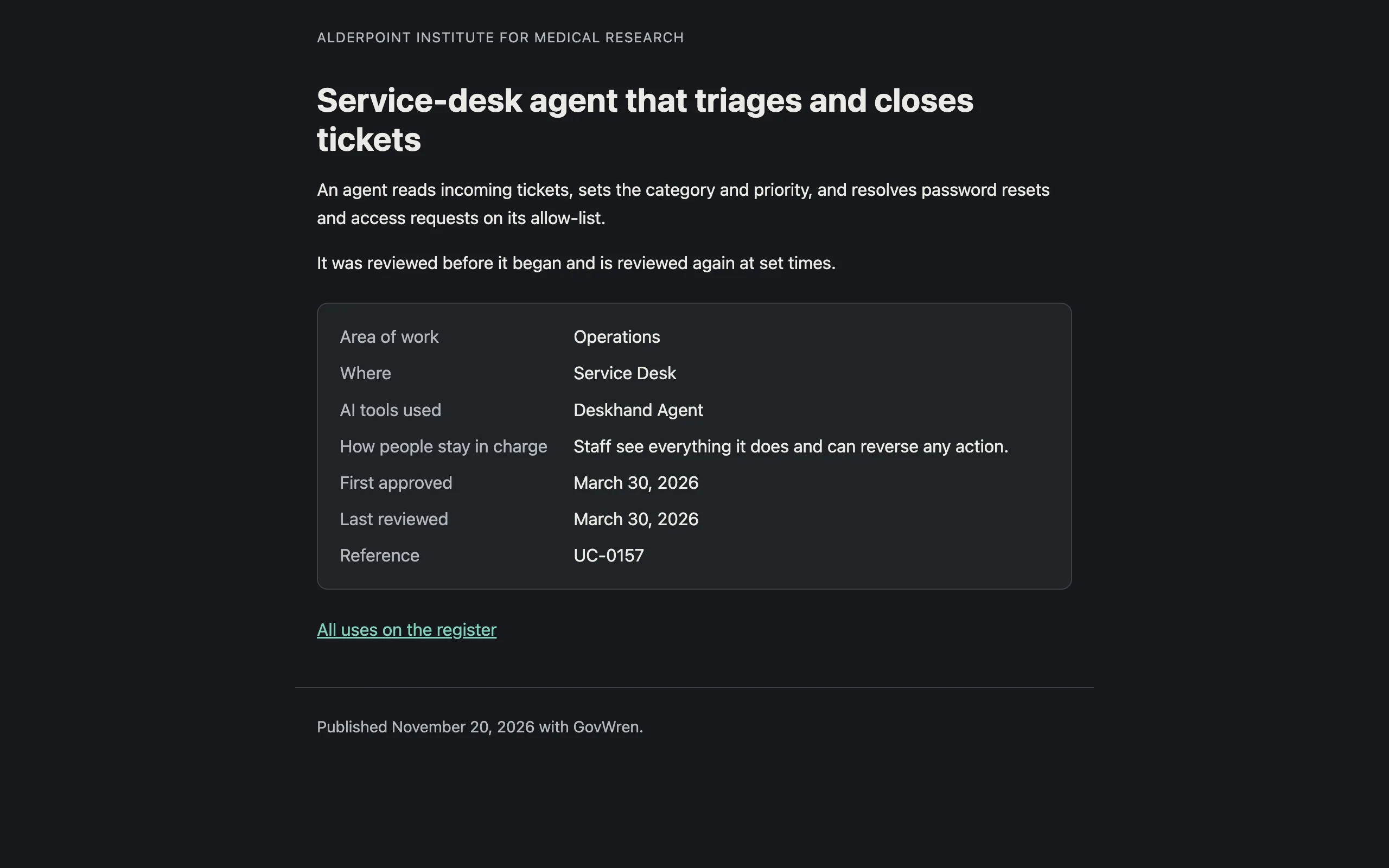
Choose the approved uses you want to describe in public and write a few plain sentences for each. GovWren writes the register as plain pages for any web server, and exports your models as a standard bill of materials.
Adoption
Made to be someone else's
Begin from a program shaped for a research institute, a university, or an academic medical center. Use your own words, your own fields, and your own colors. Run it from a container or a sandboxed service, back it up as one file, and let other systems ask whether a reference is approved.
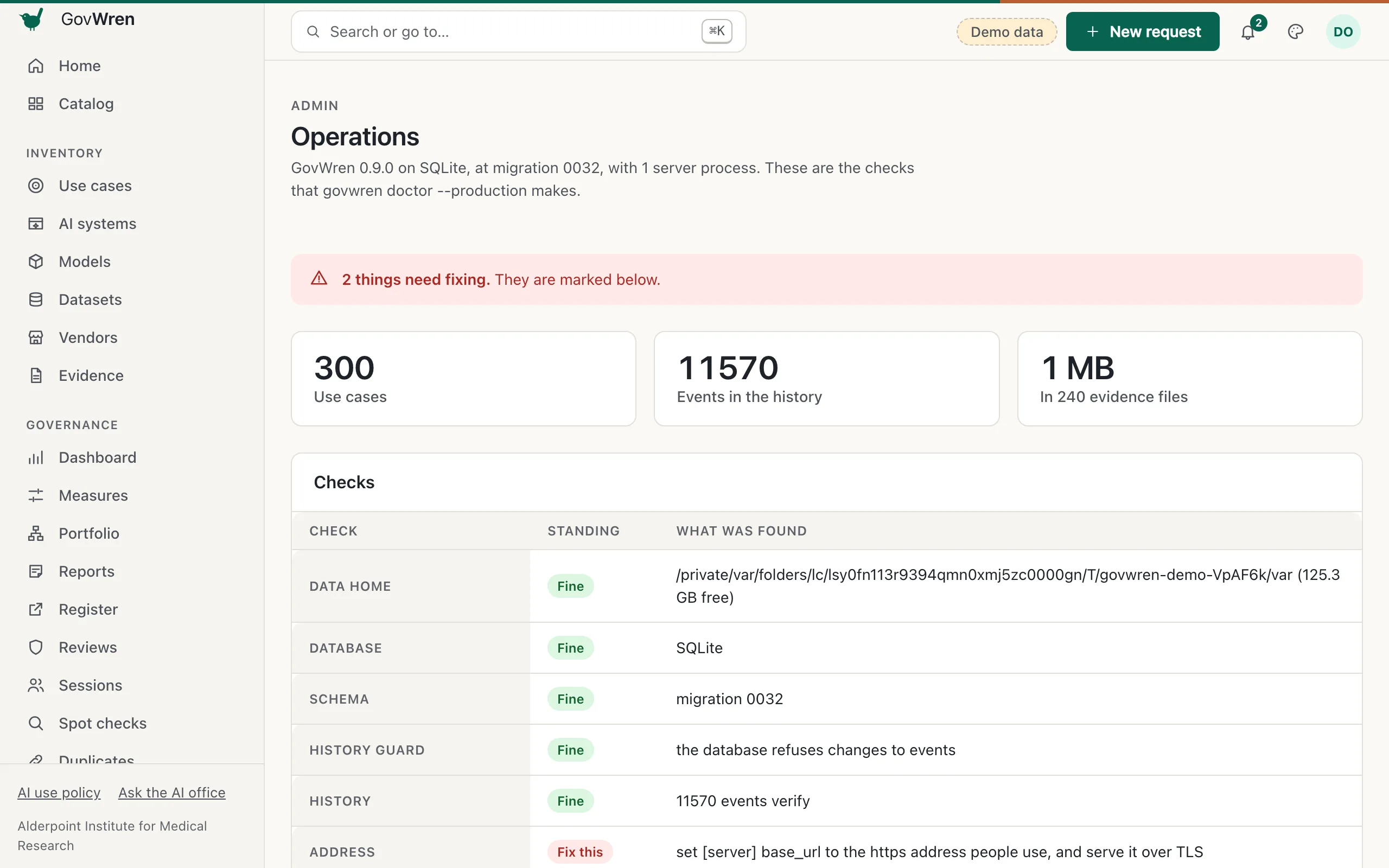
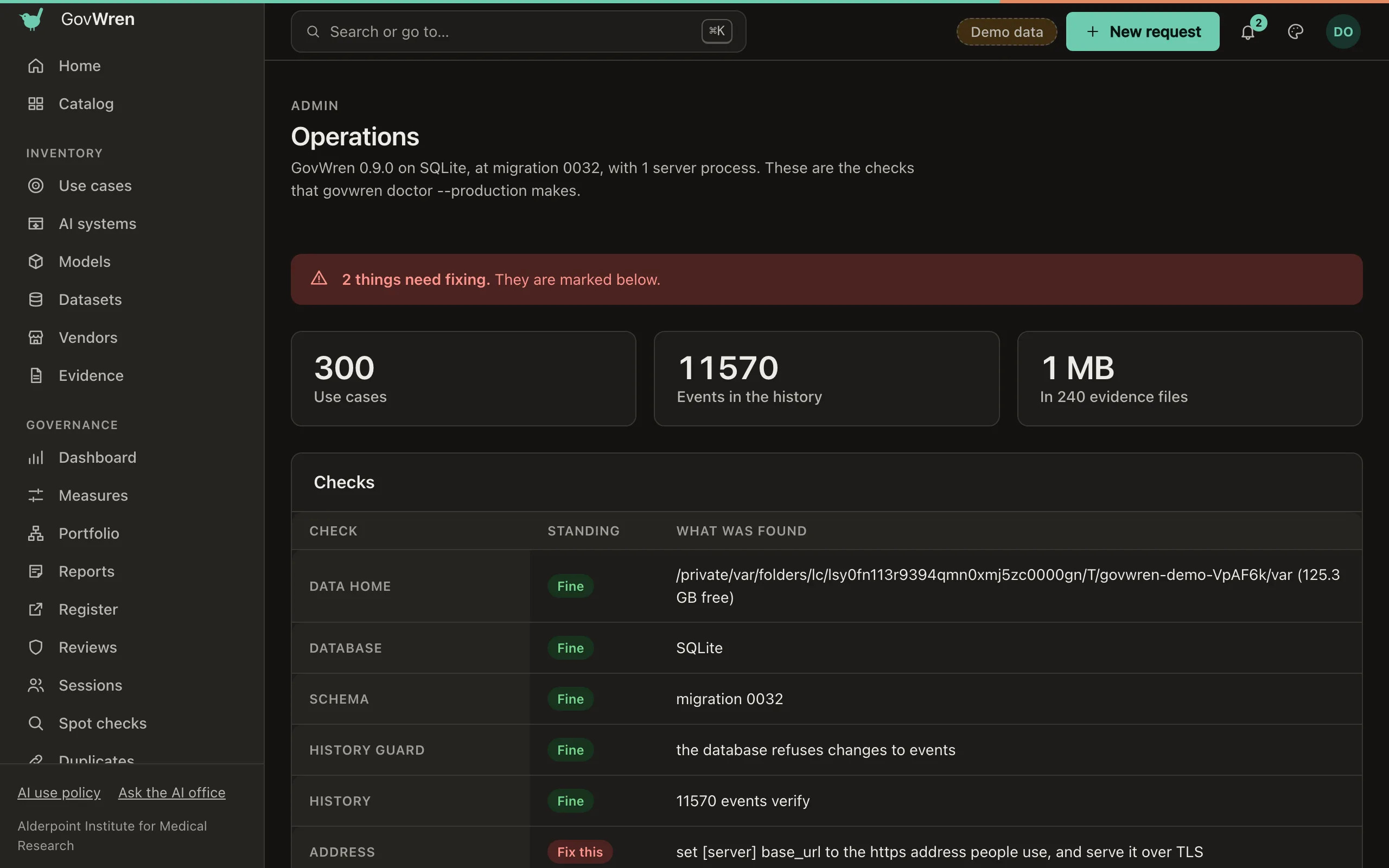
Connected
Other systems ask. GovWren answers.
A purchasing form or an ethics application asks for a GovWren reference and checks it before going ahead. Evaluation tools push their results in as evidence. A person's own AI assistant can look things up and draft a request. GovWren still goes looking for nothing.
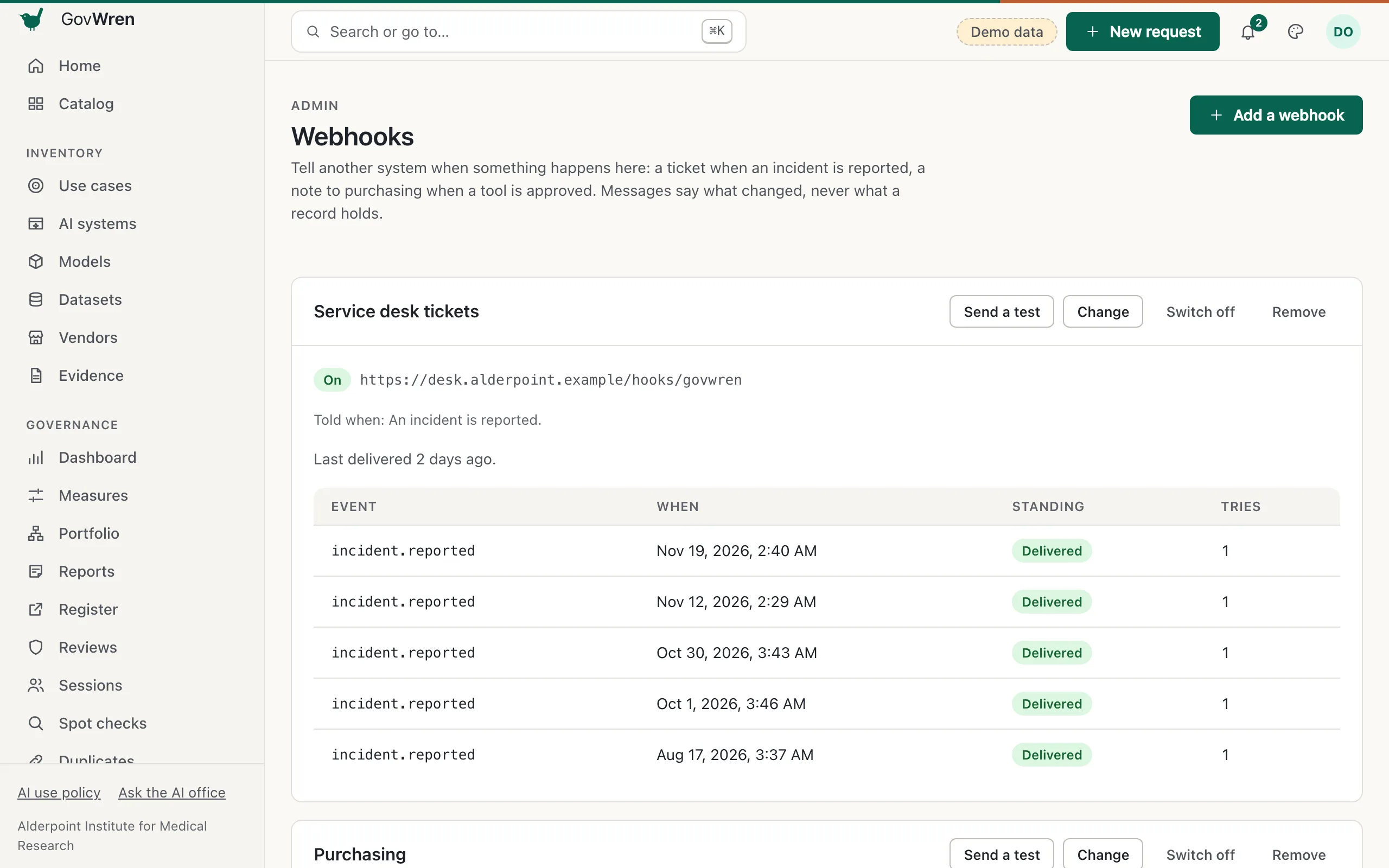
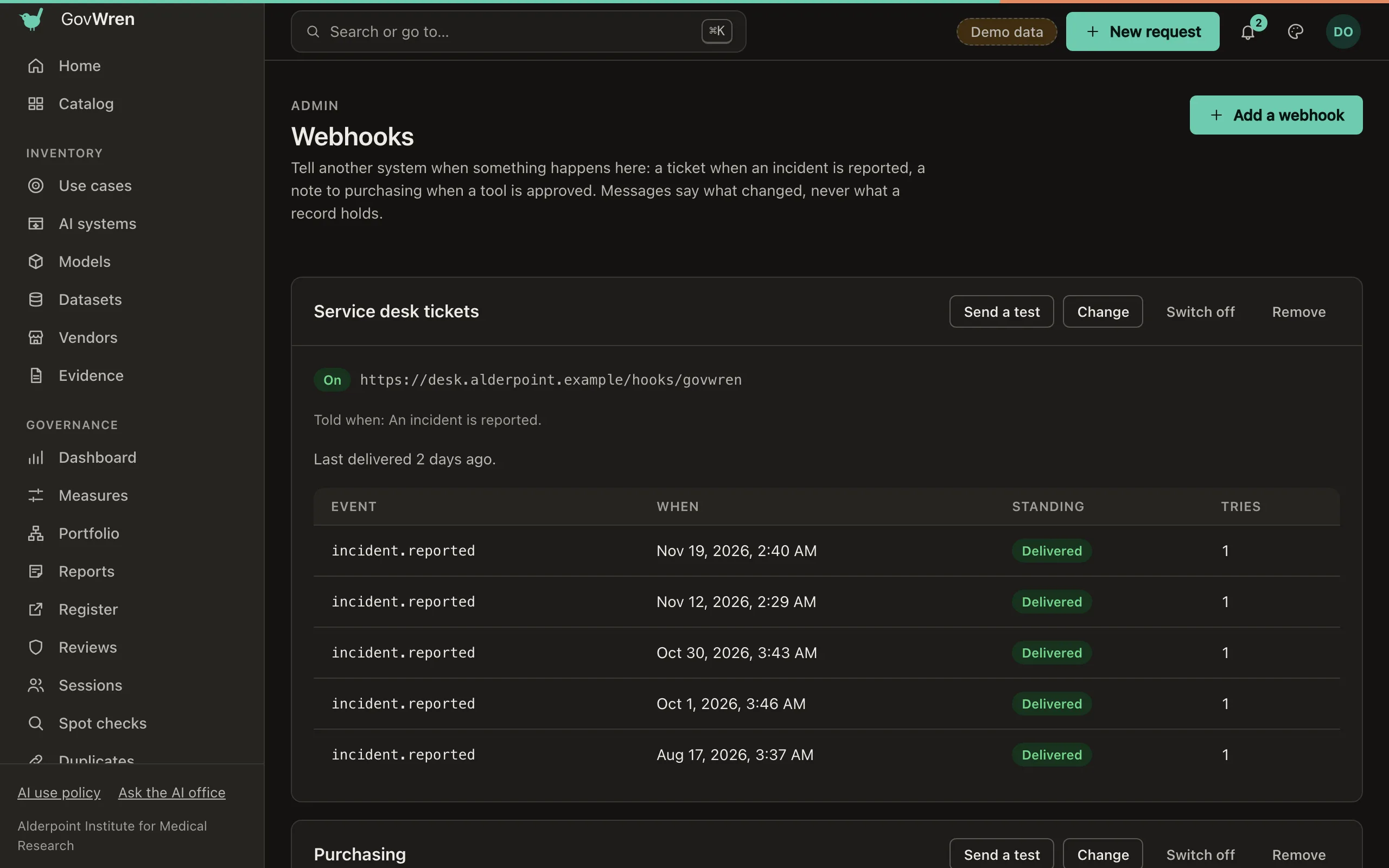
An unbroken record
History that cannot be quietly changed
Every change to every record is written to an append-only history, with who, when, and each value before and after. Entries are chained by hash, and one command proves that nothing was altered or removed.
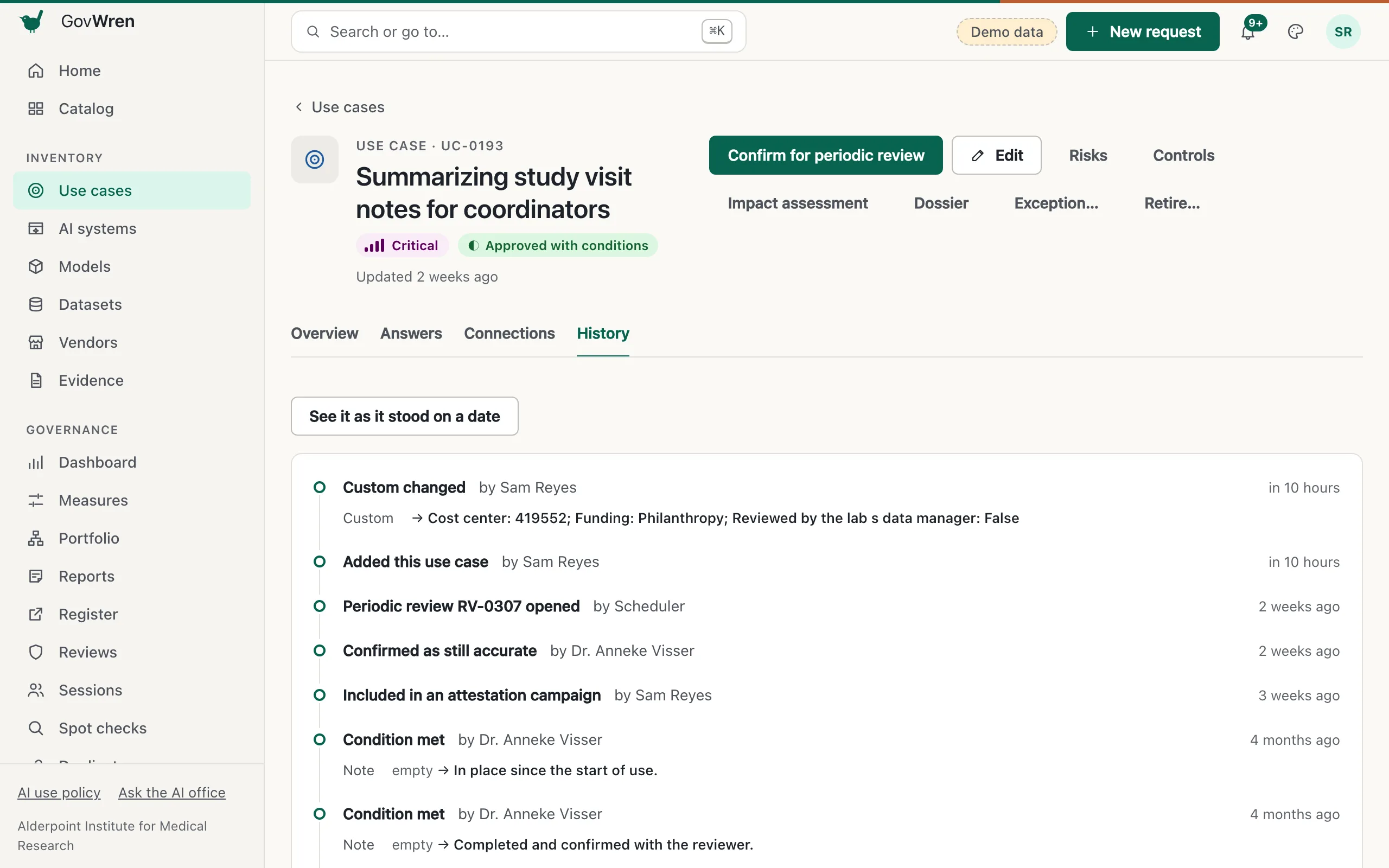
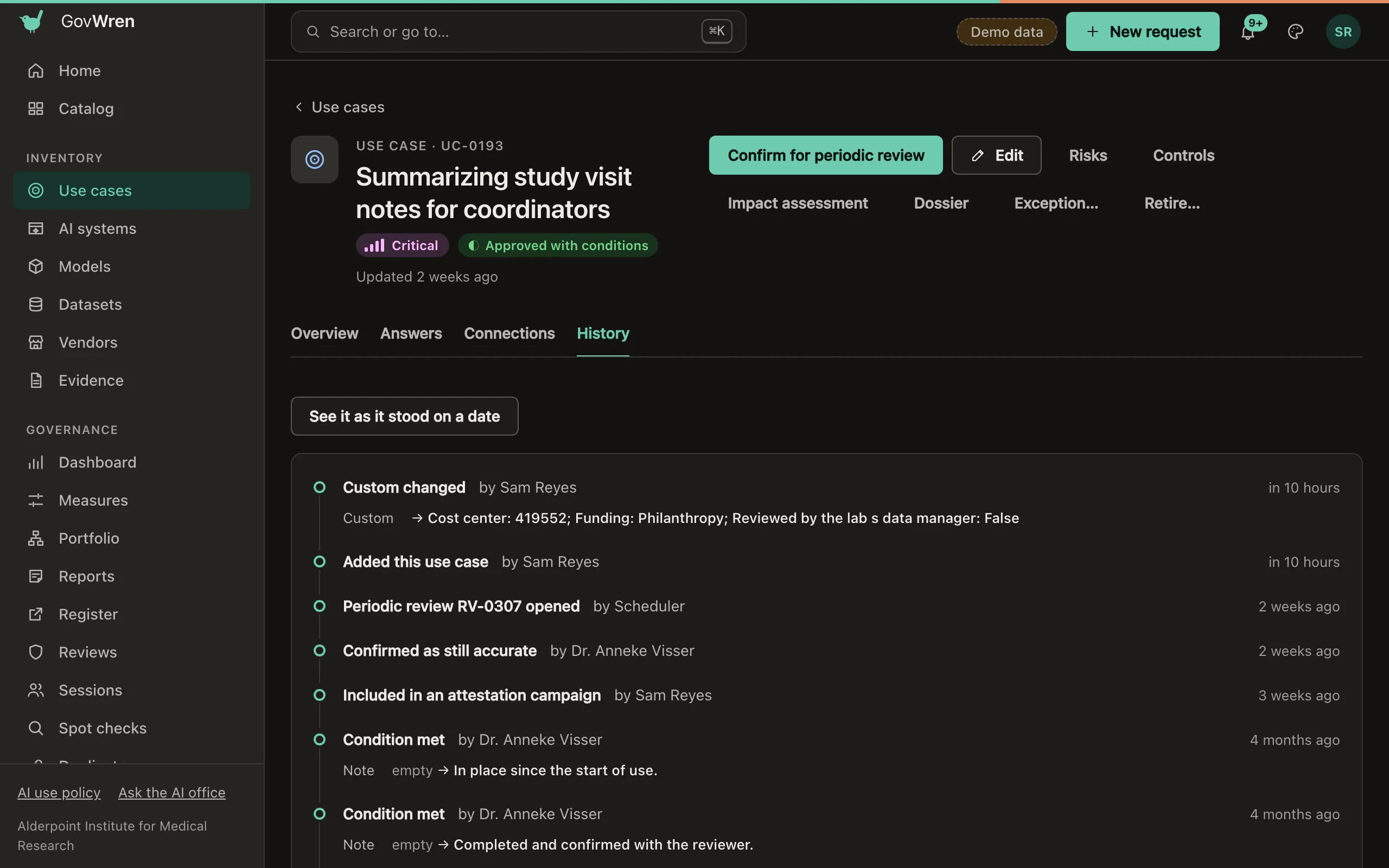
Your sign-in
Single sign-on with Microsoft Entra ID or any OpenID Connect provider, with roles from its groups. Single sign-on →
Your server
SQLite on a laptop or PostgreSQL in production, one process, and a data home you can back up as a whole. Configuration →
Your brand
Your name, logo, and accent color, three palettes, light and dark, with contrast checked as you choose. Or your brand exactly, every color and typeface, from the configuration file. Make it yours →
Checked
Every screen audited for accessibility in every palette, by day and after dark, and every route checked against one table of who may call it.
Try it in a minute
GovWren needs uv, which provides Python 3.12 or newer. The demo builds an invented medical research institute with thirty months of history: 66 units, about 260 people, 60 models, 70 datasets, and 300 use cases with their reviews, decisions, and evidence.
git clone https://github.com/robert-mcdermott/govwren.git
cd govwren
uv sync
uv run govwren demo
uv run govwren --config demo/govwren.toml serve
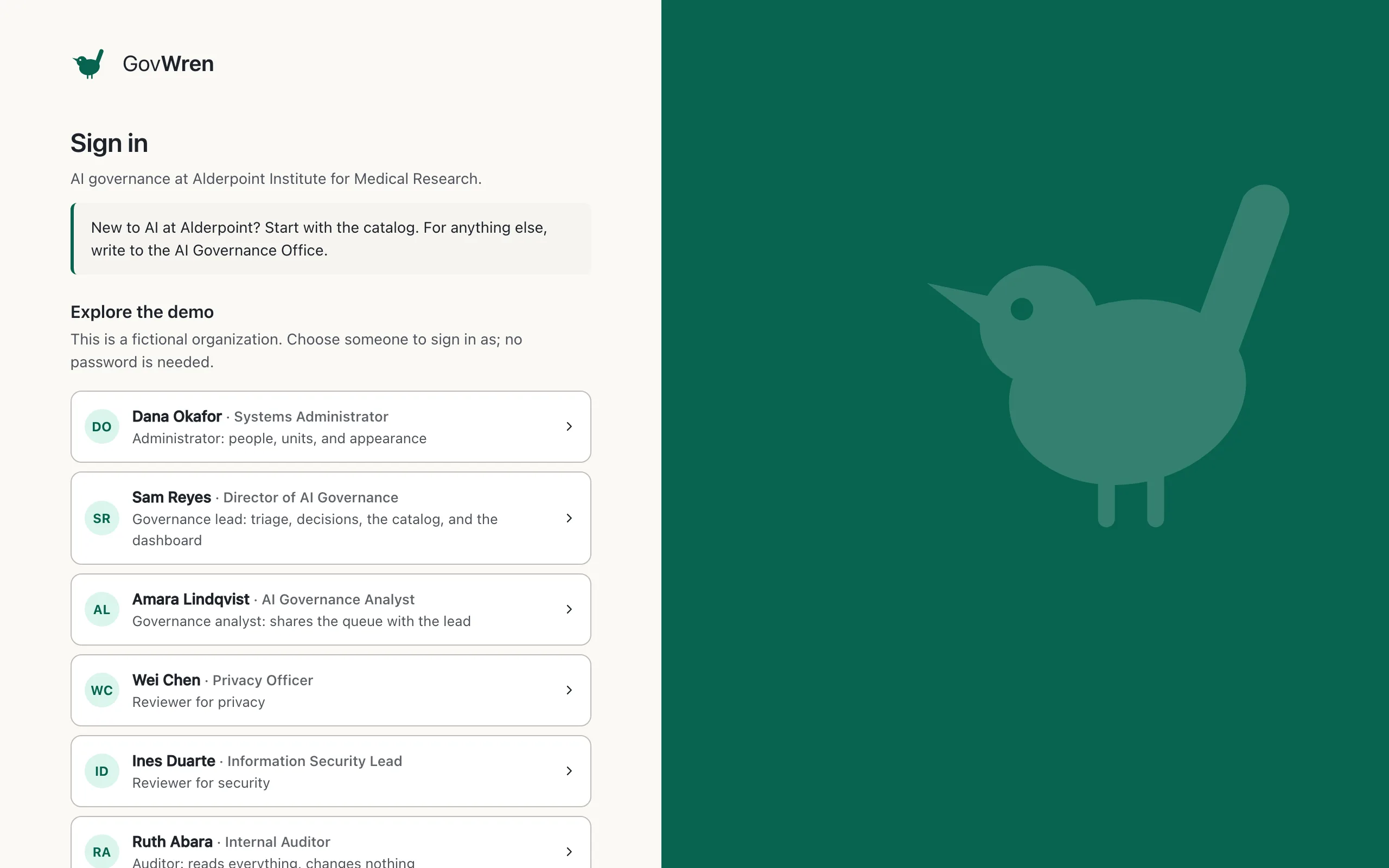
Then open http://127.0.0.1:8010 and choose who to sign in as. To set GovWren up for your own organization, start with Getting started.