
Lineage trees
B cells → Lineages builds family/locus trees from saved germlines and keeps topology ties, ancestral ambiguity and source identity visible.
Build from a saved germline result
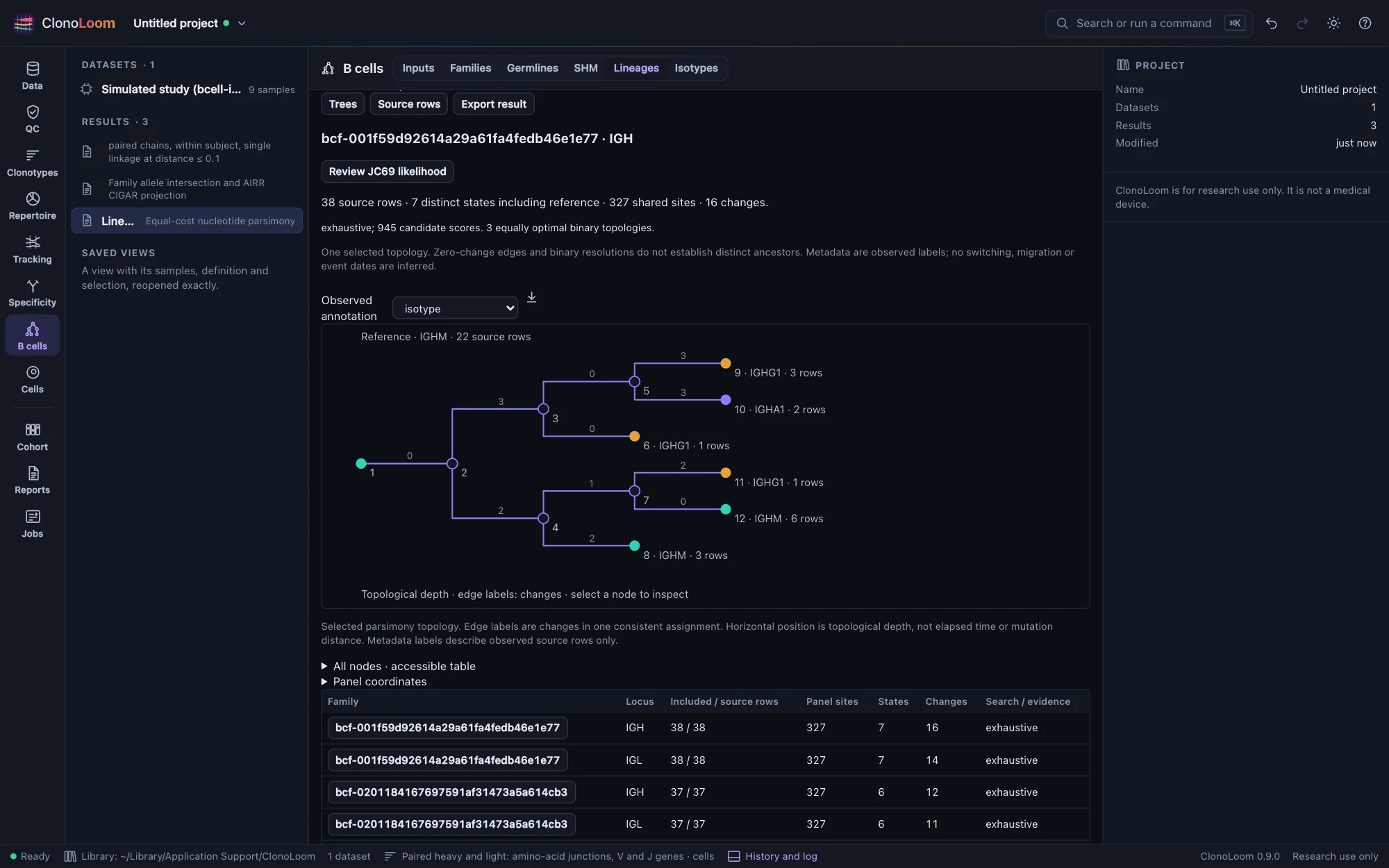
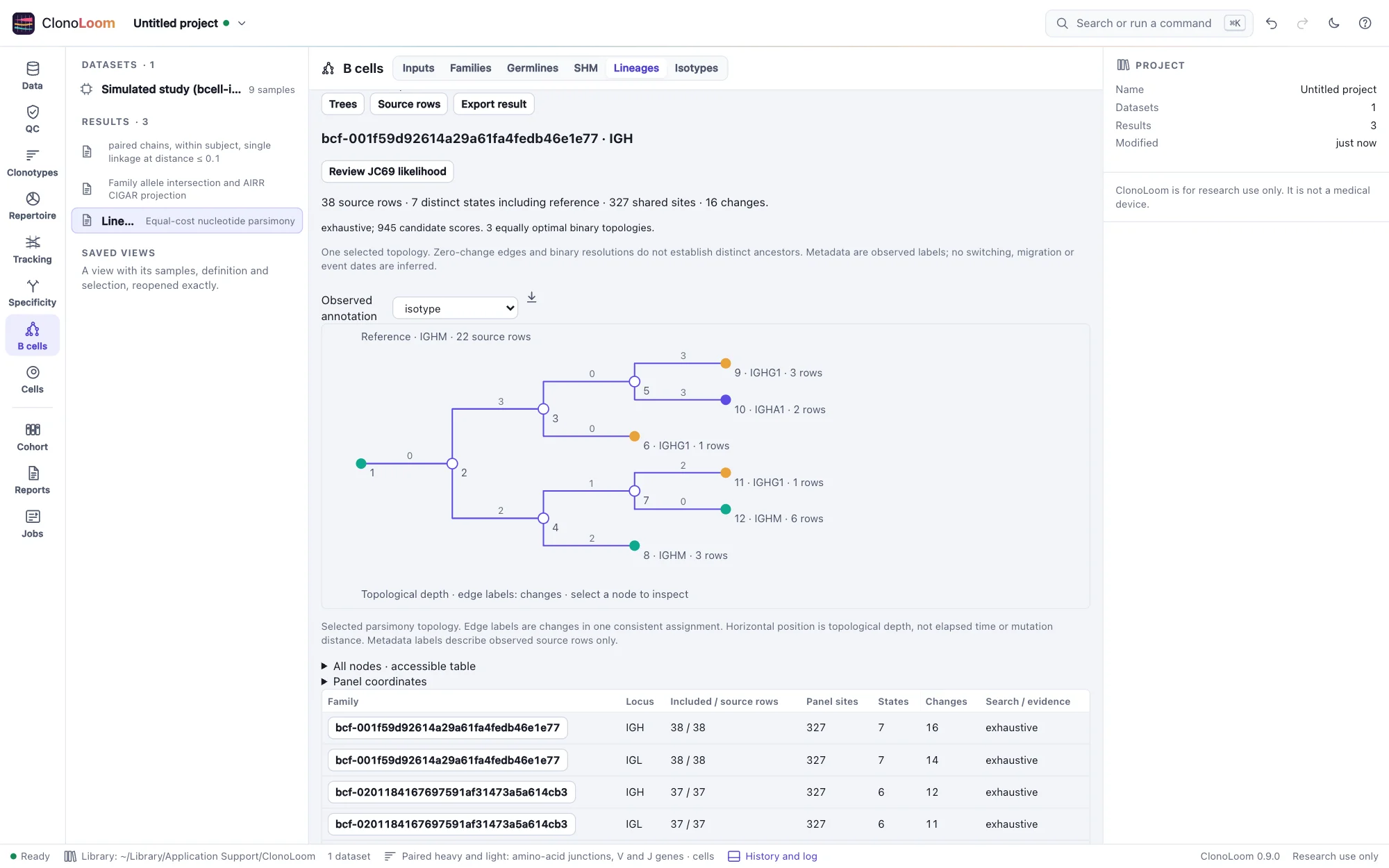
Save a Germlines result, open B cells → Lineages, choose that parent and select Build lineage trees. Family membership and reference choice come from the checksum-verified parent. Sample timepoint and tissue annotations are pinned when the result is computed. The artificial immunization guide includes this step.
A shared reference-coordinate panel
Each family and locus has its own tree. Only V/J reference positions with paired A/C/G/T bases in every eligible source row are retained. D/N/P, gaps, ambiguity and uncovered positions are omitted. The panel map records the retained reference coordinates. Sparse coverage in one row can shorten the panel; no shared positions means an explicit exclusion.
Identical panel states collapse, including observations matching the reference root, while every original source row and its annotations remain available. Sequences can agree on this panel while differing outside it. Read counts and cell abundance do not weight the tree search. The reference root is an assumption; heavy and light trees are separate.
Exact and heuristic searches
Through eight distinct states including the reference, all binary topologies are scored by equal-cost nucleotide parsimony. For 9–64 states, three deterministic addition orders and strict-improvement nearest-neighbor interchange search for a good tree; the result is not a proven global optimum. The search is bounded at 50,000 candidate scores and 200 million estimated pattern-node work units. Larger groups or work refusals remain explicit exclusions, and budget termination is reported.
A deterministic tie rule selects one topology. Exact searches retain the number of equally optimal binary trees and each selected split's occurrence count among them. These counts are not bootstrap support or probabilities. Zero-change branches and binary resolutions do not establish distinct biological ancestors.
Inspect ancestors and observations
Select a family, then a node with a pointer or keyboard. The node shows one consistent minimum-change panel sequence and IUPAC symbols for all marginal optimal states conditional on the selected topology. Arbitrary combinations of those allowed states need not form an optimal joint assignment. These are concatenated shared V/J panels, not full rearranged ancestral sequences.
Choose isotype, timepoint, tissue or sample labels. Mixed and missing values stay explicit; inferred nodes have no observed traits. A node lists observed annotations and up to 50 source rows, each inspectable with source hash and line. Source rows pages through the complete membership. An accessible table exposes every node, and panel coordinates can be expanded.
Branch changes belong to the chosen assignment. The drawing uses topological depth, not elapsed time or mutation distance. No switching, migration, event date, selection or likelihood statistic is inferred. Context-dependent mutation, sequencing errors, alignment uncertainty and family-threshold uncertainty are not modeled.
Save and export
Saved results reopen with their original metadata and provenance. Editing sample annotations affects a new analysis, not a saved tree. Export result includes tree, node and source-member CSVs; chosen panel FASTA; Newick with stable node IDs and integer change lengths; full JSON with coordinate maps and conditional states; manifest and notice. Figure export supports SVG, PNG and PDF. Exporting the full result requires the source dataset to be open under the usual data-use terms.
JC69 likelihood review · ClonoLoom 0.9.0
Select a saved tree and choose Review JC69 likelihood → Fit JC69 likelihood. This explicit baseline fits the observed/reference panel independently of its parsimony topology. It retains constant sites and enumerates all binary topologies through seven distinct states, with three deterministic branch-length starts bounded at 0–3 substitutions/site. Larger or over-budget searches are refused without subsampling. Exhaustive enumeration does not prove a global branch-length optimum.
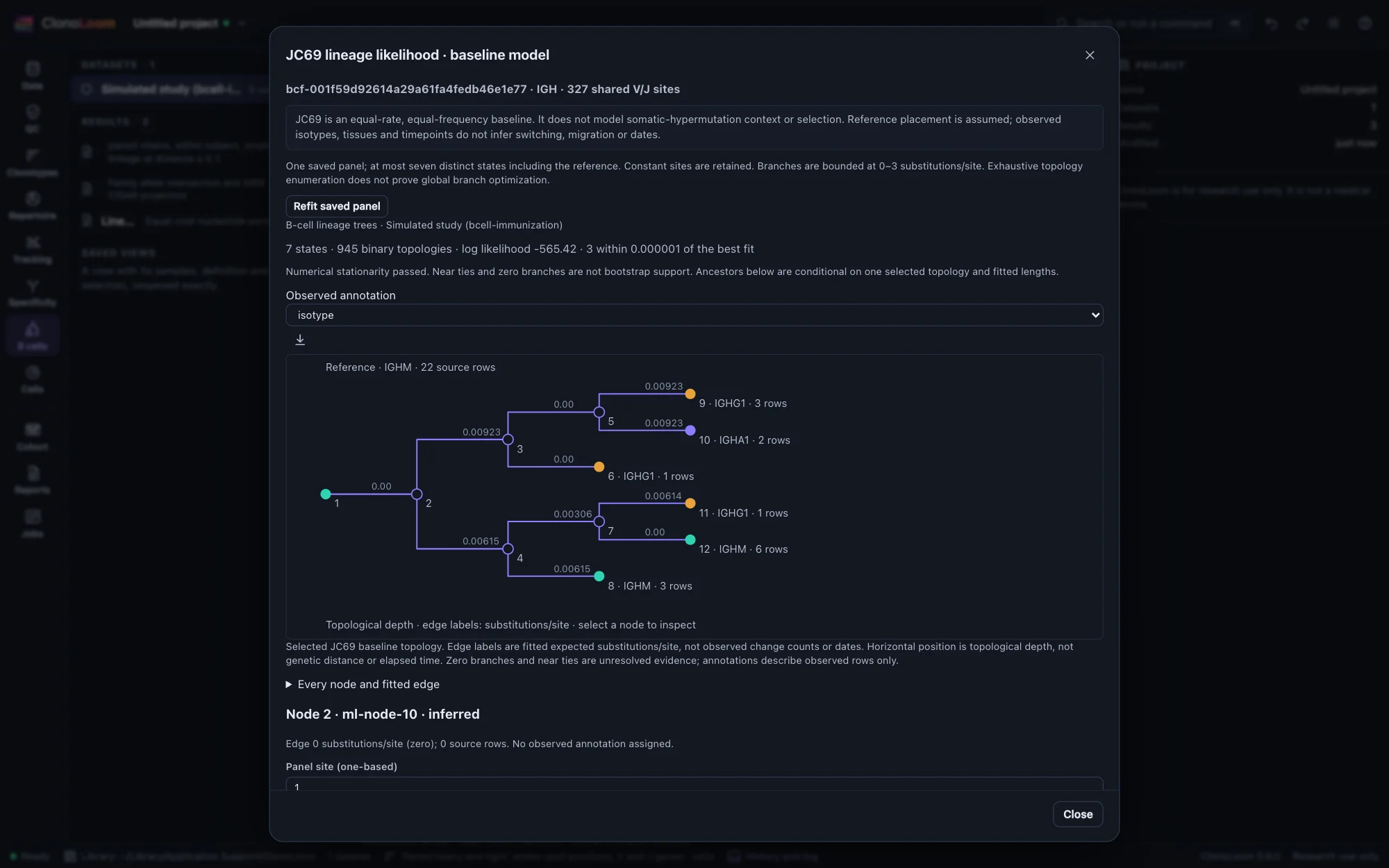
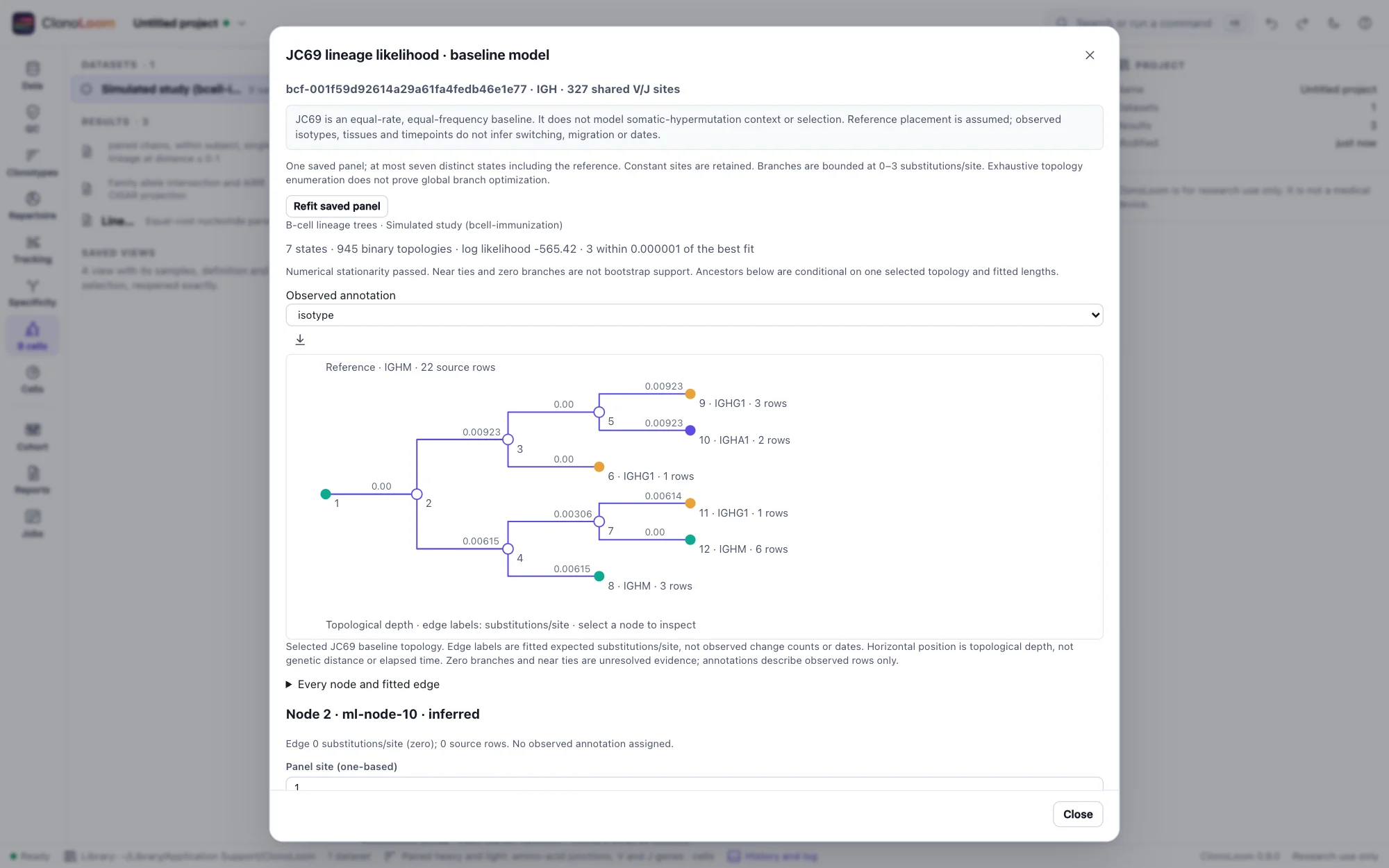
Select a node and panel position to inspect conditional A/C/G/T probabilities. They condition on one selected tree, fitted lengths and fixed reference, omitting topology, parameter and reference uncertainty. Marginal modes are not a joint ancestral sequence. The reversible model cannot infer the root; reference placement is assumed. This equal-rate baseline does not model SHM context, selection, affinity, migration or dates. Near ties and zero branches are not bootstrap support.
Save exact likelihood evidence downloads native JSON with original parent bytes/hash, all topology/start diagnostics, complete probabilities and provider notice. Restricted sources require explicit permission acknowledgment. Reviews expire after 30 minutes or cache eviction. These records remain separate from project artifacts and scientific replay. The full likelihood contract records bounds, tolerances, evidence and validation scope.
The model follows Jukes & Cantor (1969), with likelihood pruning following Felsenstein (1981). Independent direct ancestral-state enumeration and numerical optimization check the implementation; numerical agreement does not validate model adequacy for biological repertoires.
Methods and independent checks
Parsimony scoring follows Fitch (1971) and ancestral state costs follow Sankoff (1975). Panel selection, bounded search and tie policies are ClonoLoom choices. Hoehn et al. (2022) provides context for distinguishing observed traits from inferred transitions; its switching and migration statistics are not implemented here.
An independent exhaustive calculation agrees for all 72 default artificial family/locus trees, including minimum scores and optimal-tree counts: 1,093 changes in total, with ties in 71 searches. This validates the objective and bookkeeping, not recovery of the known generating topology or biological accuracy on real repertoires.