Evidence certificates
Keep a result's recorded evidence, then check that its bytes agree. Integrity and scientific reproducibility are separate questions.
ClonoLoom 0.8.0: integrity certificates currently support cohort feature tables, group comparisons, replicated count models, batch QC and motif screens. Choose integrity checking or exact replay from captured evidence. See the headless workflow support matrix for exact boundaries.
Preserve a saved result
Open Reports, choose a supported saved result and select Inspect certificate. The inventory names every saved file and its SHA-256. Keep the certificate fingerprint separately if you need to recognize that exact record later. Select Export integrity certificate to download its .certificate.clz archive.
The archive retains the exact saved manifest, recipe and result bytes, provider notice and interpretation limits. Original source files and separate parent artifacts are not bundled. Captured evidence can nevertheless contain raw counts, sequences, subject identifiers and paths; this is not a de-identified export. Provider terms still apply after the original dataset is closed.
Check an archive
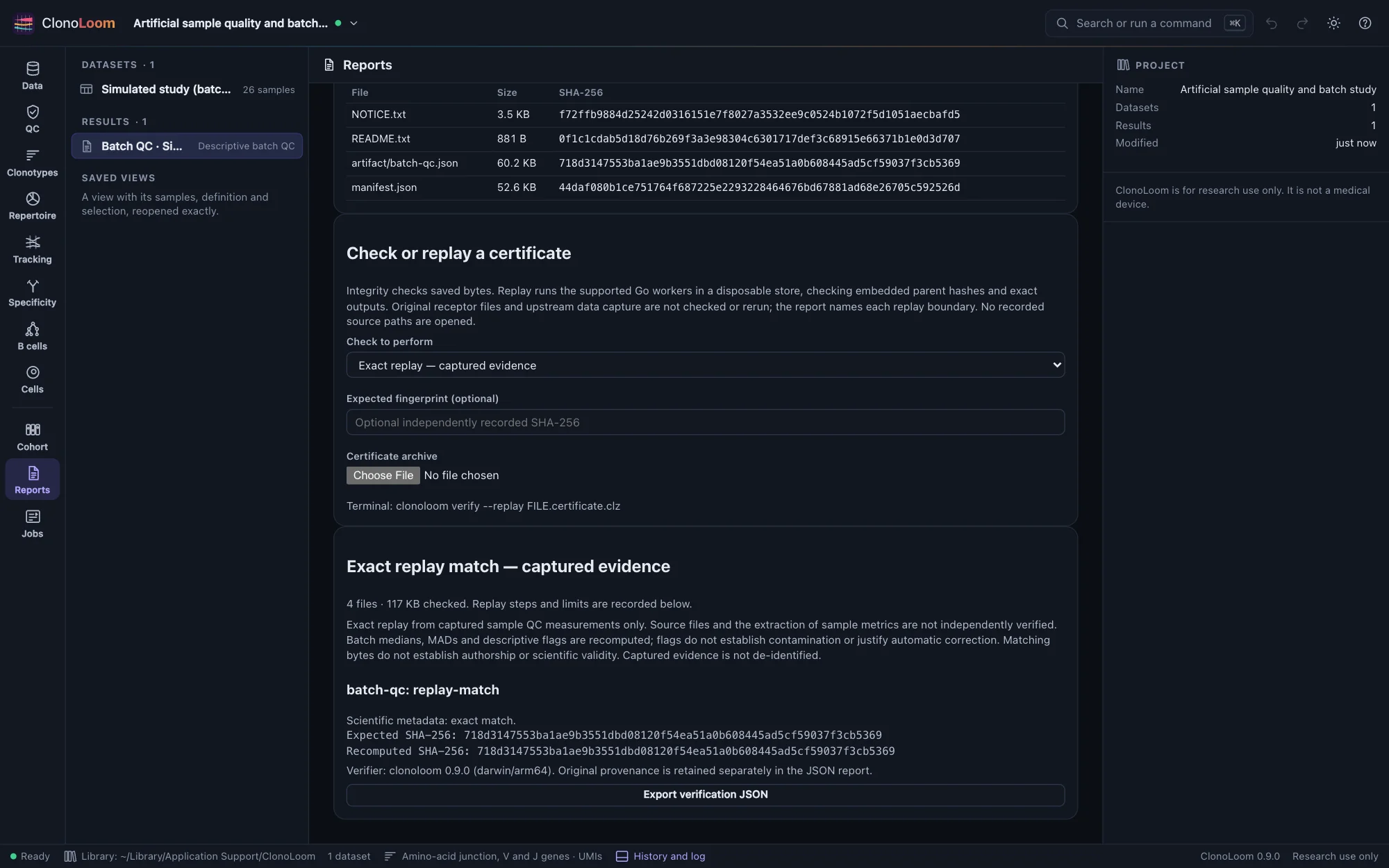
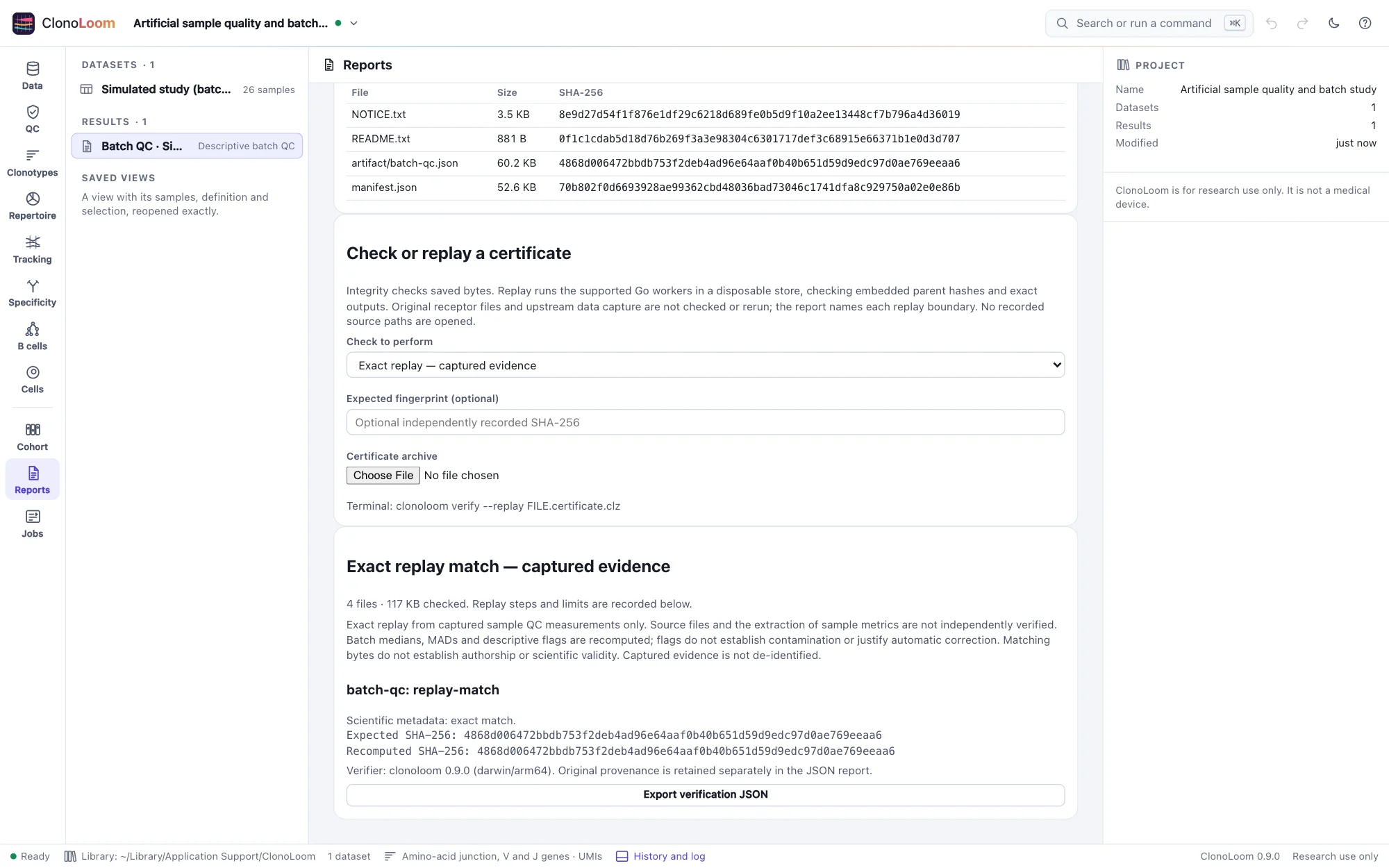
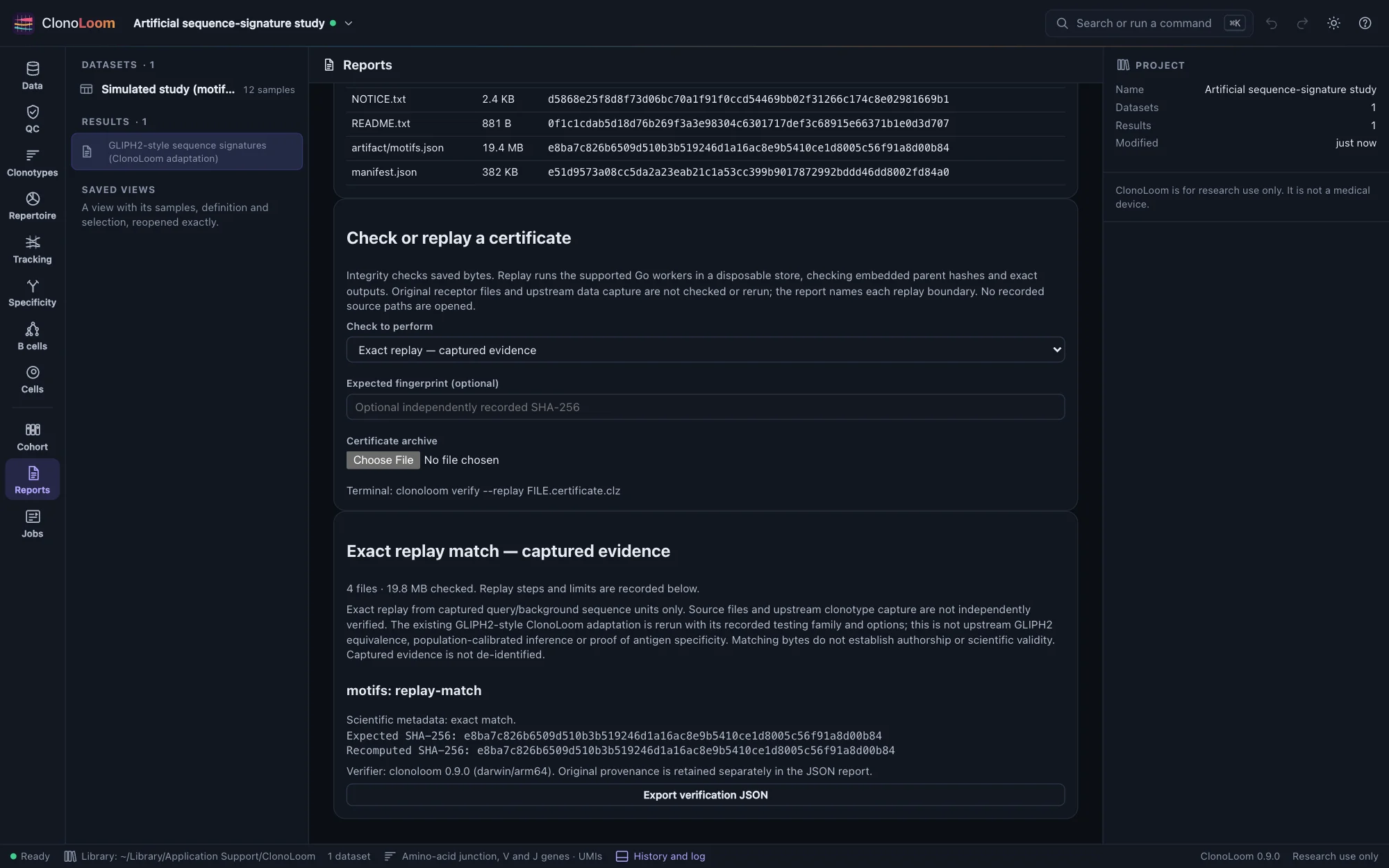
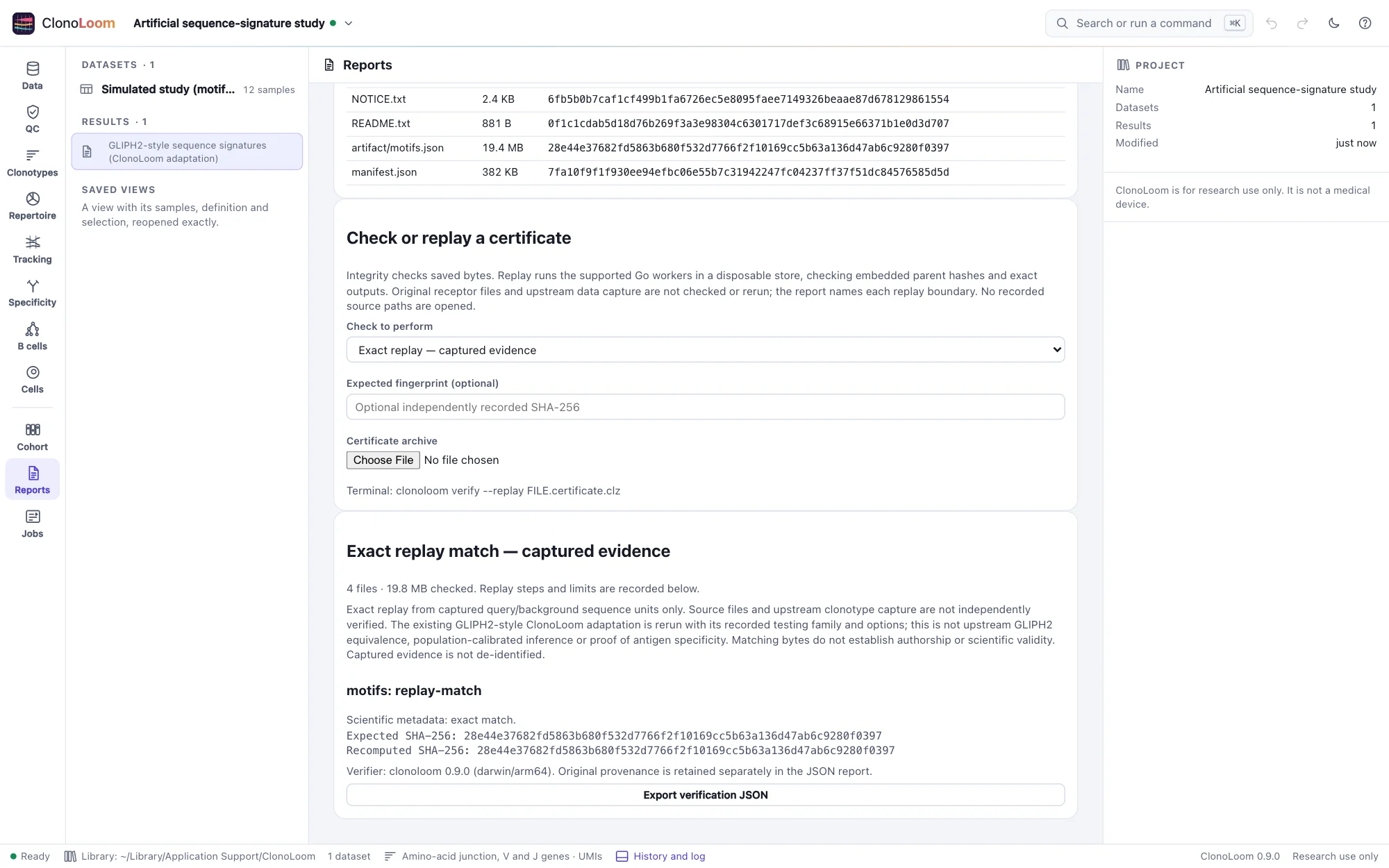
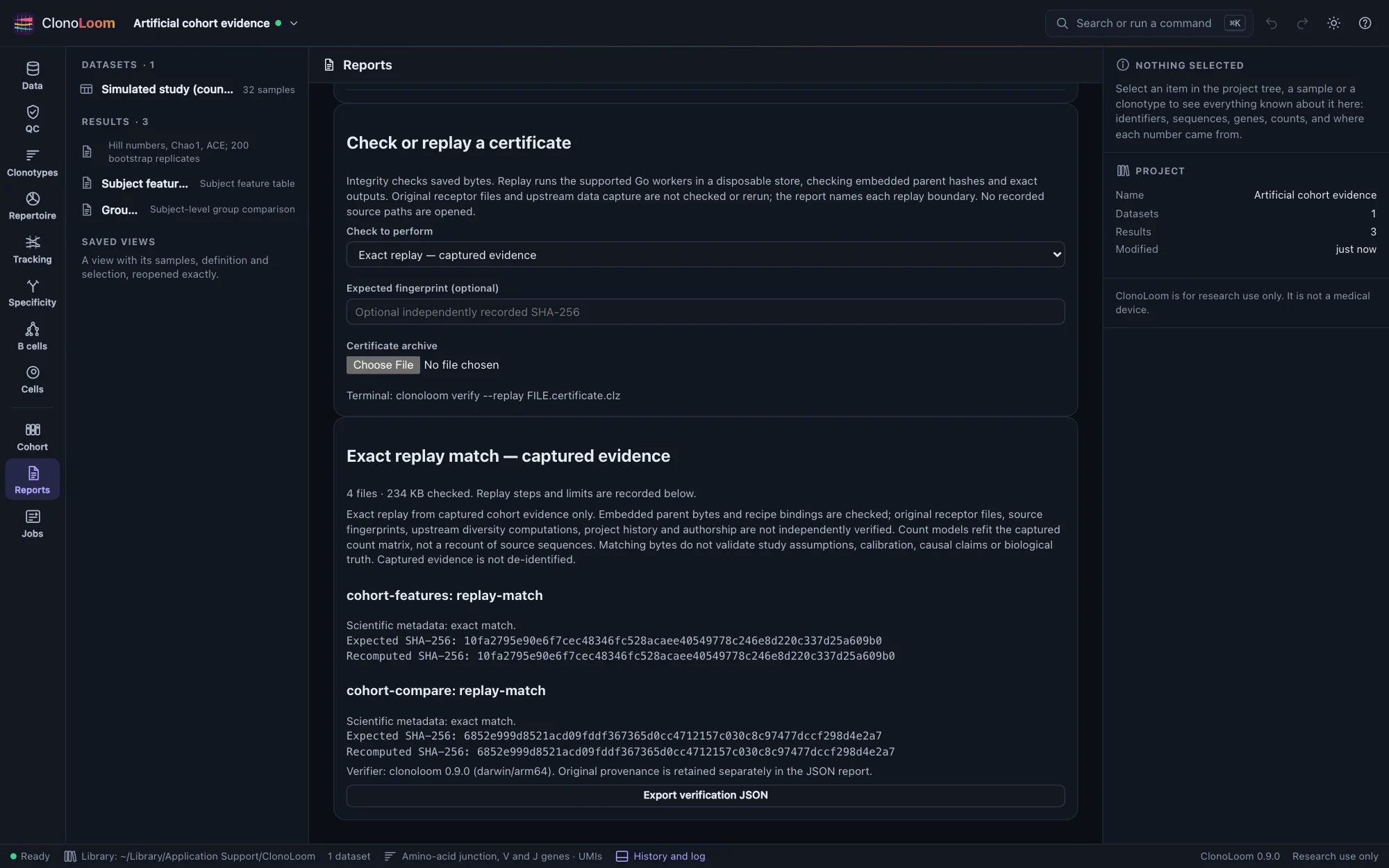
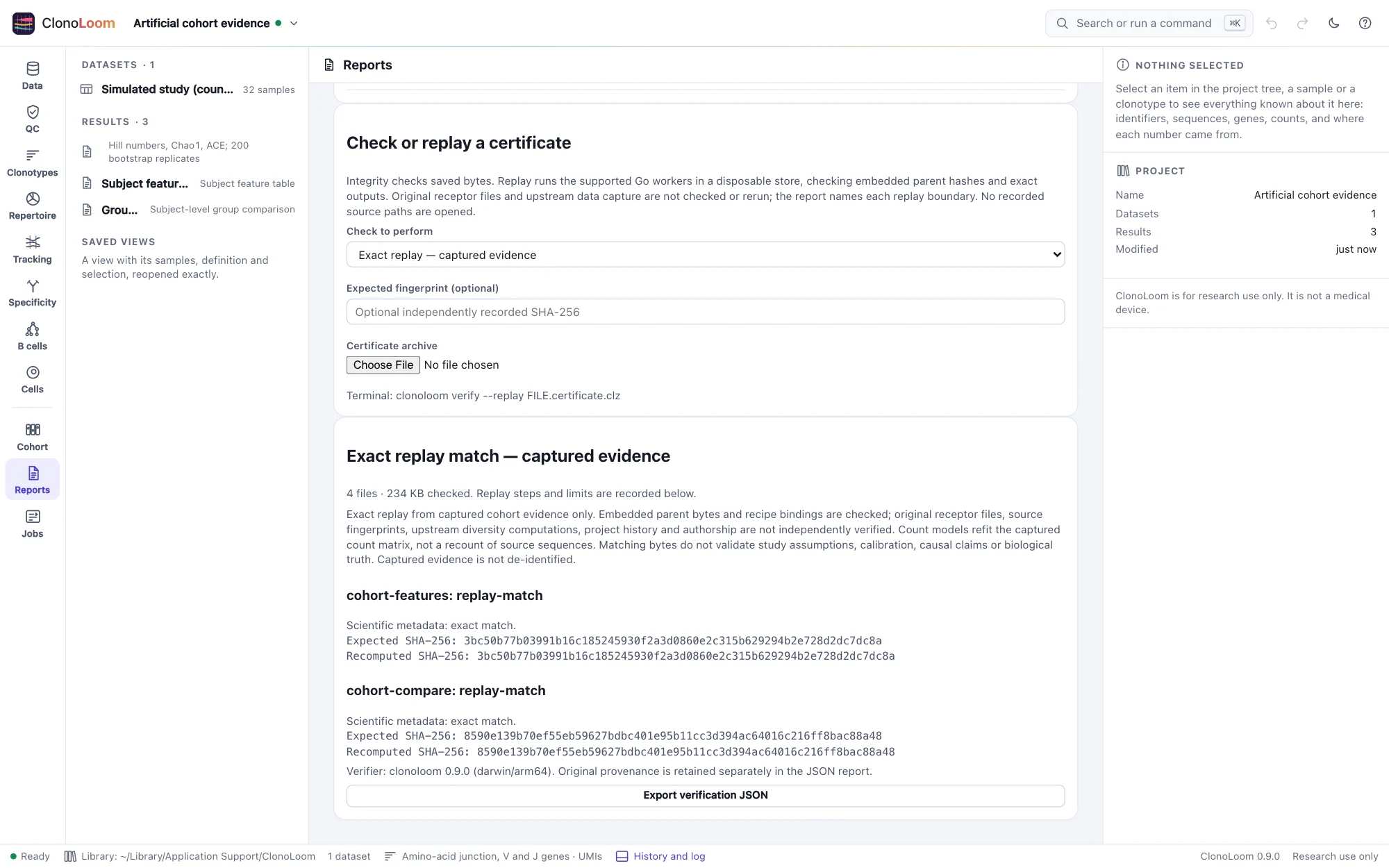
Under Check or replay a certificate, select Integrity only or Exact replay, optionally enter the independently recorded fingerprint, then choose the archive. The local Go host checks it without opening recorded source paths. Replay runs only the supported Go workers in a disposable store. Export the verification JSON to retain the outcome; use Cancel verification to stop.
clonoloom verify --integrity result.certificate.clz
clonoloom verify --replay --expect SHA256 --report replay.json result.certificate.clz
The terminal command needs no browser, running application or network. Replace SHA256 with the separately recorded fingerprint. The report path must be new. Exit 0 means the requested check matched; 1 means invalid or differing evidence; 2 means unavailable replay or an operational failure. Choose exactly one mode; a bare command never silently substitutes integrity for replay.
Read the verdict precisely
Integrity match — not recomputed means the bytes agree with the saved inventory. No statistic has been recomputed, original source or separate parent checked, authorship authenticated, or scientific assumption validated. A digest is not a signature: anyone who can replace the contents and checksums can make a new internally consistent record. Pinning a separately retained fingerprint detects a different record.
Exact replay match — captured evidence means every supported worker output byte and scientific metadata matched. Feature tables are rebuilt from embedded diversity measurements; comparison tests and count models are rerun, including embedded feature parents. Count models use captured counts. Original receptor files and upstream diversity computations are not verified or rerun. Matching calculations do not establish model calibration, replication with new data or biological truth.
Replay differs and Replay unavailable are separate outcomes. Unknown methods, incomplete evidence and failed worker checks never become a match. The JSON report retains original provenance separately from the current verifier and lists exact expected/recomputed digests for completed steps. New job IDs and timestamps do not replace original provenance.
The original subject units, denominators, missing values, fitted results, conditional intervals and method references remain in the saved evidence without numeric conversion. Their interpretation and limitations remain those of the original analysis. See the complete cohort study and format, bounds and command reference.
Batch QC and motif evidence
Batch QC replay recomputes descriptive medians, MADs and flags from captured sample QC measurements. It does not repeat source parsing or diagnose contamination. Motif replay recomputes the existing GLIPH2-style ClonoLoom adaptation from captured sequence units, with the recorded testing family. It does not establish upstream GLIPH2 equivalence or antigen specificity. Each report states its own captured-input scope.