
Overlap
The Overlap part measures how much every pair of samples shares, each value with its 95% interval, summarizes the pairs of one subject and of two, and counts the clonotypes found in more than one subject.
The measures
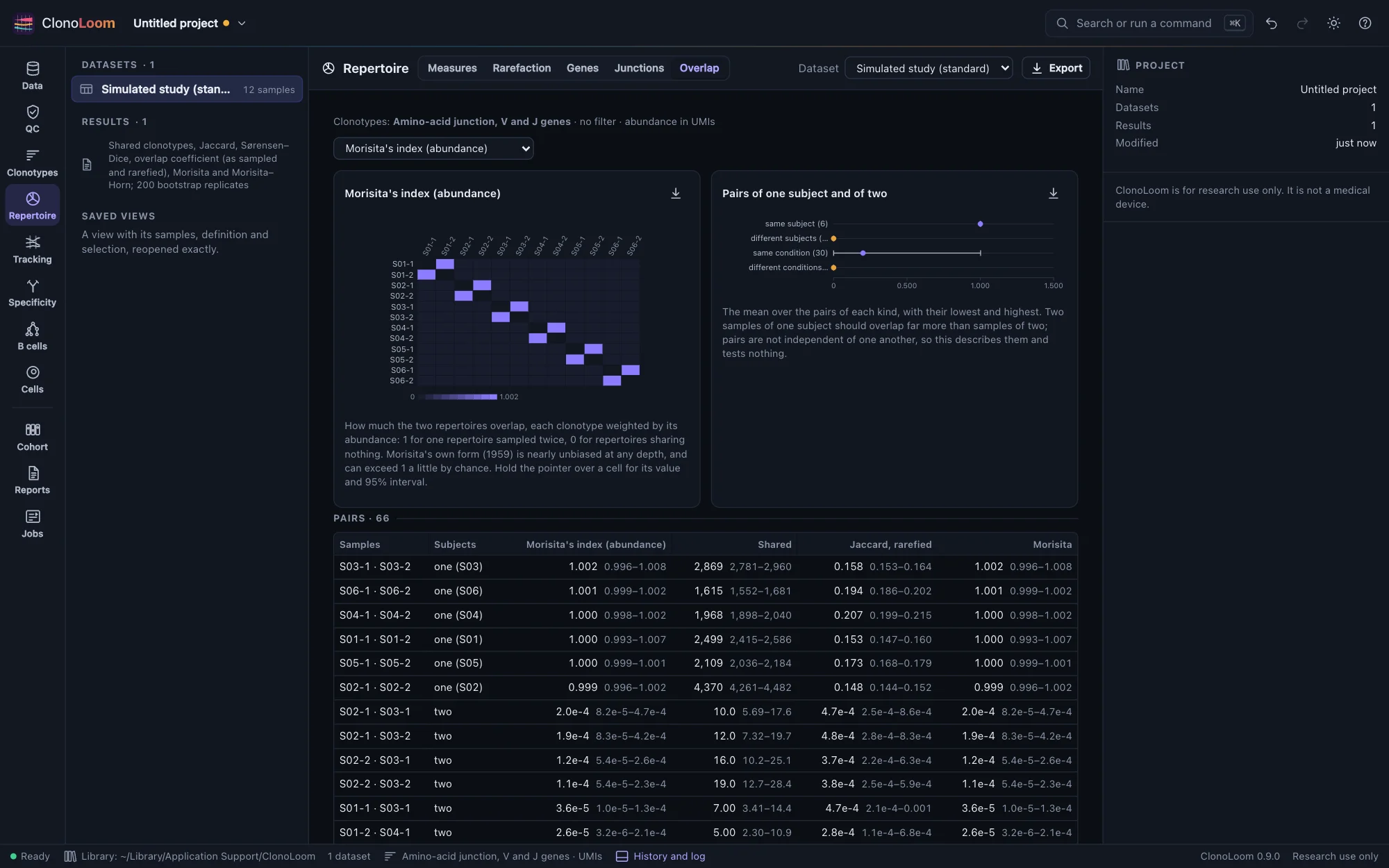
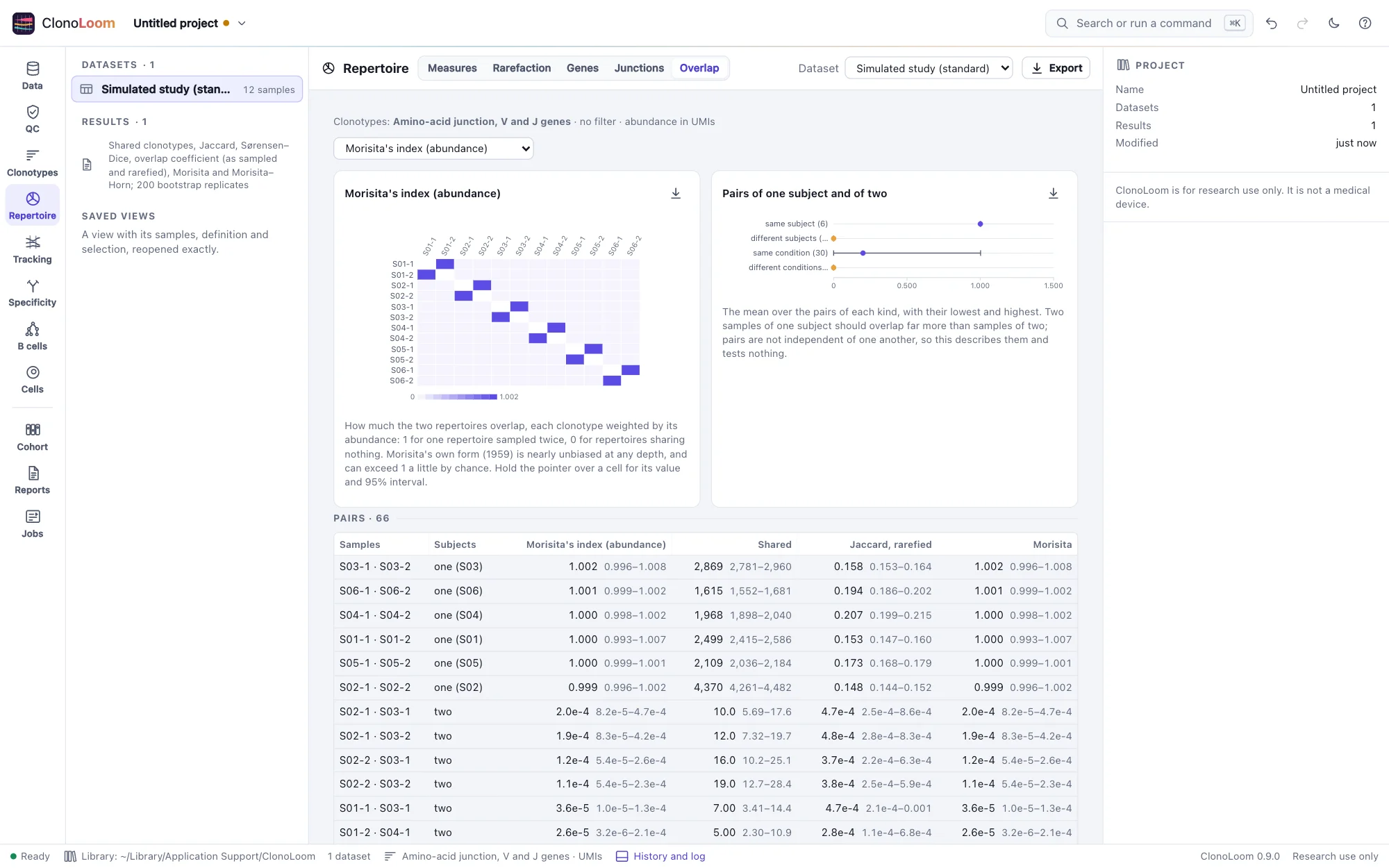
Open Repertoire › Overlap and choose Measure overlap; the result is kept with the project.
- Morisita's index weighs each clonotype by its abundance: 1 for one repertoire sampled twice, 0 for repertoires that share nothing, at any depth. The Morisita–Horn index, which immunarch and vegan give, is offered too, but it reads two samples of one repertoire below 1 when they are shallow.
- Jaccard's index, Sørensen–Dice's and the overlap coefficient count clonotypes seen, and grow with depth: take them rarefied, as expected with both samples brought down to the smallest sample's size (computed exactly, not by drawing one subsample).
- The clonotypes shared, as sampled and rarefied, and each sample's share of its abundance in clonotypes the other holds too.
The intervals
Which clonotypes two samples share is itself a matter of chance: a rare clonotype of both repertoires may or may not turn up in both samples. The intervals come from a bootstrap of each sample's cells, widened for that chance (Horvitz and Thompson 1952), on the logarithmic scale. Without that widening, they held the expected shared clonotypes in only 64% of simulated pairs; with it, in 95.2%. A pair that shares nothing gets an interval from zero to what a count of none allows.
Pairs and public clonotypes
The pairs of one subject and of two (and of one condition and of two) are summarized by their mean, lowest and highest value, and every pair is listed. The public clonotypes, found in more than one subject, are counted by how many subjects hold them, and the most public listed. Subjects come from the samples' annotation (or their AIRR metadata): without them each sample counts as its own subject, so two samples of one person would look public, and the view says so.
Using the result
The heatmap and plots save as figures, Export writes every pair's measures and the public clonotypes as CSV, and the methods paragraph says what was measured, at what depth. Scripts use measure_overlap (Remote control).