
Clonotypes
A clonotype is whatever its definition says it is, so ClonoLoom makes you choose one and states it everywhere clonotypes are counted: above every table, in the status bar, in every figure's caption, every export's notice and the methods paragraph.
Definitions
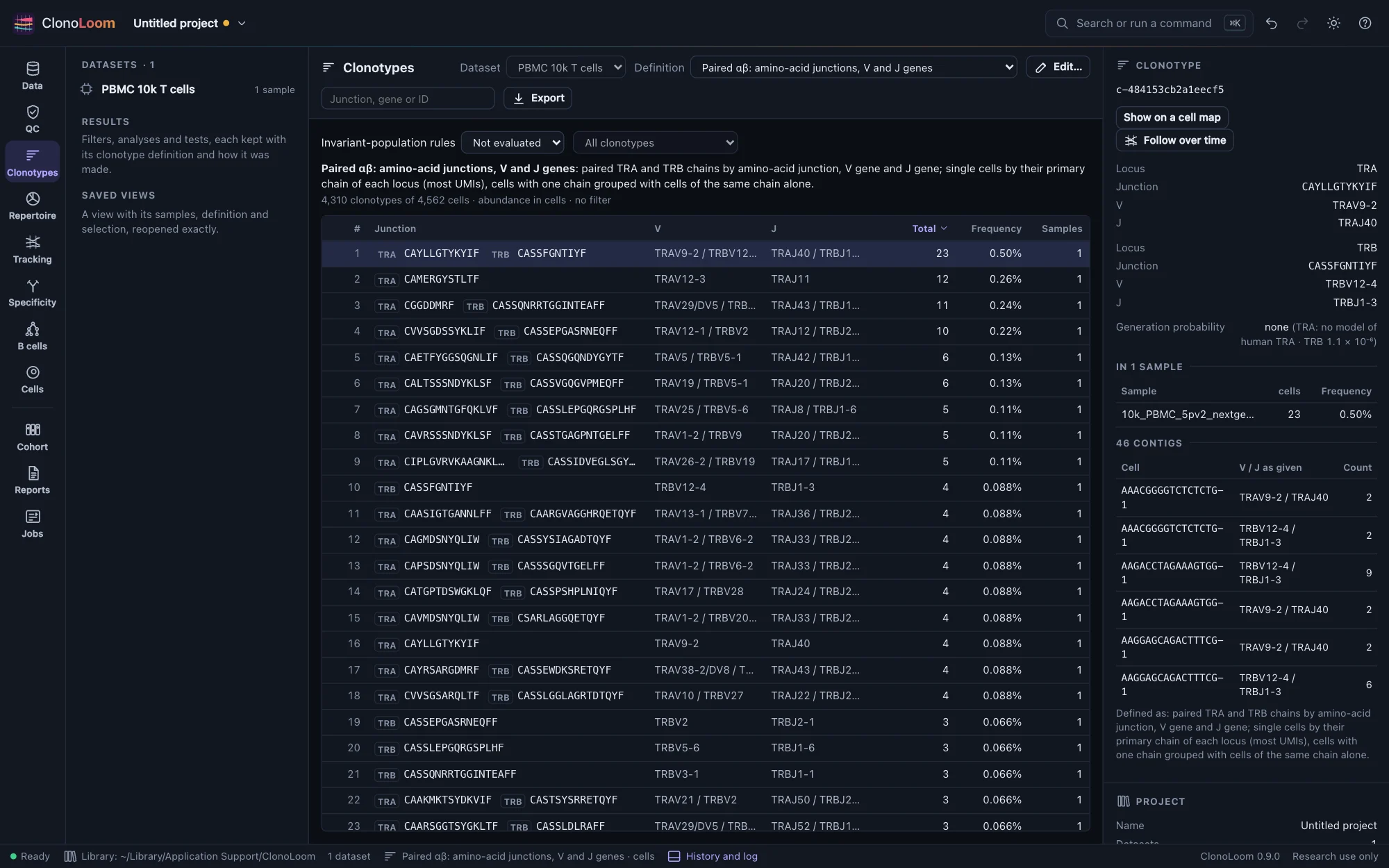
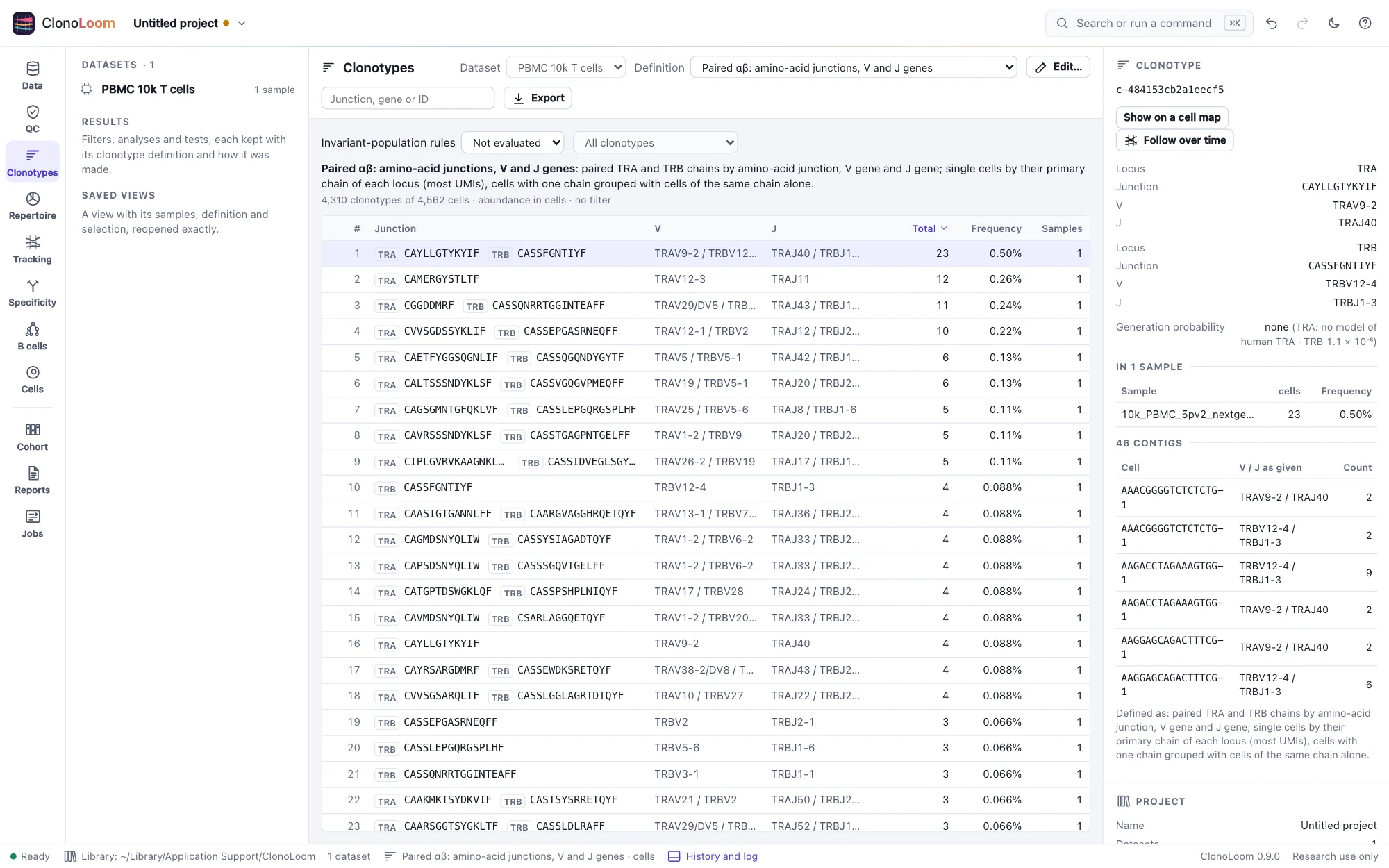
- Presets: the amino-acid junction with V and J genes (the default for bulk data); the nucleotide junction with V and J genes; the amino-acid junction alone; paired αβ chains, and paired heavy and light chains (the defaults for single cells); or the source's own clonotypes (Cell Ranger's, or an AIRR file's
clone_id). - Edit… to choose the junction (nucleotides or amino acids), V and J at allele, gene or family level or not at all, and which chains. For single cells, choose whether a cell's primary chain of each locus counts or every chain, and what to do with cells missing a chain. Save it under a name to use it for the project's other datasets.
A junction is the IMGT junction, from the conserved cysteine at position 104 to the phenylalanine or tryptophan at 118 (the CDR3 with its two anchors). A call that names several genes is kept as the set it names.
The table
Each clonotype has an ID made from the definition and its chains, the same in every run, and the definition has an ID of its own, made from its meaning rather than its name. Sort by any column, and search by junction, gene or ID: a million clonotypes are sorted and searched as they scroll. Choose a clonotype to see its chains, its abundance in each sample, and the contigs or rearrangements it is made of.
Exporting clonotypes
Export writes the clonotype table as CSV, one column of abundance per sample, or the rearrangements as an AIRR Rearrangement TSV with each one's clonotype as clone_id, each with a notice of where they came from (Exports).
Invariant populations
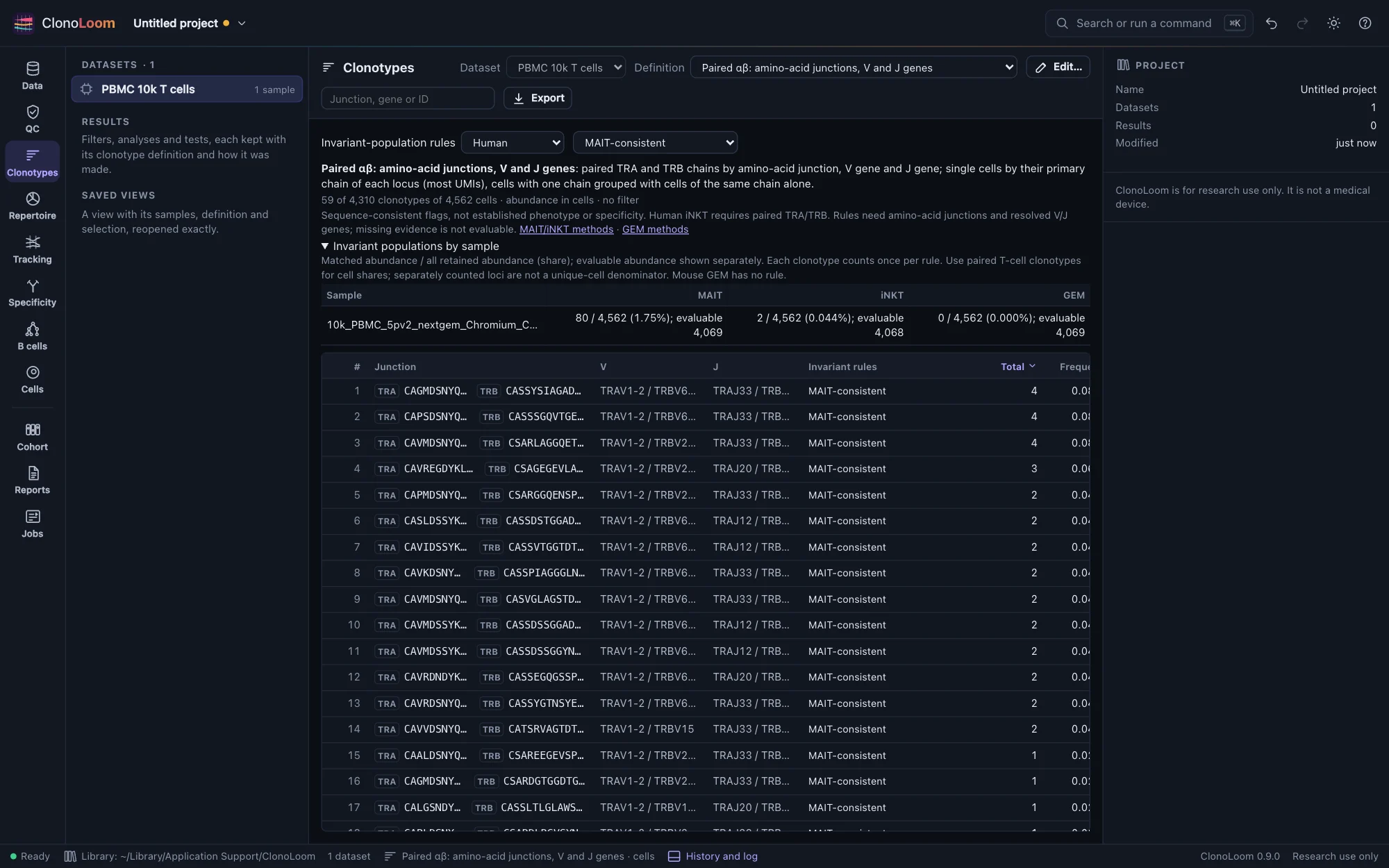
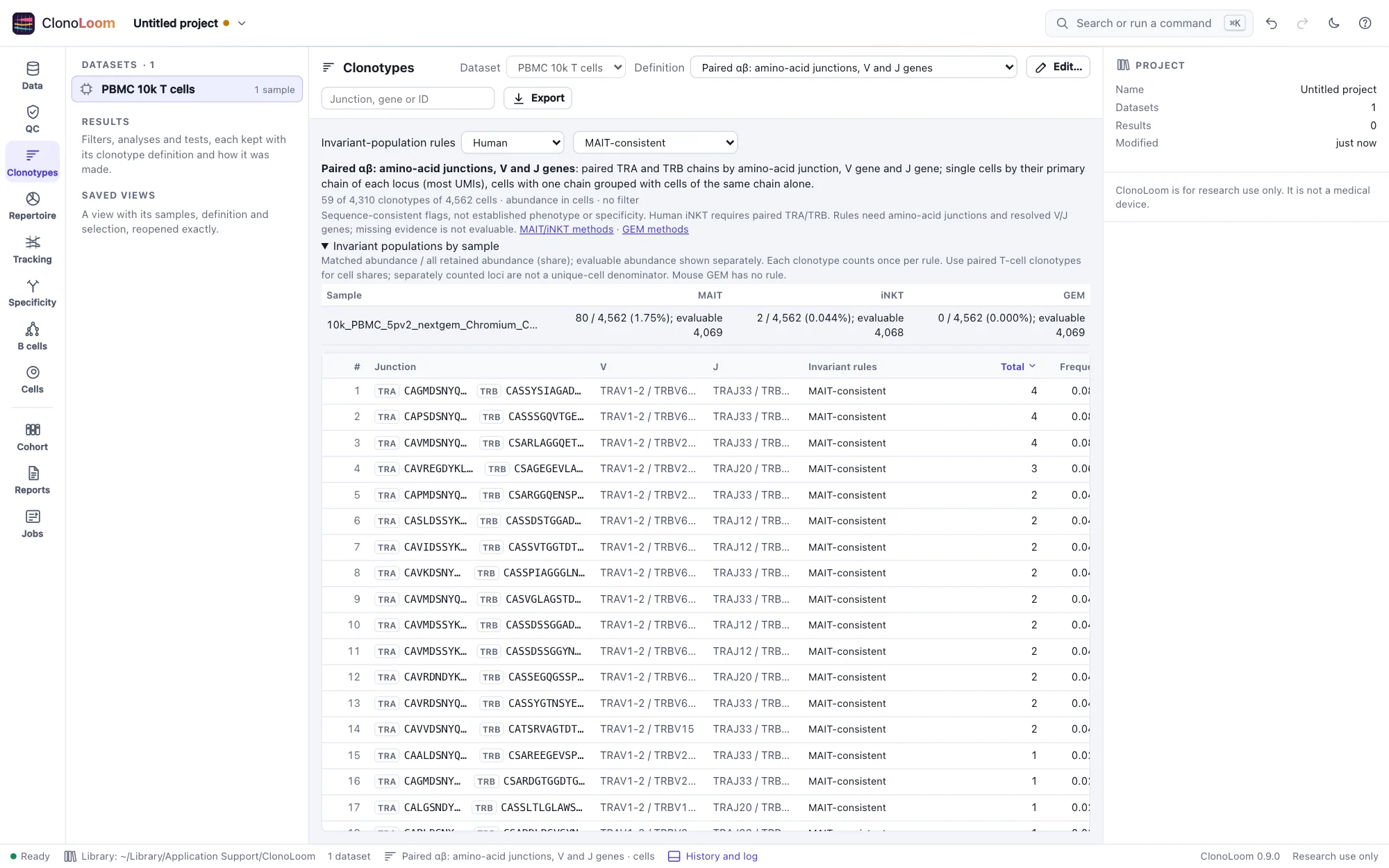
Choose Human or Mouse under Invariant-population rules. Species is not inferred from gene names; the choice is saved with the dataset. Filter to a population, inspect each rule’s status, or expand the per-sample counts. These flags describe sequence consistency, not established phenotype or antigen specificity.
| Population | Human rule | Mouse rule |
|---|---|---|
| MAIT | TRAV1-2; TRAJ33, TRAJ20 or TRAJ12; α junction length 12 | TRAV1; TRAJ33; α junction length 12 |
| iNKT | TRAV10; TRAJ18; α junction length 14–16; a paired TRBV25-1 (or TRBV25) chain | TRAV11 or TRAV11D; TRAJ18; α junction length 15 |
| GEM | TRAV1-2; TRAJ9; α junction motif CAV[RL].TGGFKTIF | No rule |
MAIT/iNKT follow Schattgen et al., CoNGA methods (2022); the human GEM motif follows Van Rhijn et al. (2014), building on the 2013 GEM receptors. Lengths include both IMGT junction anchors. The motif’s dot means one resolved amino acid, not an unknown X. GEM’s β-gene bias is not a required gene.
Only retained chains count. Rules require amino-acid junctions and gene or allele resolution. Missing or ambiguous required calls, vendor-only definitions and nucleotide or family definitions are not evaluable. Several alleles of one gene resolve to that gene; several different genes do not. A fully matching retained chain can establish sequence consistency even when another chain is incomplete. For human iNKT, an α-chain candidate without its β chain is not evaluable.
Each clonotype contributes once per rule and sample, even with several matching α chains. Shares use all retained abundance, including unevaluable receptors, with evaluable abundance reported separately. An empty sample or entirely unevaluable rule has no share. Bulk counts retain their unit; use paired T-cell definitions for cell shares, since counting loci separately is not a unique-cell denominator. Counts cover the full table under its definition and QC filter, independently of the search or population filter.
Clonotype CSV exports include all three statuses, species and rule version; invariant-samples.csv contains the sample totals, evaluable and matched abundance and shares, with sources in NOTICE. Reports cite the rules. Remote control’s flag_invariant takes an explicit species and optional population.