
Subjects and time points
Clonotypes are followed and tested within a subject, from one time to another. Before anything is tracked, ClonoLoom reads each sample's subject, time point and role from its annotation, orders each subject's samples in time, and says what it cannot place.
Annotate the samples
In the Data view's samples table, give each sample:
- Subject: the person (or animal) the sample comes from. Every comparison over time is within a subject, and between groups the subject is the unit.
- Time point: when the sample was taken, as days, weeks, months or years from the subject's reference event: an infusion, a transplant, a vaccination, the start of treatment (day 0).
- Reference: for a subject's reference sample, what it is: infusion product, donor, baseline. Tracking can follow its clonotypes, and attribution measures each sample against it. A tissue such as infusion product, apheresis, graft or donor marks the sample as its subject's reference too.
Suggest from file names reads subjects and time points from the parts of the samples' names (P07_d28), and Fill from metadata from AIRR Repertoire metadata (subject_id, collection_time_point_relative with its unit and reference event). Scripts set them with annotate_samples (Remote control).
Time points ClonoLoom reads
| Written | Read as |
|---|---|
day 28, d28, D+28, 28d, 28 days | day 28 |
day -7, D-7 | 7 days before the event |
week 4, wk4, W4, 4 weeks | day 28 (labeled week 4) |
month 3, M3, 3mo | day 91.3 (a month is a twelfth of 365.25 days) |
year 1, 1y | day 365.25 |
6h, 24 hours | day 0.25, day 1 |
14 day (vaccination), 28 days post-infusion | day 14, day 28, with the event named |
21 | day 21 (a number alone is days, and the check says so) |
baseline, pre, pre-infusion, screening | before the event, first |
post, post-vaccination, follow-up | after the event, its day unknown: last |
T1, tp2, visit 3 | a numbered visit, ordered by its number |
Samples at the same time (day 28 and week 4 are) are grouped as repeated samples within one subject. Their technical or biological relationship must be established from the study design; they do not add independent subjects. Only scientifically justified stable replicates should be used to estimate expansion variance. Cohort design checks require explicit handling of these repeated observations.
The Subjects part
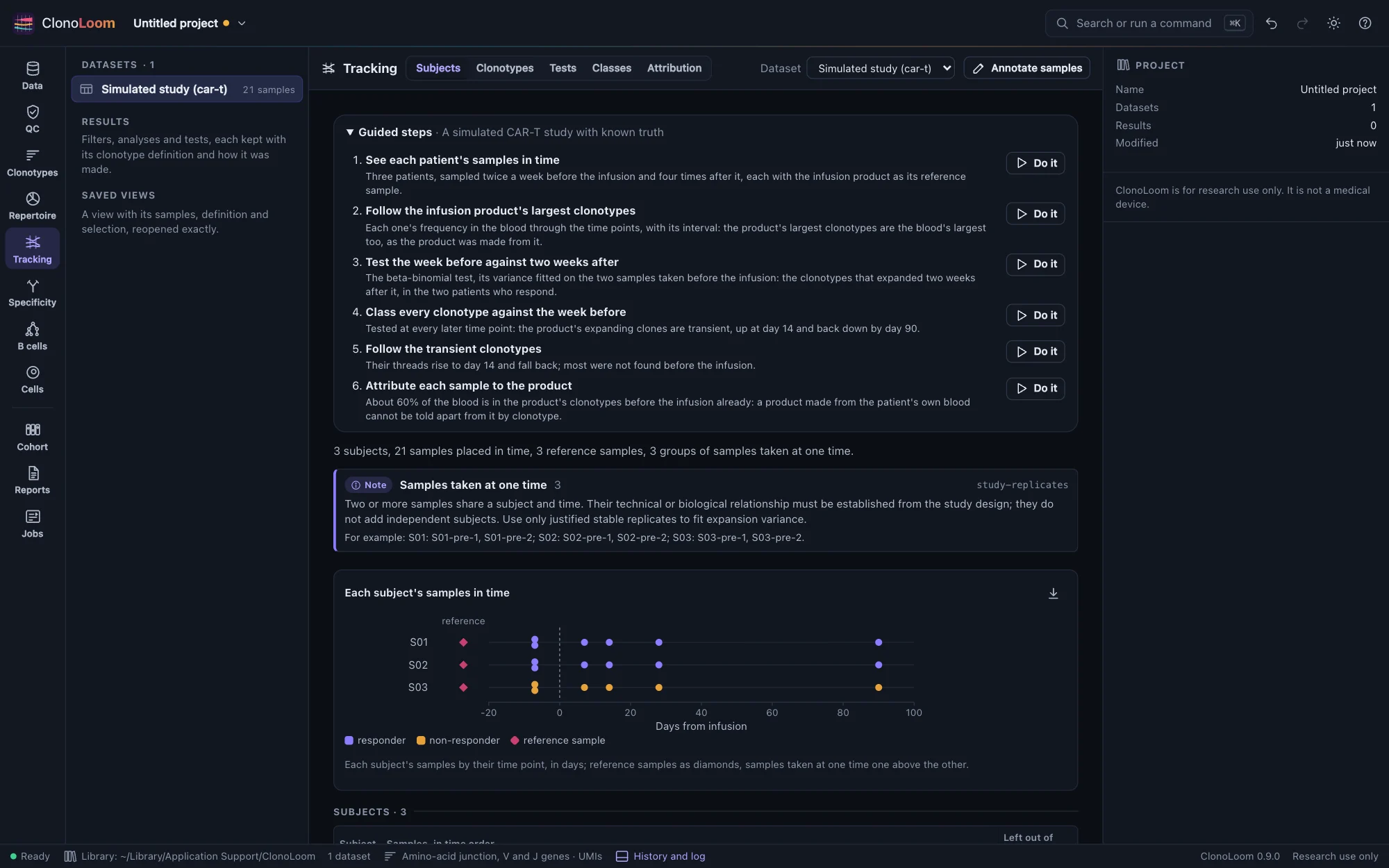
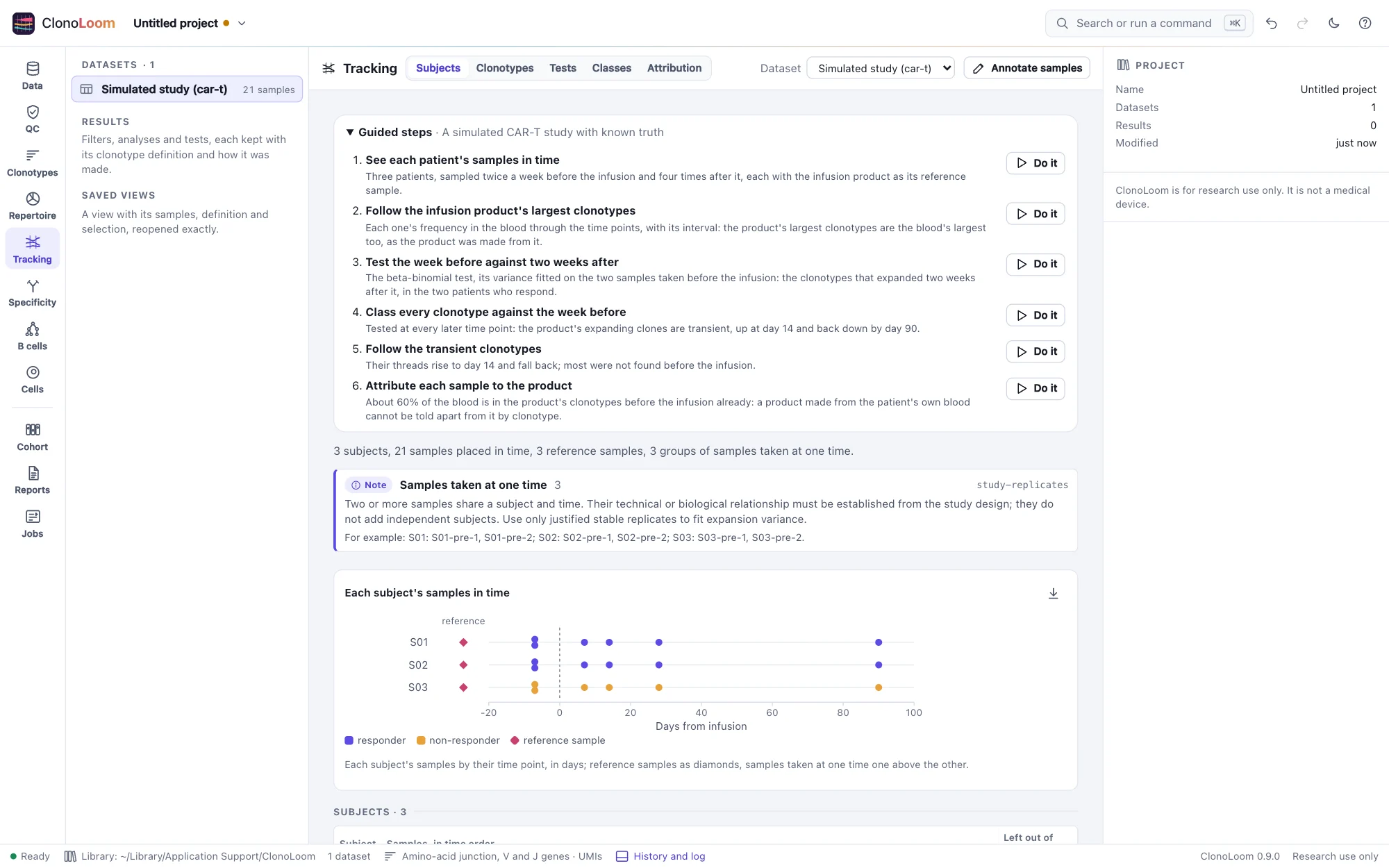
Tracking › Subjects shows what ClonoLoom made of the annotation:
- each subject's samples on one axis of days from its reference event, reference samples as diamonds, baseline samples in a column before the axis, replicates one above the other, and the subjects colored by condition; the plot saves as a figure;
- a table of each subject's samples in time order, with their time points, references and replicates, and the samples left out;
- the checks' findings, warnings first, each with its code.
What is checked
| Code | Severity | What it says |
|---|---|---|
study-no-subject | warning | Samples without a subject: left out. |
study-time-unread | warning | Time points not understood: left out, with the forms ClonoLoom reads. |
study-no-time | warning | Samples without a time point: left out (a reference sample needs none). |
study-bare-number | note | Numbers without a unit, read as days. |
study-replicates | note | Samples of one subject taken at one time. |
study-one-sample | note | Subjects with one time point: nothing to follow or test. |
study-no-reference | note | Subjects without a reference sample: nothing to attribute to. |
study-mixed-times | note | Days with visits, or "after" without a day: their order assumed. |
Scripts read the same with describe_subjects. Then follow the subjects' clonotypes through their samples (Following clonotypes). Testing them between two samples, and attributing a sample to its reference, come with the next parts of the Tracking view.